Nothing academic happened yesterday. The city had been getting more and more humid for several days until noon, when the sky opened up and rain drenched everything in sight. Molly and I had to spend the morning dealing with some unfinished business from Florida, and by the time we were ready to explore it was pretty much impossible to go outside. So instead we bunkered down, found some cheap liquid entertainment, and watched the Panama-Bolivia Copa America game with some very enthusiastic fans.
So instead of logging my observations on this post, I want to put down how I imagine this thesis materializing over the next few months.
I came up with the idea for this thesis while taking Professor David Garrison’s Geoperspectives class last spring. The class focused on the philosophical work of several Ghanaian intellectuals, among them Kwasi Wiredu, a brilliant mind in the field of linguistics and political rhetoric. Wiredu’s contribution to intellegensia was the concept of conceptual decolonization (CD). CD is a mental exercise that asks practicioners to analyze their thoughts using three crucial criteria:
- What is the belief that you hold?
- How is that belief constructed by the social, environmental, and linguistic factors in your life?
- Can your belief exist without those factors in place?
Wiredu was writing for a Ghanaian audience that was struggling with a common political challenge in post-colonial Africa: how can a country that organically speaks dozens of non-Western languages operate in a state that uses an imperial language? CD is a test for Ghanaians to discern what English (the former colonial power in Ghana) political theorems were meritious in their own right and should be preserved, which ideas were ineffective because of conceptual differences owing themselves to the vast dissimilarity between English and Akan (the native language used by Wiredu and 30% of modern Ghanaians) and which ideas, when examined using an Akan conceptual schema, were in place because of the old imperial order and don’t need to exist in a state consisting of non-imperial politics.
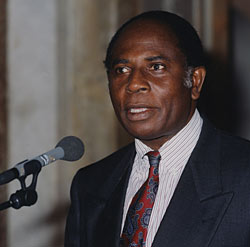
Looking at my political beliefs through the lens of CD very much challenged many previously-untouched maxims. The morality of globalized democracy is an excellent example of this. Growing up in a conservative household, I always believed that the rest of the world would be safer, richer, and happier under the auspices of democratic governance. Wiredu pretty much decimated that belief; I was unable to disassociate my democratic advocacy from my family, my culture, and my language (i.e. the way that the English language attaches pedagogically positive cues to words like “freedom,” “independence,” and “self-governance”). Most states are not contemporarily or historically democratic, and many existing democratic states are and have been very authoritarian.
CD applies to much more than politics, however, Wiredu wanted readers to critically look at their beliefs on femininity and masculinity, wealth and poverty, and strength and weakness. The text our class used in Professor Garrison’s Geoperspectives class, Cultural Universals and Particulars, devoted chapters to pulling apart these ideas. There really is no idea that is beyond the kind of analysis that Wiredu proposes, and as I found each one of my ideas growing less stable than they were before, I began to ask myself: what do we talk about when we talk about freedom?
Like, really, what is freedom? Is freedom the ability to go where you want, and do what you want to do when you get there? Is freedom the nature of humanity, and what does that entail? Do my rights as an American guarantee some sort of freedom, and if so, does their lack of universality (by nature of my status as an American citizen) deny such freedom a permanent quality? And if I consider myself “free,” how do I evaluate the lives of those with seemingly more freedom and, conversely, those who live in places with less?
These questions kept me awake for many nights. The only plausible solution, I figured, was to live out of a backpack in a few foreign countries and try to find some answers.
It’s time to go explore. On another rainy day, I’ll detail why we chose to come to Latin America, the process I’m using to answer some of these questions, and a few nascent theories that are running through my head.
 certification
Leave a comment