The heat has claimed it’s first victim. Molly’s computer overheated last night, meaning that we get to investigate a new facet of Panamanian life today: access to consumer electronic repair. Which may not sound like much, but the more Molly and I talk about it, the more significant this aspect of life becomes. Think about how much we depend on electronics in the United States. Cell phone permeation alone is massive, and I’ve yet to encounter a family that doesn’t have access to a computer. Businesses depend on computers in a way that would have been incomprehensible 30 years ago.
So what happens to a society that doesn’t have a functioning consumer electronics repair infrastructure in the 21st century? We’re set to find out today. PS- Apple, you should really consider setting up more stores in Latin America than the two you have in Mexico City and Rio de Janeiro.
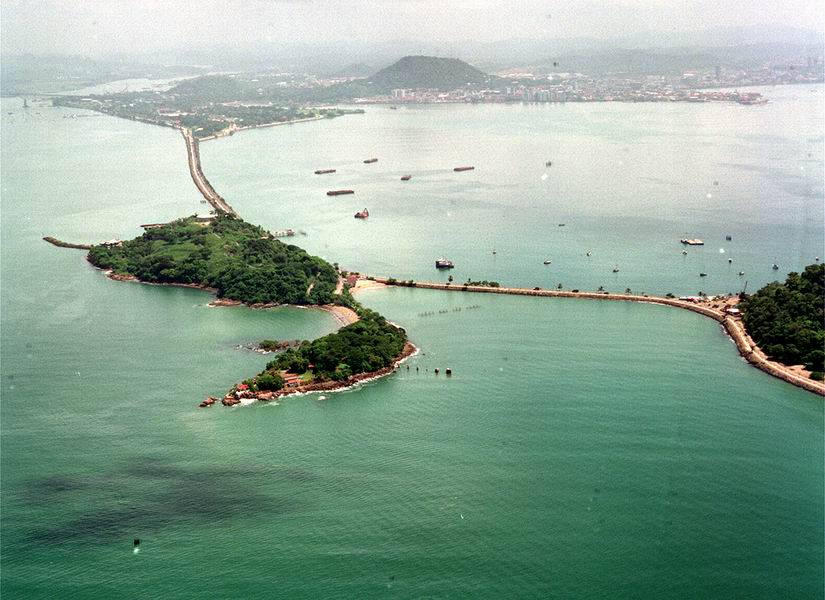
Anyways, the two of us had a wonderful Tuesday. We walked close to 10 miles, from our metro station to the island of Amador. Amador floats a mile off the coast of Panama City, connected by a causeway that seems to stretch on forever. Before getting to Amador, we really knew nothing else about the place. A lot of people retire there, and apparently Panama City is one of the top five places to retire in the world, so maybe there would be amenities closer to what one might expect in Miami than in a Central American republic.
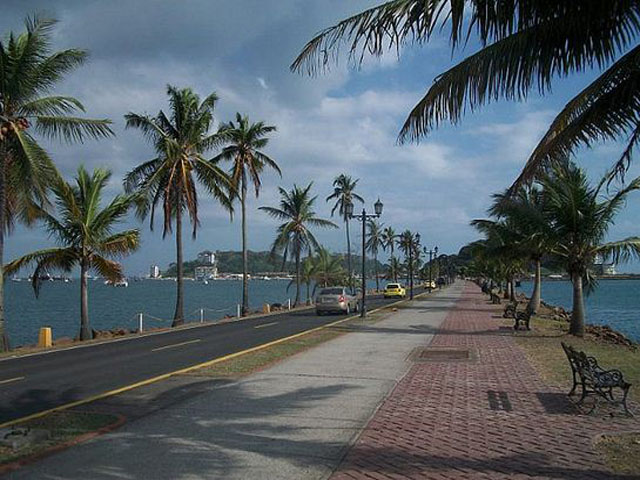
Except that our destination wasn’t a Miami look-alike or an island paradise. With the exception of a main road, Amador is completely privatized, warding stark white resort towers off into the upper limits of the island’s mountains with imposing gates and shotgun-armed security guard checkpoints.
We found a sunny open-air restaurant, El Bucanero, and enjoyed margaritas, paella, and ceviche. The waiter was remarkably pleasant and offered to take us to the roof of the establishment after we finished our meal. Molly and I were breathless with the view. For the first time since we arrived in Panama City, the entire modernistic skyline was before us. It stretched on for miles, with metallic twisting spines and gravity-defying backward bends seeming to dance in the cloudless sunlight.
Andres (now sharing one of our cigarettes – truly, a universal sign of appreciation), our waiter, remarked that all of the construction had been completed in the past 16 years. Molly couldn’t believe it. “None of this was here in 2000?” Andres shook his head. “Once the Americans left, we used the Canal to tax shipping. We paid for all of these buildings with trade income. Everything is cleaner, bigger, and safer. And everything is Panamanian.” He pointed at two squat, ugly towers away from the bulk of skyline. “Trump’s Towers.” “Trump es maldito,” I quipped. We all laughed.
We digested what he said before Andres turned around and pointed at what looked like cement ruins in the side of the hill, literally pressed against the back wall of El Bucanero. “When [the] Americans were here, Amador was a base. Panamanians were not allowed onto the island at all, not even to work.” We couldn’t believe it. Personally, I was surprised that my uncle, who was formerly stationed in Panama, had failed to mention that little detail, although to be fair I never pressed him. “Since the Americans have left, this island has become a tourist destination. But it is all privately owned, and Panamanians are still not allowed to live on the island. Even though it is our land, that we built with our hands.”
So many questions to answer. As we experience our last full day in the city, I’m sure we’ll find more questions than answers. For the time being, however, we get to find a licensed Apple repair mechanic in a city that struggles to have adequate lighting at night. If that’s not an adventure, I don’t know what is.
 certification
Leave a comment