Saturday 16.7.2016
Today is a special day. My brother, Zach, is turning 20. I’m not home to wish him well, but as one of the most fiercely independent people I know, I’m not worried about that bothering him. I wish instead that he was able to see this new place with me. Best of luck, Zach. 21 is better.
Molly and I are spending today on a bus from Lima to Cusco. We’ve been on a lot of busses now so the activity is becoming routine; however, long bus rides make for little interesting writing material, and I find myself grasping at the vast disparity present in the fact that I even have the ability to write at length, from my iPad, on an air-conditioned bus, touring a foreign place.
By disparity, I mean to say “disparity in the opportunity I have with the opportunity many Peruvians have.” And since our global capitalist system places a heavy tariff for opportunities on affordability, disparity in opportunity is al oust synonymous with disparity of income.
If you could see what I see from this bus seat, you would understand the affects of disparity of income. A few observations over these past hours:
– at 5 am, a line of women older than most professors, carrying their lives on their backs, was passed. We passed them on a desert road, sprinkled by marks of civilization such as burnt homes and the occasional rusted fence. We had not been in a town for an hour, and we would not see another town until noon. But there they were.
– entering that town, our bus was the only motorized vehicle in sight. Mothers sat with their children on the side of desert roads, displaying a mat of Chinese-made “local artesian products” (the twins of which we had seen on so many mats by this point). As the bus came closer, these women rushed the bus, begging the driver for the potential life-changing opportunity of selling wares to foreign tourists. The bus did not slow down.
– cleft palettes. There were so many children with jaws mangling teeth in directions seemingly inspired out the of demon-focused church portraits of Quito. I don’t know how people with teeth extruding from their nostrils eat, nor how children learn to smile as a result.
It is stunning to consider the gulf of opportunities between those children and myself. Many do not speak Spanish, instead being raised in a home which sparks only Quechua, the ancestral Incan creole language. The towns they inhabit are without windows or roads, let alone streetlights or basic services like medical care or police. Truly humanitarian teachers travel hours every day to teach basic arithmetic to highschool-aged children, risking potential kidnapping (a lucrative industry in southern Peru) for pennies.
What kind of charlatan is able to equate the opportunity I have with the opportunity of a young Peruvian?
It was not always this way. Ancient Peruvians lived in peace for thousands of years. Mann documents a civilization in 1491 which developed without agriculture (only growing cotton for tools and clothing) and relied on food from the sea. Based just south of Lima, those people existed without developing weapons – archaeologists have yet to find evidence of an unnatural killing, a mutilated corpse, or any artistic codex depicting warfare. They lived without starvation, and they lived without murder.
It is racist to posit that ancient Native Americans were simple, overtly peaceful, or too unorganized to follow the agriculture-and-warfare heavy lifestyle of the Europeans. But I understand the attraction of lamenting about the loss of those cultures like Christians lament about the loss of Eden. It is hard to see how the past several centuries have benefited Peru or Peruvians in any topographical way.
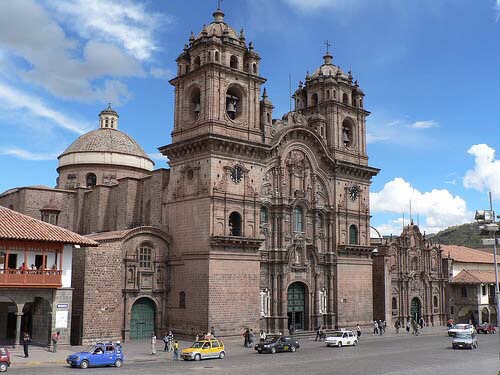
Update: we arrived in Cusco and had a hell of a time finding out AirBnB. The high altitude, combined with the 50-pound bags on our backs, made exploring the upper hillside barrio where our AirBnB was supposed to be very difficult. A local shopkeeper took pity on us and told us that the host had moved away a month ago. So we hiked to a relatively safer part of town and eventually found a hostel after very little luck. I have a feeling that the modern-day incantation of the Incan ancestral homeland will leave me with even more cynicism.
For now, I’m just glad that this city has real color.
 certification
Leave a comment