Picture this:
You’re groggy when you wake up. And damp. Your bedding was pulled off the line in a rush last night because of the freak storm that is still dripping in to your bedroom and your sheets were wet, so you strategically tucked the worse end in near your feet so that your face would feel just a little bit warmer in the morning. And it does, it really does! Your face feels nice. But everything else is damp, slightly sore. Your hair is in a knot and the indistinguishable smell of beans left in water too long wafts in from your outdoor kitchen, so even before you’ve gotten out of bed life feels and smells like England during the Black Plague.
Breakfast is the worst potatoes, the tiny ones with demonic little gashes in them that need to be cut around. Your pan, your last clean pan, tastes like the plantains and tomatoes you had for dinner last night and it takes an act of titanic creativity to pretend the rotting vegetable matter will help season the dish. You check the coffee bag, and you mix the remaining three spoons of “fresh” coffee in to the black sludge you’ve been reusing for the past week. There’s nothing quite like the black sludge of four-day coffee grounds at the bottom of a pan to start off the day.
Before leaving your house for the first time today, you take stock of your house. Laundry hangs on every edge and still hasn’t dried. Shoes are without companion in every corner. Tiny brown curds – chicken shit – sits in the most unlikely places, and even though you’re sure they’re inside the wonderful chicken house you made for them last night, that scratching noise you heard around 2 am is confirmed to be the professionally executed espionage of curious pet fowl hunting around your house for something to snack on. There’s cigarette butts on the table (broke that rule again, didn’t you) and the cushions from the back of the couch are stacked up on the arms so that you could recline on the sofa and watch Archer, and the computer screen is still open, and the tin you ashed your cigarettes in is still open too, and in a brief flash of inspiration you’re able to see yourself, eating plantains and tomatoes on the couch by candlelight, Archer making crude jokes on your computer, just like you were sitting there last night. You are ashamed and amused but primarily you are not quite awake enough yet to face the day.
But face the day you must, because you’re an idiot and didn’t save a cigarette for the morning. So now, you need to don some damp laundry and your comically small green plastic slippers and walk through cold mud to the closest shop, hoping that there’s one door open on a Saturday when the Good Lord said that shopkeepers are not allowed to sell cigarettes (look it up, it’s in the Bible). It’s always a treat, to go out in to the village for the first time on a day off. All of your students want to stare at your legs and need to come up and fist bump you first thing, but they need to be in front of you while you do it, so you’re conscious of exuding the Jesus-like affinity for children you’ve become known for while simultaneously trying to not trip over the little urchins and reinforce your competing image of a European conqueror out for blood. All of which is difficult to manage at 7 in the morning on a cold, muddy Saturday.
There is a sinning shopkeeper with his door open and he sells you three of the most vile, carcinogenic products ever to cross a counter, all for only 13 cents. That pre-drag excitement all smokers feel, of securing access to a cigarette, momentarily brightens your day. Until you step in a literal pile of human shit outside the shop door, left by one of those fist-bumping urchins, and the shit squeezes up the cracks of your Charity Crocs and defiles your toes. Your smile slips away. It starts to rain, and you’re able to clean most of the fecal matter off in a small puddle. You have adopted your third aesthetic: the worn out, defeated foreigner who can’t make the cut before 7 am.
Life feels small and tight in these moments. There are no houses beyond the main street, no lives twinkling with their individual dreams and aspirations, no magical hills pouring clouds forth like Roman cornucopia behind the cement facades of your street. The universe has compressed to the immediate, to the front doors held in place by string and flopping against their frames in the morning wind. When the street loses an inch of dust to the strong gale that precedes rain fall, that dust isn’t God breathing off the old from the attic of the world: it’s just dirt, slicing, flying dirt, and it gets in your ears and in your eyes and makes you wince from the cut. I’ve felt so many of these moments in the past year, and in my past lives, that I could start a whole blog just focusing on them. What a fun read, right?
And yet, for some inexplicable reason, the universe always seems to offer a way out of these tight moments, like a small stream letting innertubers float to safety before the rush of the real river. And in my current tight moment, a small girl runs up to me (starting from down the street, of course, her frayed dress prancing with none of the color but all of the energy with which it was designed to articulate) and hands me the tiniest, most fragile pink flower. And cupping the flower in one hand, she wraps her tiny fist around the pinky and ring finger of my other hand, leads me all the way to my door, and tells me to have a good day.
What I’ve just described is an example of Beauty. I’ve found that Beauty is always momentary, always immediately doomed to expire, and from this impregnated demise arises the force of Beauty; we appreciate it because it is always fleeting. Usually, when things are terrible – but fast terrible, living-in-a-blender moments – Beauty is immediately around us, caught in the same malevolent force that consumes us and pushes us along. We don’t have to look far for it in those moments. But when we struggle against something steadier, heavier, more daily and more persistent, Beauty can be harder to see. Our universe contorts to an impossibly small size and we forget to look beyond it, accepting the close walls of our perceptual confinement.
But Beauty is not subject to our self-possessed isolation, and it does not wait for us to feel good to show itself. It can come in the tiniest of forms, like a pink flower, or in the overwhelming vista of a view from the side of a moving bus, or in the sympathetic glance of a coworker. It can be in the dancing of yellow birds in the trees on your walk to work or in the comically exaggerated yelps of kids using their distinctive hill-calling as echolocation. It can be private, like when you overhear a rapid- fire conversation in Kinyarwanda clearly focusing on workplace gossip that is only met by different versions of “Mmmmmm” or “Mhmmm,” which always sounds hilarious. It can be public, like the enthusiastic game of pick-up football happening on the street outside school. But most importantly, Beauty cannot wait, because it lives so briefly. We have to look for it, to search for it earnestly, and when we see it, we can’t let go.
On bad days it’s even more important to open our eyes to these tiny little beautiful moments around us. They flutter in and out of our universe so innocently, so unaware of the impact they can have on a weary observer. But on the worst days, sometimes these moments are all we need.
***
Two important events on Monday, 26 November:
I read a good article. Elon Musk shared that there is a “70% chance” that he will be living on Mars by 2025. All of the technology needed to sustain life on Mars is currently available, and in a way, the total sum of Musks’ business ventures – vehicles powered by clean power, large-scale tunnel-boring transportation networks, and cheap solar panel technology – are all multiplied by his darling project, Space-X, which hopes to make space flight a regularity through intense private research and development. Despite his stock-shocking antics over the past year, he is continuing his partnership with NASA and filling up my list of Google’s recommended articles every time I check my phone.
I also attended a funeral.
The deceased was a student in Senior 6. I taught her this past year and wrote about her on the day that she had a bloody nose [May 2018 – Discipline]: she appeared faint in class and then started bleeding from her nose profusely. Soon after that, she was taken out of school, although she returned on several occasions and loudly lamented her family’s suffering during the genocide. Many people regarded her with sympathy, if they regarded her at all. The stigma of a young woman soon to graduate school was physical; if a boy her age, destined to leave the community and pursue a college education or business in the big cities, acted the same way, I am sure that the response would have been more interventionary. But anyways.
My student, “J,” left her house last Friday early morning and walked in the dark to a river, where she drowned herself. When I asked people why she died, they simply said “madness.”
Her family recovered her body, built a tiny coffin out of repurposed wood, mourned. The funeral was at one in the afternoon, in the small hamlet bordering the road I took days before to hike to Gitwe. The house was at a lower elevation than the road and about fifty people stood on the walls of the depression her family’s house sat on. The older brother draped a white sheet with a purple cross stitched on the front over the length of the coffin, and the younger brother, no older than six, held a palette-hacked cross so that the intersection hid his face so that only his terrified eyes could peek out at the stoic crowd. Motorcycles sped past during the sermon, prayers, and hymns, but one of the drivers stopped abruptly and solemnly walked to the body, removing a portrait of J from under his shirt – safe from the rain. A grandfather held up the portrait in front of his face, just like the grandson.
The mother was so overcome with grief that she began wailing, a sound I’d never heard before coming to Rwanda. She became limp and was taken in to the house, and her sobs became a soundtrack for the next hour. Undoubtedly a mother’s wail for her departed daughter is the most unholy sound I have heard in my life. As if targeted by an invisible assassin, J’s female friends would go limp and begin wailing as well, the closest people grabbing them by the armpit and dragging them to a wall where they could regain composure.
At the end of the speaking, the brothers picked up the tiny coffin, kicked away the three simple chairs used to support J’s weight, and carried her to the ten-foot hole next to the house, the ground fresh with ground dirt, banana trees buried up to their knees in dark soil. The coffin was lowered in to the hole and a dozen men shared the responsibility of filling the grave. The youngest boy, the one with the cross, planted it in to the soil once the hole was half-full and we all watched silently as the arms and finally head of the simple icon was buried with the coffin.
Now, imagine that during this entire procession of morbid events, that twenty old men were sitting in the shade of a house across the street, leaning against the cement, talking loudly and laughing at their own personal jokes. Imagine the wail of a mother at her daughter’s funeral interrupted by old men missing front teeth spitting phlegm through their gaps at some private carnival. What is the right way to feel in this scenario?
After the funeral, I went back to the village and talked to Albert, my buddy in the community. I asked him why the old men laughed, and why nobody said anything to them at any point during the funeral. Isn’t this a disrespect in a culture so aware of the morbidity of death? Every one of my neurons was firing off in anger at the transgression that I felt like an unmoving witness to.
Albert said simply that old men have seen so many funerals for children that they simply don’t take them seriously anymore.
Consider for a moment the world we live in, where Elon Musk can promise to sustain a mission to Mars on the same day that old men can dismiss the suicide of a young girl in Rwanda as frivolous.
***
Short wooden table. Eleven bottles: 4 Mutzig munini, 3 Skol Gatanu, 3 Bond 7, 1 repurposed jerry can full of urgwagwa. The straw has fallen in the bottle, will need to awkwardly circle finger around interior to fish it out. All consumed prior to our arrival, promise. Stale alcohol sticks to the wooden cabana we’re all under, a goat carcass still swinging from the last machete clef over tile blood drain. The sky is gray. Current guests include lazy-eyed village heavy lifter, two co-teachers (both women – unusual to see women at a bar), fellow volunteer, and now a tiny little
human, tattered skirt flapping at knees, pink cardigan rolled up for still-pudgy arms, head shaved, eyes wide, when I stand she steps on my shoes and can almost wrap her legs just below the knee. Two bright pink flowers, wet with dew, one clutched in each hand. She tells me to take them and I do. Waddles away.
***
Always start Thanksgiving-themed English lessons with a pinch.
“Do you feel that small flap of skin beneath the ribs? Above that the bones are difficult to cut through, but below that are the guts. We want to cut the skin open here *pinch*, at the sternum.”
“The stern-a?”
“Stern-um. You can feel it on your chest too. Right here. It’s a weak point.”
“Yes, sternum, I remember that from school.”
Cutting, slicing, the smell of an open cavity.
“I have never cleaned a rabbit before.” Jose stops shaving sweet potatoes and turns her head, surprised. They exchange a few hushed words in fast Kinyarwanda and share a laugh. Mateso is enjoying the first month of his new marriage.
“How do we cook this?”
The smoke from the charcoal stove is being sucked in to the small yard, bending through the parallelogram window and floating up like mist. Chickens are pecking between the legs of our chairs. Eric is dicing potatoes in to thick steak-fries. His ears visibly prick at the question. We’re all hungry.
“We’ll fry it in oil. The meat will turn white and juicy. Urusenda and tomato paste will glaze the skin. You’ll like it.” Everyone sighs.
We did.
Happy Thanksgiving, America!
***
Departure + 110 minutes
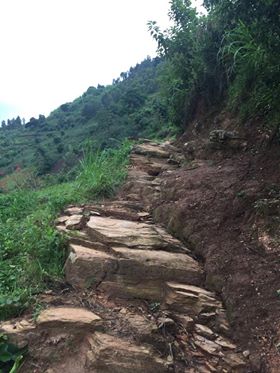
The t-shirt has since come off and, folded, is now at the bottom of the red backpack slapping my sweat-stained undershirt. Gitwe is behind the mountain in front of us. The trail materializes and disappears in the grassy hill dividing endless braids of family-owned farm plots woven through the valley, winding through this village and then the next village until it breaks upward in a cow-stamped incline and joins the wider dusty road bending around the rise of the mountain. At the top of the road, we’ll turn a bend and see the four-story hospital dormitories lining pavement in the distance at the end of a long procession of hamlets in an ascending order of development, pocked with spindly plants that aren’t actually aloe vera and leave unsightly blisters if foolishly exposed to the skin. At the bottom of the road, in our pre-incline braid-flanked village, the mountain is imposing and demands a rest.
“I wonder if we can get any sugarcane around here.” There are endless crowns of tall grass circled around hidden sweet stalks dotting the farmland around us. Rhetorical question?
We ask the nearest musaza. He beckons us with the flick of a machete behind his house, three other old men flawlessly balancing on the rain-soaked perch we strategically step down. Behind the house, 20 meters from the road, is a small jungle of sugar cane. The machete-wielding man inspects several crowns, pausing at each crop with paternal attention. For 20 cents, he hacks a 2-meter stalk at the root and passes me an edible bo staff. He uses the machete to break the stalk in to backpack-portable sections and keeps a chunk for the labor.
At the road, our entourage of school children – my school children, who must hike up and down the other mountain separating this valley from my valley and our school every day to study – laughs with the audacity of us strangers. We toss them a few sections – gusangira, “to share”
And for a half hour, everything is perfect. Sugarcane is split and shaved. We rip the tendons with our front teeth and push the sweet pulp to our molars. Some slivers get stuck but we don’t care, because each chew spills out fresh, cool glucose, and it drips on to our shirts and makes puddles in the dirt. The musaza joins his curious customers. We can hear cows groaning happily, the way cows do, and the kids take their eyes off us while the oldest girl parcels out portions to the crew and everyone chomps contently. Our eyes are on the braids, or the patches of a warm quilt (depending on perspective), or maybe like the boroughs of Istanbul seen from the eyes of a gull on a smog-less day, but the tension of our distinctions dissolves like the last of the rolling mist evaporating to the same roof held up by the mountains around us.
***
If two young men are determined enough – inebriated enough, set on not falling enough, intent enough on looking at the boldly distracting galaxies swirling in the cloudless skies only reliable in the East – they can hoist themselves on to the rim of a housing complex’s walls, listen to the wind peel and push corrugated tin rooves and frayed banana leaves with equal tenderness, and drink a pack of itabi until they drown in the conversation of Taurus’ horns broad across the black velvet periodically creased by sleepless shooting stars.
***
The shoulders of my brother’s jacket have started to fray. The dye was army green when I came to country, but slowly it’s slipped into a sweat-stained brown under the armpits and at the cuffs. There’s a permanent dark spot in the small of my back and two buttons – one on the wrist, another over the left breast – are sitting inside a pocket waiting to be reattached. Never learned how to sow, what was I thinking? My jeans are still “smart,” brought over by mom when she came in August. They’re long and I have to pull them up to my belly to make them sit right. But they sit right, that familiar but forgotten snug of well-fitting denim reminding me more of home than the plastic chairs and the smell of smoked meat floating out of the diner and on to the street that I’m standing on.
Tonight I would eat fried fillets of chicken and chips at a popular dining establishment located close to the Peace Corps office in Kigali. I’m in Kigali because I bit in to a rock last week while eating beans at school and my tooth really hurt. I was hoping – hell, I felt entitled – to get sent down to South Africa for dental surgery and two weeks of living on a stipend in Pretoria, a place that means nothing to me other than a destination away from Here.
The last weeks of the third term were rough. It was the end of my first full year of teaching in Rwanda, and there was cause for celebration. But my standards are always a little too high and I was disappointed that we hadn’t gotten more work done. Practically none of the 1400 students at school eat lunch and we’re trying to set up something sustainable where they can eat every day, but everything is moving slowly: the girl’s room we’re building is taking three times as long to finish, the teachers want me to spend money on a bulldozer to level a field to play football instead of saving that money for water tanks, we’re understaffed and the teachers we do have are facing an English exam next year which promises to put everyone out of work but somehow no one wants to start these English classes. My headmaster was busy organizing the exams for the end of the term and our committee wasn’t able to meet to talk about where we are on our laundry list of projects, not that there’s been any real progress since the girl’s room was started.
There is reason to be discouraged. My co-teachers feel more motivated to go to Gisenyi, a six-hour drive away, than to talk about some of the structural problems at our school, or what we can do to fix them. And I can see why. Gisenyi is a beautiful place and most of the teachers have never gone. The 10000 RWF cost per person of the trip is too expensive for half of the teachers to go, but the school still wants to pay for the trip. And I can appreciate the benefit that would come with building a comradery amongst the teachers, of spending a day away from Here and catching our breath. Between the local elections and a small famine resulting from a lack of rain during the rainy season – but no, climate change isn’t real – things have been stressful for everyone. We need the break.
But we also need to work. We need to organize teachers in to groups that can manage small businesses to raise revenues for the school. We need to start having English classes amongst the teachers because that government exam is looming over everyone like a sword hanging on a thread and the school would be shut down tomorrow if we had the exam today. We need to leverage all of our contacts and find people in Rwanda who are willing to sponsor projects – the football field, for one, but a bakery, and a charcoal repository, and a rabbit hutch, and more than one kitchen. We need to start having clubs again so that our students feel motivated to be at school, and so that our teachers can take more responsibility in the life of the school. For the last two weeks of classes, most of the teachers sat in the teacher’s room and played cards.
All of this is swimming around in my entitled skull while I’m appreciating the smog and horns of a proper city, the hug of clean denim against my legs, and the imminent deliciousness of fried chicken. And as I sit down at my table and dig in to the first meal I hadn’t had to cook in weeks, I was able to stop thinking about my problems for a minute and enjoy the smog and horns of my present position in life.
***
Positivity is an intentional skill. I used to want to punch people who were always happy, who seemed to smile at everything they came against, but that’s changed since coming to Rwanda. Positivity is in short supply where I live, and that’s not to say that people aren’t happy, but the skill of positivity – of remaining optimistic despite conditions – is not an easy one to maintain under duress. And everyone is under duress, all the time. There’s the duress of making sure your kids don’t throw rocks at other kids. The duress of knowing your tiny little kitchen garden is the only source of food for your family next month. The duress that comes from exhaustion, when you have to walk two hours to get to your family’s plot of land, and you have to start farming before sunrise – the duress of sleep deprivation. Everything anyone can drink in the village is basically poison, and most of the food people eat is nutritionless and light, so you can tack on the realization that your body is slowly withering away to the list.
It’s difficult to remain positive under such conditions. When I feel bad I’m able to look around me and point out dozens of examples of people who have it so much worse than me yet who are able to suffer with a smile on their face, but that observation doesn’t make me feel better – it only makes me feel guilty. But something keeps these people going, and whatever it is, it must be an intentional, deliberate attempt to foil the cruelty that the universe has dealt them.
See, in Rwanda, positivity is an act of survival. People need to stay positive to trust in their government when they toe the line between benevolent patrimony and authoritarian overreach. Farmers need to stay positive when their crops fail and the hunger of their family can’t be alleviated. Mothers need to stay positive when the health clinic is out of medicine for a daughter’s illness. Families need to stay positive during the lean years. And for Peace Corps volunteers, positivity is part of the job: we have to stay positive to serve as an example to our coworkers, to set the tone for events with children, and to sell our outlandish ideas to community stakeholders. We have to be positive because we’re alone in a strange place far from the comforts of home, and without positivity things would get bleak, fast.
So this month, I’m going to try and write about my own deliberate attempt at living positively. There’s several important elements to this, and I’ve organized them in my own head chronologically: finding positivity in the present moment, the mid-term goals, and the long-lasting visions we hold.
***
My spine is extended, toes barely touching the ground, arm outreached to something just beyond my grasp. There’s a roll of chart paper waiting to be pulled from a shelf, waiting to be filled with concepts that my students can use, and like everything else this month it’s just out of reach, it’s inherent static teasing the tips of my fingers.
Her voice fills the small shop, sharp against the traffic and motorcycle engines idling outside. Long black hair falls over shoulders, like a frozen river of onyx fresh from the source. Her lips are red, almost excited to spring forth the voice I hear. I can feel her eyes staring in to my back, in to the skin shyly peeking between the loops of my jeans and the brim of my jacket. For some reason that spot is warm.
I stop reaching and turn to face her. Rarely does life electrocute you through the iris, does it place something so good and real within your grasp. I don’t need to reach anymore. What I want is in front of me. The hair on my neck stands up in a salute.
My face is red. I return to my previous prize. This time, I’m able to let the roll of paper fall in to my hand, balancing against the force of the drop like a tail-spinning pilot, using every ounce of concentration in my body to not weaponize the chart paper and destroy the precariously stacked packs of pens and computer equipment. I succeed. I’m able to pass the flush in my face off as arrogance for this tiny victory. My friend stands in the doorway watching everything that just happened, quiet, smiling, seeing everything. Does he know what he just saw?
I shake her hand and the warmth of her palm ripples through my body in waves. Something has happened, a clear marker separating everything Before and everything To Come. When you feel that, and the subject of your revelation feels it too, you hold on to that moment and never let go.
***
I’ve seen jackfruit in the expensive produce isles at our supermarket back home but I’ve never held it in my hands before. It’s heavy and feels waterlogged like a melon but has a tough, organic shell-like coral – the bad kind of coral that no one wants to step on. A single jackfruit is larger than my head.
Bosco opens the fruit with a machete, the same forceful cut he swings as he shaves limbs off of the goat hanging at the bar. The outer shell is thick and solid, but after a few whacks, it cleaves in two. A pungent, sour smell fills the air.
I’ve never seen anything like this before. The inside of the fruit looks like a cell from my high school science textbook; there’s tendons of brownish flesh and puply sacs holding seeds and a thick cluster where the tendons converge like a brain, except each strip of fruit is light gold and the smell is decidedly Starbursts.
Eating a jackfruit is a visceral experience. Only the flesh around the seeds, the pulpy sacs, is supposed to be eaten. To get to those sacs, I have to dig my finger in to the taught tendons connecting the brain with the outer shell and dig out the seeds, which plop out of their sacs with a wet thunk that makes me flinch. I try to hold the fruit with one hand and dig for the sacs with the other, but they’re in there too deep and I end up having to use both hands to locate, twist, and rip the edible part of the fruit from its enclosure.
The entire experience is weird. Jackfruit has a tart, truly Starburst taste to it, and the flesh is chewy but goes down easy. But I’ve never eaten something that required so much interaction. Before I’m done picking each seed sac from the fruit, my hands are face are covered in a glue-like sheen and the hairs of my mustache are stuck together. When I go to the rain catching tank at the bar to rinse off, that sheen coagulates in thin strips of plaster on my forearms and solidifies in my hair. I’m still trying to get it all out.
***
I’ve spent the past month away from my computer (and my phone). Sorry for the delay. Hope everyone had a good Thanksgiving and Christmas back home! The December post will come out when it’s ready.
 certification
Leave a comment