Friday 26 July: Day 15
Today we had the best cup of coffee of our lives. It was a short cup, the size of a shot glass, made with Iranian dark chocolate, cinnamon and mint, served scalding.
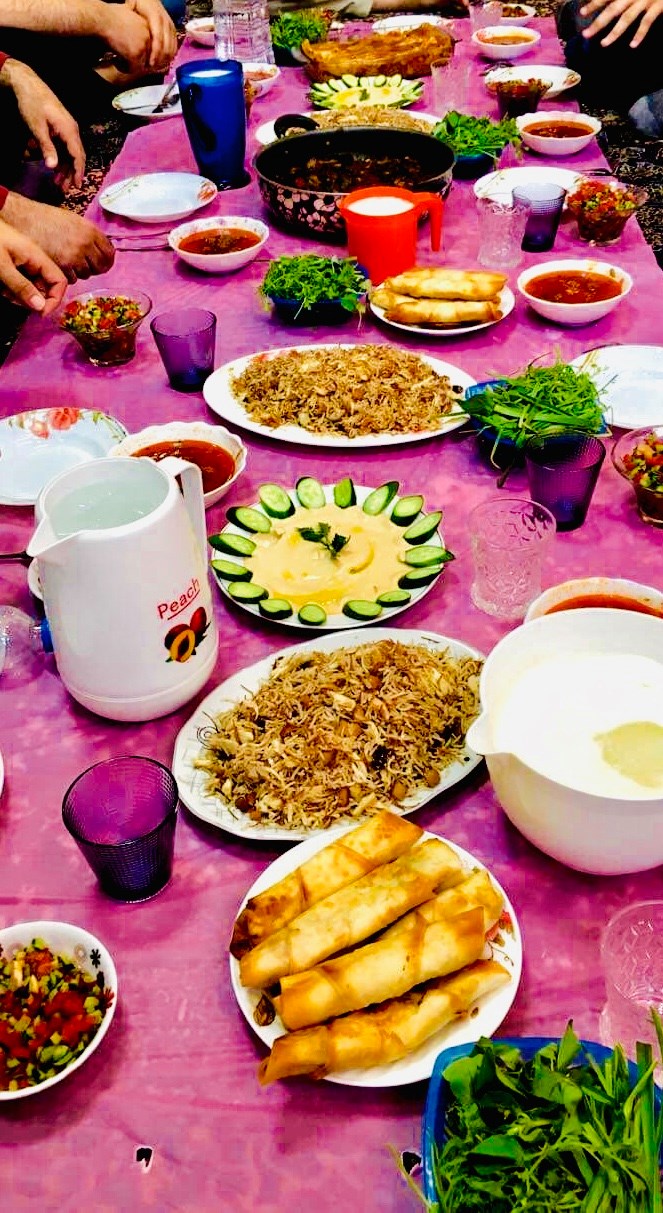
We had this drink at the home of one of our students. Her father invited us over for lunch and all of the teachers came with us. We were treated like royalty. The house was a custom design and we sat in the largest room, flush with stained wood and thick Persian carpets, the cool breeze a blessing on this hot day. The meal was at least two dozen dishes: eggplant roasted with tomatoes and garlic, lasagna stuffed with lemon chicken, wraps of lamb and jasmine, sweet milk, salads of cucumber and garden-picked herbs, beef on rice, all eaten on the surface of a finely woven rug surrounded by every member of the family.
Afterwards – over coffee sent from heaven – we sat in the parlor and talked. Men and women sat next to each other and spoke with the same frequency and volume. You could have heard English, French, Farsi, Arabic, and several dialects of Kurdish. Kurds don’t really have time for small talk; every person present is expected to only speak well-argued points and irrationality or insults are dismissed at the wave of a hand by the oldest man in the room, which abruptly stops the conversation and redirects it to something productive. We discussed the origin of the word “Iraq” (colonial), the history of the Medes (ancient Kurds feared by Alexander the Great), the American escalation with Iran (pitifully political), and the encroachment of capitalism in Kurdistan as it threatens the worship of family and community with the worship of money. We sat there until the sun came down and it was cool enough to walk outside without sweating, as Kurds have done since before pasta passed from China to Rome.
There are so many people whom I wish could be here right now. If only they could see the strength, history and respect that was afforded to us, spread out like a succulent meal at a wedding banquet. How differently would they see the world? How differently would they see themselves?
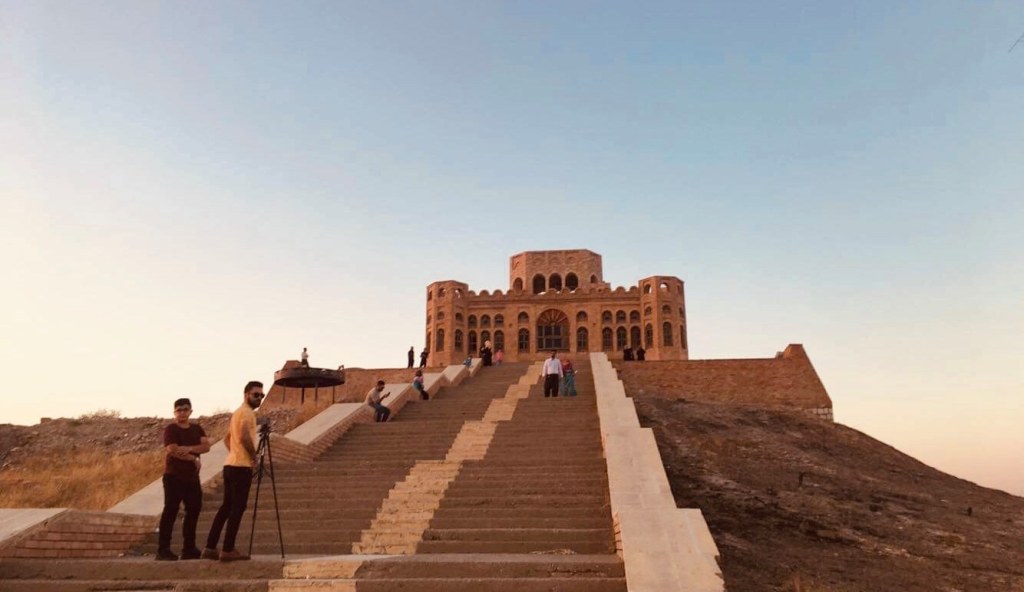
[We visited kalar’s Sherwana Castle after dinner, to see the sunset – standing since the 12th century, survivor of multiple wars and conflicts. This is where we live!]
“Chwita shari kweran dast ba chawtawa bgra” – if you go to the city of the blind, cover your eyes
Saturday 27 July: Day 16
I lost my tempter today.
Mitsu and I arrived at the school around 2 in the afternoon to meet up with the other teachers. We had planned to finish grading, work on the blog, go shopping, keep working on the apartment – in hindsight, my goals were unrealistic. There was so much to talk about, from exam preparation to classroom management and lesson planning, and I should’ve known that it was going to take the rest of the day. Around 9 pm I rudely interrupted Akam and the meeting was abruptly ended.
This was wrong in a lot of ways, and I apologized the next morning. Akam is a good man and took it easy on me. But the experience, like so many experiences, brought me back to Rwanda.
Mucubira’s lack of development meant that things moved at a very slow pace. Finding out costs for a new football pitch took all of three months, with constant revisions and numerous leaders being consulted. The deprivation of resources and outside attention meant that things “happened when they needed to happen,” not when some plucky volunteer wanted them to.
In Kalar, development has never meant a lack of resources (international trade, oil, fertile soil for crops) or a lack of attention (Saddam, genocide, ISIS); rather, the absence of stability defines life in Iraq. There’s certainly a slow moving wisdom permeating this place, but in daily life it seems that people must take what they can if they are to get ahead. Executing a plan requires the resources of course, but more importantly a seamless coordination between all parties and a flexibility more similar to a ship’s crew in a storm than the improvisation that arises from the lack of resources or buy-in, as in Mucubira’s situation.
Stability seems to be the most valuable capital here, which may be why Kalar still feels like a developing environment – despite the European clothing shops, sports cars and oil refineries, “frantic” is the strongest adjective I can use to describe street scenes happening every moment. This may also be why making time to write in this journal feels so special.
I’m sorry, Akam.
“tedaga” – he understands
Sunday 28 July: Day 17
Back at school today. Somehow the weekend was not restful and we’re exhausted – slipping off between classes, sleeping in our free periods. I startle awake and see Akam’s daughter hiding under the desk, staring at me with her big dark eyes giggling at my drool. Sleep comes back. Later, I wake up and the lobby is empty, the power is dead, light the color of golden rust is hitting dust through the doorway, the security monitor is black, my back is sticky with sweat from no AC. I don’t like this dream as much and go back to standing under banana leaves in the pouring rain.
“eau” – water
Monday 29 July: Day 18
The Peace Corps taught us that understanding and respecting culture is the starting point for any meaningful change in a community.
This morning I tried to integrate the boys and girls of my youngest class. Not intentionally – I just wanted random groups so that students would focus on their work instead of talking to their friends. The result was catastrophic. Several parents signed their children up for our school with the explicit precondition that the children wouldn’t be forced to work with members of the opposite sex. Most of the students didn’t have a problem with the new group arrangement, but one of the boys adamantly refused and called his female partner a “ghost,” which is bad. Very bad. Akam had to spend 10 minutes calming down the students so that their parents wouldn’t pull them out of class, so that the school wouldn’t gain the reputation of a godless, dishonorable cesspool, so that an unstable parent wouldn’t enter the fevered night terror of honor killings. All of this before noon.
Later, one of my students asked me what “cupping” meant. At first I blushed – how to explain this to a mature young woman in light of this morning’s debacle – but she was referring to a traditional medicinal practice, by which a needle breaks the skin and a heated cup placed over the wound creates a suction, pulling blood out of the affected area. Bloodletting. The woman wants to be a doctor, she shared with me, before pulling back her hijab and proudly showing me the instantly recognizable marks of this practice on both temples. What am I supposed to say to that?
Finally, one of my evening students – an aspiring politician – shared that he wanted to visit Germany, “to see the home of Adolph Hitler.” During the break he elaborated, that Hitler’s goals were noble and his aggression admirable. The student was deaf to my comparison with Saddam Hussein, to a story about mutilated twins, to an elderly peer’s disappointment in him. He’s an otherwise decent student with great spoken English but doesn’t see why liking Hitler would be a problem.
Where do we draw the line? What is universally abhorrent? What is deferred to local custom? How do we learn to respect?
“min letetutiangm” – I do not understand.
Tuesday 30 July: Day 19
Ten minutes before the end of my second class, one of my students – whom I assumed to be absent today – knocked on our door and asked if she and her sisters could decorate the classroom. She wanted us to finish the class (her class) early to throw a party for Hama, another one of our teachers.
Hama is a 22 year old college student who lives in Kalar every summer to work in the English Access Institute. He’s a mountain of a man, standing just taller than me and taller than any other Kurd I’ve met so far. When he laughs, the windows shake. He’s brilliant, moving from a conservative, respected background of conservative mullahs to pursue a liberal arts education, studying English and Political Science in Sulymania, where his eyes opened to the outside world for the first time. His English is nearly flawless and you can tell that he’s spent thousands of hours perfecting his pronunciation, practicing his inflection, and expanding his vocabulary. To Mitsu and I he speaks slowly and with a booming voice that commands respect from everyone listening, but when he switches to Kurdish, his voice raises and octave and his language takes on the sing-song quality of a professional solo singer in a packed church service.
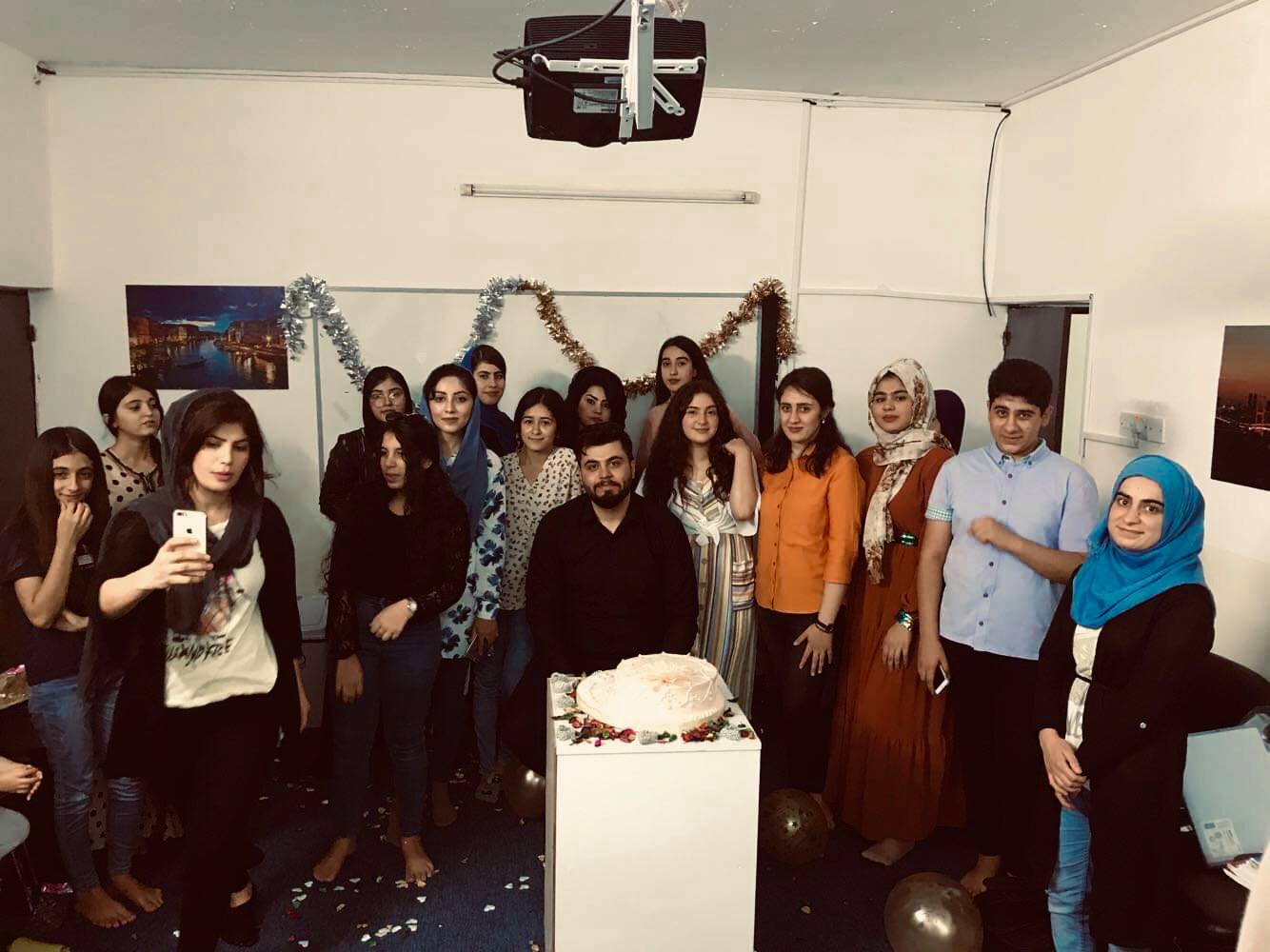
And today was his birthday, so of course I said yes to my truant student’s request, but we agreed on a different course of action. I took Hama over to the neighboring coffee shop where his cousin and two other strangers were assigned to distract him. We held him there for fifteen minutes, and then when we showed up to class, three or four dozen students surprised him with a cake, flowers, burning incense and balloons. Hama was over the moon – one of his students took a selfie with him, and then every single student in the class started taking selfies with him and with each other (Snapchat filters turned on, of course) and before long Hama was simply sitting like a king as all of those in attendance took turns getting their pictures with the man of honor. Gifts were bestowed, songs were sung – and the cake was really, really good.
Happy birthday, kaka.
“kaka” – term of respect for men
Wednesday 31 July: Day 20
A friend is visiting us tomorrow night so after 12 hours of work and Kurdish lessons and dehydration and frantically addressed business items and running home during break to plaster scars on our wall and having to order coffee on the steps of the shop because women can’t go inside we thought we could sweep and mop and dust and paint and fold laundry and bleach the ants we just found and reward ourselves with a nice four hour nap before we do it all over again tomorrow without having a meltdown and unfortunately, we were wrong.
Tomorrow’s another day.
“shuti” – melon; “inshuti” – friend [Kinyarwanda]
Thursday 1 August: Day 21
We made it to August.
The students in my last class told me to wait in the lobby for the first half hour of our lesson. We were confused and excited – I had heard rumors of a surprise since Hama’s birthday party and the extended preparation was killing us. Akam led us from the staff room to the classroom and before us was a beautiful scene: 60 students in desks and on the floor sitting around a massive blanket spread in the middle of the class, with darkened lights and rich chocolate being passed around by a young girl.
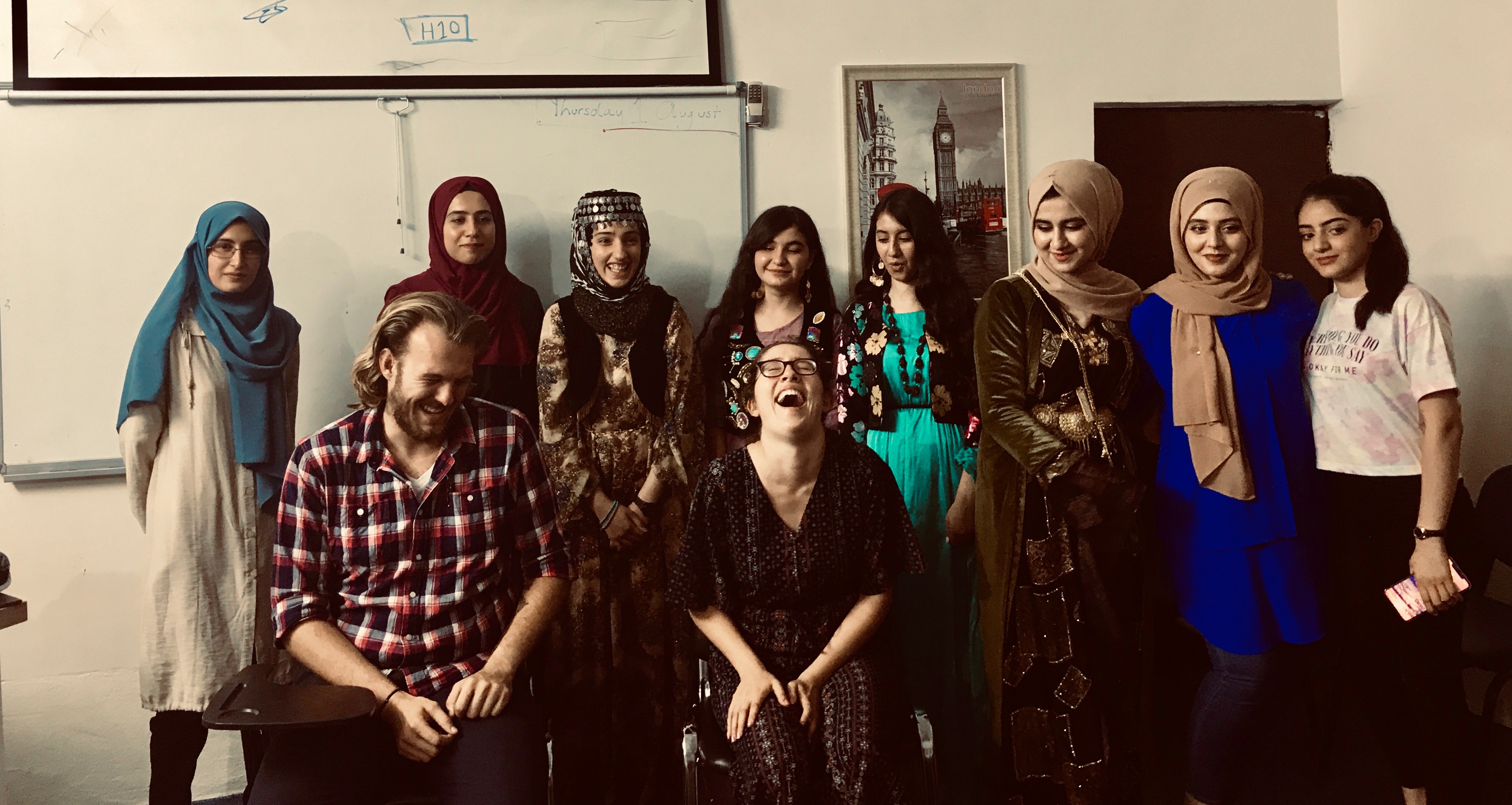
The door opened and seven students walked in, single file: all female, all wearing elaborate, ornate traditional Kurdish garb. One student wore a long gown with trails from the wrist wistfully following behind her; another student wore a tight head scarf around a crown with dozens of silver coins, which jangled lightly as she turned her head; all of them wearing heavy, perfectly applied make up and smiling soft smiles, slightly bowing.
One student recited in perfect English what we were about to see: a performance explaining different aspects of Kurdish culture for Mitsu and I’s education. They played a video that took the audience through every corner of the country and explained each location with strong adjectives and inflection in their voice, just like we had been practicing all week. Four students then acted out a “traditional Kurdish scene” where two students pretended to be hosting two other visitors. The guests gave the visitors their jewelry, clothes and anything they could eat or drink in the house, demanding on their honor and their family’s honor to accept every gift offered. Everyone was laughing when one of the students asked to go home and the hosts forced them to take a customary vest reserved for women in spring time with her.
Two of the men in my class also wore the loose-fitting full body tunic that we’ve seen almost every other man wearing in Kalar, and they both went in to detail about how these outfits were worn by people as long ago as the ancient Medes, whom philosophers like Socrates and Xeno looked to for guidance in the natural sciences. They demonstrated how to wrap and unwrap a piece of headgear that was a little too snug on me when they goaded me in to trying it on.
Later, two students led a tongue-twister activity and made every person in the room pronounce silly sentences. Mitsu and I had to try some Kurdish ones too, which didn’t work out too well. Being a teacher means embarrassing yourself every day, though, so we took it in stride.
I’m still a little overwhelmed from the demonstration. We’ve only been here three weeks and it feels like the students are responding positively, but Akam says that they’ve never been like this before. None of the foreign native English speaking-teachers had this much of a warm welcome (or this many invitations to visit students and their families at home). Our enrollment is over three times higher than it was this time last year and the train keeps steaming ahead in the right direction.
“abba” – a type of full-body cloak that Kurdish women wear; very comfortable in the summer heat
 certification
Leave a comment