
Friday 9 August: Day 29
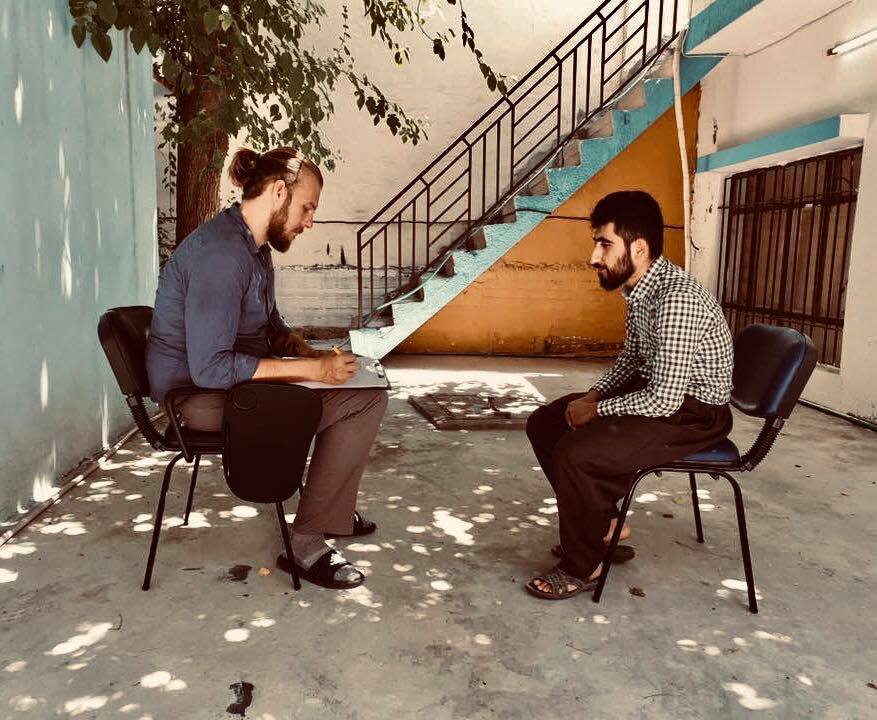
Taro left for Kifri today. Kifri is an Arab-majority town on the border of Iraqi Kurdistan and Arab Iraq, lying within the ominously-named “disputed areas.” He wants to meet members of the Turkmen ethnic group, who have lived throughout Central Asia for, well, forever. He also wants to meet members of the Hashibi, a Shia-believing, Iranian-backed militia group listed by the Department of State as a terrorist organization. The Hashibi have never committed an act of terrorism – no assassinations, no suicide bombings, no poorly-filmed beheadings – and since he’s Japanese and has already traveled to Iran, he thinks he’ll be OK.
The problem with the “terrorist” label is that it means nothing – no denotation to speak of. If a “terrorist” is someone who incites or commits “terror,” then Wayne LaPierre, Bernie Sanders and Gritty, the Philadelphia Flyer’s mascot, could all justifiably be labeled terrorists because they make someone afraid. Clearly a terrorist isn’t just anyone who makes certain people feel afraid.
If we use a more practical definition and define a terrorist as some sort of card-carrying member of a violent organization, the label still doesn’t make much sense. What about the SWAT units of American police forces, or ICE raiders? The type of violence is important – it has to be “political,” whatever that means, and it has to be against an adversary that threatens some sort of security that we, the terrorized, feel is important to our way of life.
The Houthi “rebels” in Yemen – camel-riding goat herders receiving food aid from the United Nations, are terrorists, according to the US government. Whatever threat they posed to the US-backed coalition of Saudi and UAE forces has long since been scattered to ash, like their schools and hospitals under the torrent of a relentless air campaign. Paul Kagame’s RPF, stationed in Uganda while waging guerrilla warfare against the genocidal Habyarimana government for the first half of the 1990’s, were labeled “terrorists” by the USG up until Kagame’s forces stopped the wholesale slaughter of innocents in 1994. Now they control the Rwandan government, which receives foreign aid from many Western countries (including the US) equivalent to half of the country’s GDP. So clearly, there’s some flexibility with the term, since terrorist organizations can exist with defined or undefined goals, capabilities, ideologies or territory.
None of this is new commentary for Americans, and the “terrorist” label has long lost any real meaning for Kurds and Iraqis. However scary the word is today, it didn’t stop Taro from travelling to their community and drinking some tea.
“Ser ‘chao’” – upon my eyes, an expression used to say hello, goodbye, thank you, you’re welcome… it’s used a lot.
Saturday 10 August: Day 30
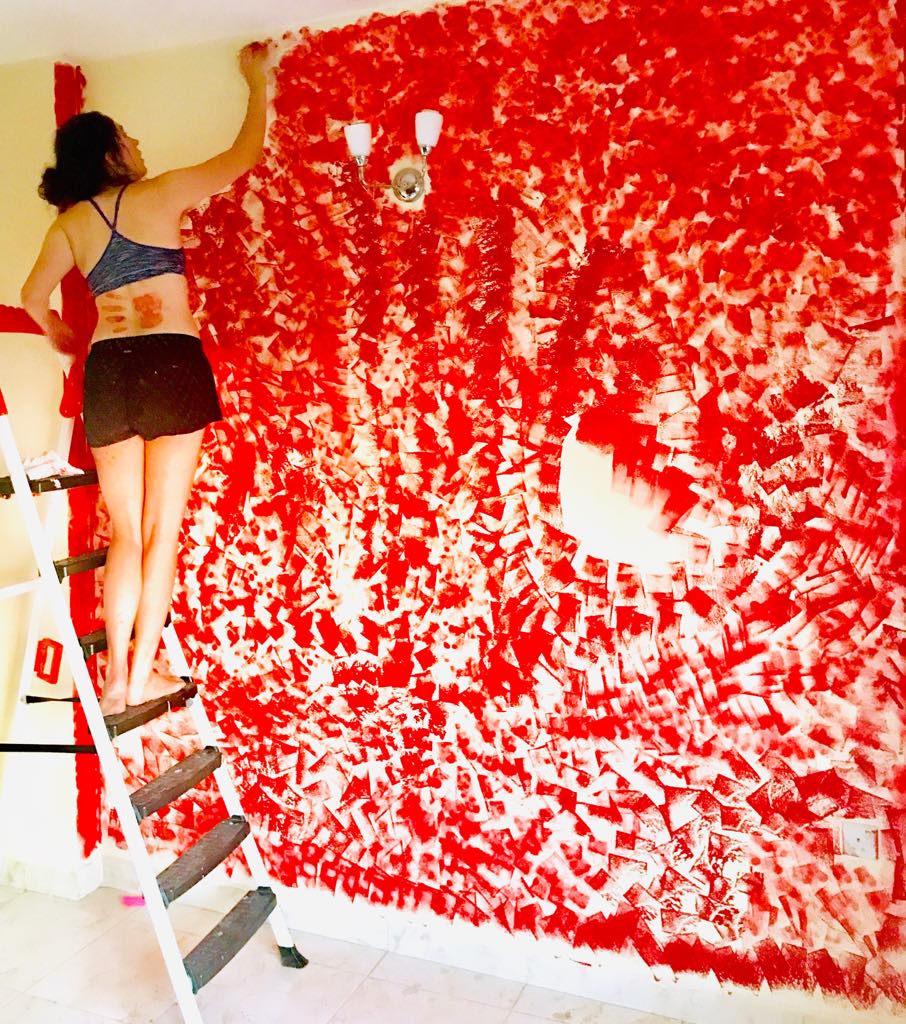
Our walls have gone from a patchy, flaky yellow closer to the color of vomit than sunflower petals to a nice, almost suburban coat of beige. We found sponges and dabbed red accent walls in our rooms, tracking paint drops on our toes and defuming the apartment with open windows and roaring ceiling fans. Our breaks were trips to the supermarket for artisnal fizzy drinks, knuckles still red, and sweaty pauses on sofas that make a wet noise when we get up to work again.
The result of our hard work: a new home.
Thank you, Mitsu, for sticking with me through this smelly, drawn-out, potentially toxic activity. We’ve moved in to a couple of homes together now and I doubt that this will be our last.
“has” – to love
Sunday 11 August: Day 31
Today is Eid. Chaman, a bright student from my latest evening class and the newest addition to our teaching staff, invited us over for the meal- because of course, there is a meal. Unlike other meals with Kurdish families, this one was simple: Iranian meat stew over jasmine rice, with tea and baklava for good measure. The real joy was sitting on a rose carpet passed down through generations talking about video games and high skill visas and ideological purity and US foreign policy. We talked for five hours. And then, exhausted from the heat, we slept.
Not everyday is an adventure.
“jejin piroz” – happy feast
Monday 12 August: Day 32
We live in Iraq, a country stereotyped as an endless, scorching desert. Our province is called “Girmayn,” which literally means “the hot place.” And today, the Kurdish Regional Government issued a warning that the following days would be exceptionally hot. At 2:00 pm, when I walked to the tea shop to write for the day, my phone’s thermometer was 139 degrees outside.
At what temperature does ink spill off the page?
“des horsch” – you have gifted hands, said to servers at tea shops and restauraunts.
Tuesday 13 August: Day 33
Another meal with the family of a student. The power is dead for most of the dinner but that doesn’t stop the youngest son from bringing his $350 PS4, disconnected, in to the room, just to show off to us in the dark.
After demonstrating the actuality of his video game console, the young boy returned to playing games on his cell phone, along with his two older brothers. Combined with their portly mother and father, this small family of 5 represents the “normal” family in Kalar – in a reasonably sized house, with a car parked outside, with a beautifully decorated and painstakingly maintained home still subject to the injustice of power centralized in the Arab-dominated southern two-thirds of Iraq.
A different student in my afternoon class lives alone with his mother, no siblings or father – all causalities of conflicts in the past three decades. He helps his mother with the “women’s work” of sweeping, mopping, doing the dishes, cleaning laundry, cooking, every single action that must be performed to maintain a household – and as a result, this other student gets made fun of. The afternoon student gets in fights constantly because someone will mock him for doing chores, insulting the young man’s family in the process, and my student proceeds to kick the asses of whoever feels justified in their criticism. He’s actually come to class bruised and cut from these fights, and one day even explained that he was arrested for the fight but was allowed to come to class because the police officers knew his personal situation.
I expected our hosts to behave similarly tonight. Instead, the mother spent an hour and a half preparing chicken soup, rice and bread for 7 people on the floor of her kitchen, in the dark. When the power cut off the air conditioning died too, but the husband rolled a massive cooler in to the eating room where Mitsu, the boys and I sat, ran a cable from the cooler to the car, and ensured that the six of us would be able to sit in less-sweaty silence while the sole woman finished up her duty. In the darkness, we couldn’t see the sons staring at us but we could see the whites of their eyes as they stood up to answer their mother’s calls for help or, annoyed, told one of their other brothers to do it. I’m glad that the contours of our own faces were not well illuminated that evening.
“troi” – by the grace of God
Wednesday 14 August: Day 34
Mitsu was at home grading essays all day but I had made plans with a student of mine to meet up and discuss a book that I was borrowing from him – David McDowall’s A Modern History of the Kurds. We agreed to meet up at the Millet Café and trecked through the scorching late-morning sun towards our indoor, shaded rendezvous with excitement.
Rzgr is one of my best students: 50ish, shy in speech, exceptionally well-read and gifted with an expansive knowledge of Kurdish history and politics. We sat in the smoky den, walls lined with rugs from hundreds of caravaned journeys, and discussed the taboo topics of our setting: the cycle of tyranny and anarchy that characterizes political culture in thew region, the main parties and their cynical support of tribal sectarianism, the history of the PKK and the complex relationship between Kurdistan and Iran. We eventually broached the subject of religion and discussed the intricacies of Shi’a theology for another hour after all this.
We talked about too much to put down here, and most of it probably shouldn’t be published in a public forum like this anyways. The bulk of our conversation was relentlessly paced and abstract. The best part was that this man was my student, and to be able to speak on all of these subjects in English – teasing out difficult words, circumnavigating concepts that were difficult to translate, working together to get through a conversation for the purpose of improving our mutual understandings of the world – well, I felt pretty good. Then again, maybe a dozen shots of tea will do that.
Shi’a – to support
Thursday 15 August: Day 35
Tonight, we want to buy furniture. It doesn’t need to be fancy or fresh – just stable and a set price. We want to see that perfect dining room table, have a short but heated price negotiation, and throw it in the back of our truck, victorious.
There’s a place for this kind of trade – the mazaard. Unlike the structured hallways of the bazaar, centralized in the busiest intersection in town, the mazaard is a spontaneous auction in the biggest field in town. And it’s only online at night.
Picture this: we’re driving along a highway away from the lights of the city and see a dozen or so floodlights scattered over an uninhabited expanse to our right. The truck takes a right turn and we’re on uneven packed dirt, and hundreds of cars just kind of materialize in to existence hidden previously by the streetlights. They form a wall around a busy area of carts, but as we exit the “parking lot” and make our way in to the crowd, the bulk of trade is done on the tops of tarps and mats which form impromptu aisles in the dark. Here, there’s a tarp covered in repossessed bathroom sinks, dusty piping and plastic fixtures; here, another tarp, this time making a small hill of shoes, thrown haphazardly on one another like a fascist book burning. There, a “stall” – metal work tables, stool, house-sized plastic sheeting – selling hairbrushes, hair gel and blow dryers, but as we turn an imaginarily constructed corner an intricate rug is being stamped in to the dirt by two dozen men all sipping tea on squat chairs, their collective cigarette smoke less like idling cars in traffic and more like a factory smokestack. We see a seller of potted house plants, a blanket covered in kitchen knives, a truck bed overflowing with potatoes and onions, and not a single uniformed police officer or even a docent to offer the air of legality or structure of any kind. The noise is coming from everywhere and nowhere, tinny stereos and alarmed mullahs overlayed by the raised voices of bargaining in a foreign tongue, all as decentralized and chaotic as the scantily-lit shopping spaces whose silhouettes pop in and out of existence with the flashlights of smartphones or the abrupt failure of a gasoline-powered excavation light.
We don’t find our table, but we do find the washers we need for a home improvement project. The seller is an old man whose job has been the provision of hardware for almost 37 years, all spent in this exact same spot. He tells us that 16 years ago, a group of American soldiers in need of parts bought everything he sold in one night, and that he could send his girls to school as a result.
It was in a place like this where trade was born: strangers meeting in a neutral space cool in the moonlight after a day of travelling across deserts, their herds and mounts forming a perimeter. Nothing here is private – think freshman year Intro to Econ lectures describing unrealistic conditions for a “perfect” free market economy. Over the millennia everything has been bought or sold here. We’re told that before blow dryers and flip flops, mazaards had guns and bomb parts for sale, and long before that, slaves.
Tonight there’s mothers telling their children to behave and little girls chasing cats, as ambient as the still-heavy heat. We left it all behind and bounced back to the highway as the exchange popped back out of existence, just like everything else – slowly, and then all at once.
“mazaard” – auction
 certification
Leave a comment