Friday 16 August: Day 36
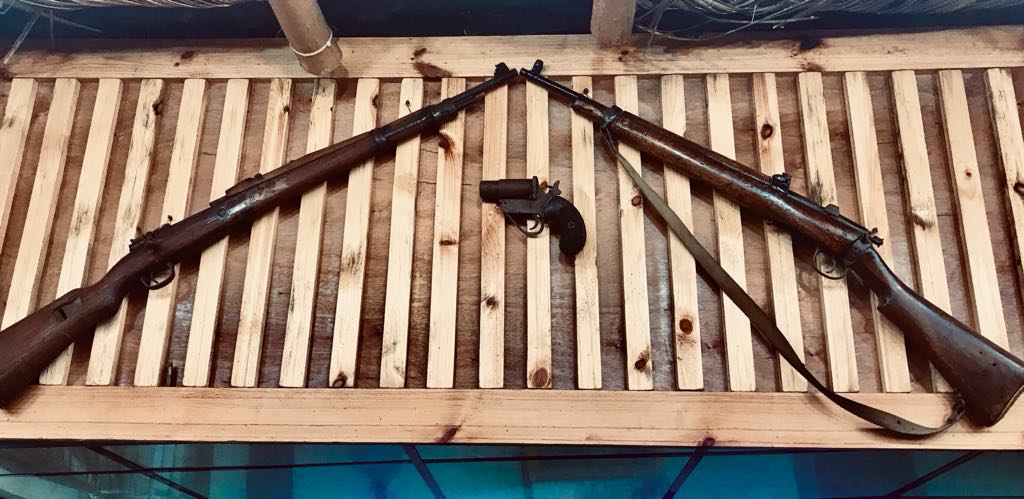
Drove for the first time today – a Toyota Hillux, the best vehicle I’ve never seen in the United States. It’s a truck used all throughout the Middle East and Africa, valued for its ruggedness and shallow learning curve. Our truck (Akam’s brother’s truck, to be precise) is a manual that handles the sharp turning required for hectic city driving as easily as the uneven potholes that we’re bumping over on the back country roads.
As the city turns in to the village, we pass over the silty, wide Sirwan River and through our first checkpoint without a problem. We’re in a small town that consists of little more than a market and a poorly marked intersection. At the second checkpoint, the soldier is talking to a parked semi-truck driver and doesn’t even look our way.
Mitsu and Akam are talking about something important, but I’m focusing on the road. The lines are gone and the speed limit signs stopped a while ago, so I shift up to 5th gear and give it gas. The suspension on the truck is fantastic and neither of my passengers comment on the slight weaving I have to do to avoid the massive potholes that litter the road, until my headlights outline a severely damaged section of the highway and I have to machine break the truck to avoid damaging the suspension.
I know driving isn’t supposed to feel exciting, and as the sun starts to set over the hills, the sparsely populated countryside looks like it might be a scene out of Wyoming or New Mexico. And then I see a pack of hungry dogs and their eyes show that ghostly reflection that appears when we shine lights at eyes and I’m reminded that This is Iraq. It’s my first time driving outside of the United States and less than 3 years ago this road was wasted by jihadist bandits hungrier and meaner than any stray dogs we come across this evening. How did we get here?
“dapira” – grandmother; nick-name for the strong, dependable and always present Toyota Hillux
Saturday 17 August: Day 37
When I needed to buy lightbulbs in college, I drove down to the Home Depot past Busch Drive and made a purchase. There was a whole section just for light, with dozens of bulbs clearly marked in never-opened English-language packages. I miss Home Depot.
Today I sat on a chair in front of a mobile air conditioning unit as a practically salivating salesman tried to sell me something I didn’t need for twice the price I was expecting to pay. We wanted yellow-light bulbs of two different sizes that wouldn’t explode before we went to bed that night. I told him that I would think about his offer before stepping outside.
Across the alley of the bazaar three men were busy installing a new sign for a shop. One lowered a circular saw on to a square iron beam, sending a million glowing hot sparks of metal in to the busy street, his eyes squinting shut for protection. Thousands of the sparks went back in to his face and the difference shot in a clean ark not unlike the spray from a garden hose, except red and then orange and then black, all in less than a moment. The other two men balanced on the cross beam of nailed wood supporting their weight a floor above street level, blowtorching the cut iron in to an almost-perfect right angle. Men here use their feet to extend measuring tapes, and since one hand was holding a blowtorch and the other was holding the ledge of the metal frame precariously handing from the store front, the older worker used his teeth to hold the measuring tape squeezed the tape between his big and second biggest toe. The third man yawned, lazily. All of this almost twenty feet in the air – a tightrope act, impromptu lightshow and bone-setting operation all at the same time.
I told the salesman that his price was too high. The next shop had exactly what I needed.
“wasta” – worker [Turkish]; used for laborers, servers and uncles
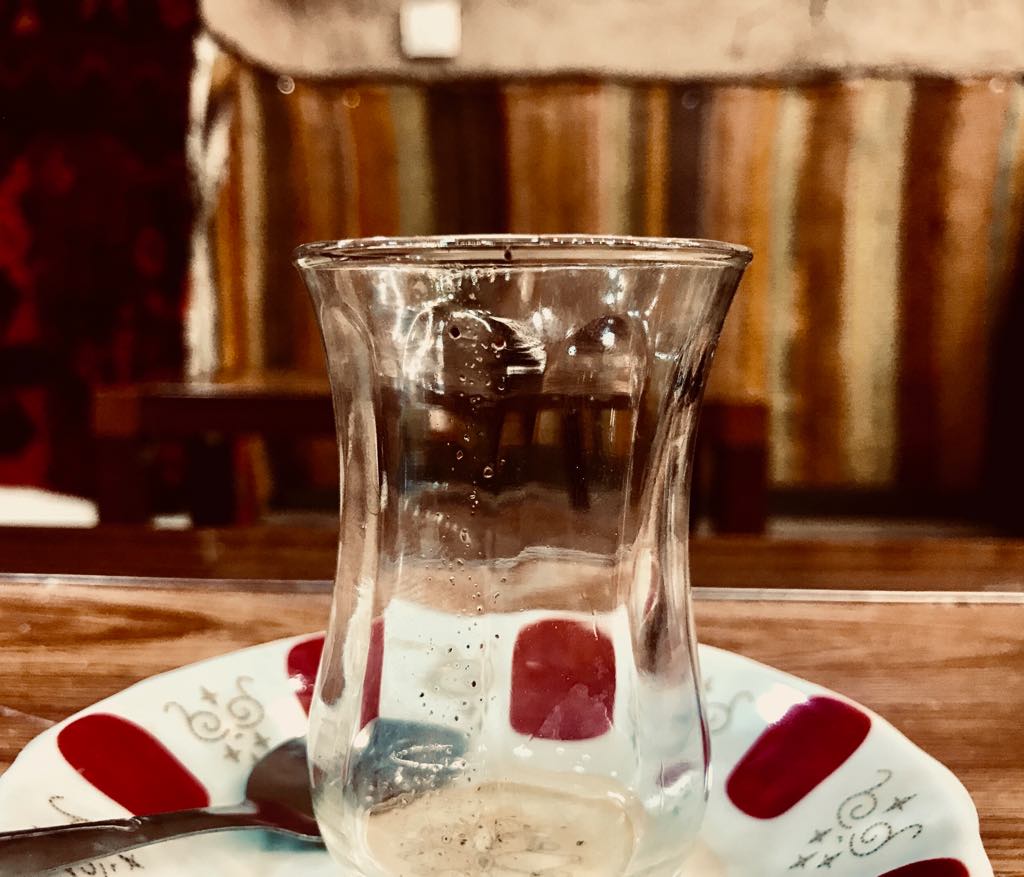
[Crossed rifles at top of post are over the entrance]
Sunday 18 August: Day 38
I cannot recommend Chimamanda Ngozi Adichie’s Ted Talk, “The Danger of a Single Story,” highly enough. I used it in class today to demonstrate the proper method of giving a presentation and it was a smash. I wonder if she could have guessed that a class of 22 Kurdish women would one day model their end of course project on her popular speech.
Not feeling good today – “stomach bazos,” as we said in Rwanda. Missing the Peace Corps Medical Bay in Kigali right about now.
“nahorsch” – sick
Monday 19 August: Day 39
Couldn’t get out of bed today. Abdullah tied off my forearm this morning and gave me an IV of saline. He hung the bag from a nail in the wall of his lobby, filled with plastic lawn chairs and very inquisitive fellow patients. The cold of the drip was strangely not very refreshing and I started puking a lot after the procedure. Mitsu didn’t let me go back to work after that.
“hawbash” – partner
Tuesday 20 August: Day 40
This weekend, Akam moves back to Hawler to teach at a British school. Starting on Monday Mitsu and I will have full reign of the English Access Institute to implement a slew of reforms at the school. Our work is cut out for us.
[Going forward, we’re going to use “Hawler” (Howl-air) in our writing. Hawler is the Kurdish name for “Irbil,” which is the non-westernized name of “Erbil,” the largest and most politically important city in Iraqi Kurdistan. Our neighbors all say Hawler, so we’re going to say Hawler, too.]
Before he leaves, Akam has promised us one last furniture shopping trip. The trip was tonight. We must’ve entered close to twenty different shops: small smoky garages with Iranian fathers sharing tea and cigarettes, dirt lots lit by cell phones, whole warehouses full of particle board waiting to be cut and assembled, and a few high-end shopping malls advertising a partnership with Ashley Home Furnitures. Ashley Home Furnitures, like many Western retailers, has partnerships with companies in developing economies that brings unsold living room pieces from last season overseas for the hope of making back some of the expenses on the furniture’s construction. This means that products advertised as “brand new” and “customized for [insert market name here]” are really just recycled. Akam was pretty bummed out when we talked about this.
His mood changed inside of one medium-sized furniture dealer about an hour and a half in to our adventure. We saw the perfect coffee table – squat, wood, sturdy and fresh. Akam told the merchant that, being a foreigner and a teacher, I surely merited a substantial discount on the table. The merchant enthusiastically agreed but countered that his son had to bribe half a dozen people to get this table in front of us and that the Barzani family (Iraqi Kurdistan’s most politically influential dynasty) takes most of his profits from sales. The back and forth continued for almost an hour and we were laughing at the absurdity of our bargaining attempts, discussed over tea served on the table we were intending to buy, the whole time. We finally settled on a price far less than what we were expecting to pay and proudly carried the table through the street to the back of our pick-up truck.
While we were shopping we were also having an impromptu Kurdish lesson. Kurdish seems like a very difficult language: object-verb-subject word order, unclear etymology and morphology, a lack of consensus on pronunciation and definitions, and no real academic backing for discussions on grammar and usage. There’s also a lot of throat sounds, which any Kurd will tell you sound really funny. Our lesson was complicated by the fact that we were trying to hustle furniture dealers around midnight on a Tuesday and we were laughing so hard that it hurt.
Good luck in Hawler, Akam. Your organization is in good hands.
“talaba” – student (Arabic)
Wednesday 21 August: Day 41
We had 90 minutes.
As soon as Mitsu left the lobby, Aram – Akam’s older brother and second-in-command of the EAI – and I spring in to action. We bolted to the car and skidded out of the parking space in front of the school.
Our drive took us out of town, in the opposite direction of our driving test earlier in the week. There are small businesses lining the road outside the city but as we drove further away, the countryside became more clearly devoted to agricultural production and livestock. The plant nursery one of our students recommended to us was on the side of the road next to a dirt lot full of unused construction materials, but we were going pretty fast and there was a lot of traffic. Without an exit ramp, Aram, who is quite possibly the best driver I’ve ever ridden with, defly pulled a U-turn on the major highway and skidded in to the lot before the traffic caught up to us. We left the car unlocked and hurried over to the rows of flowers.
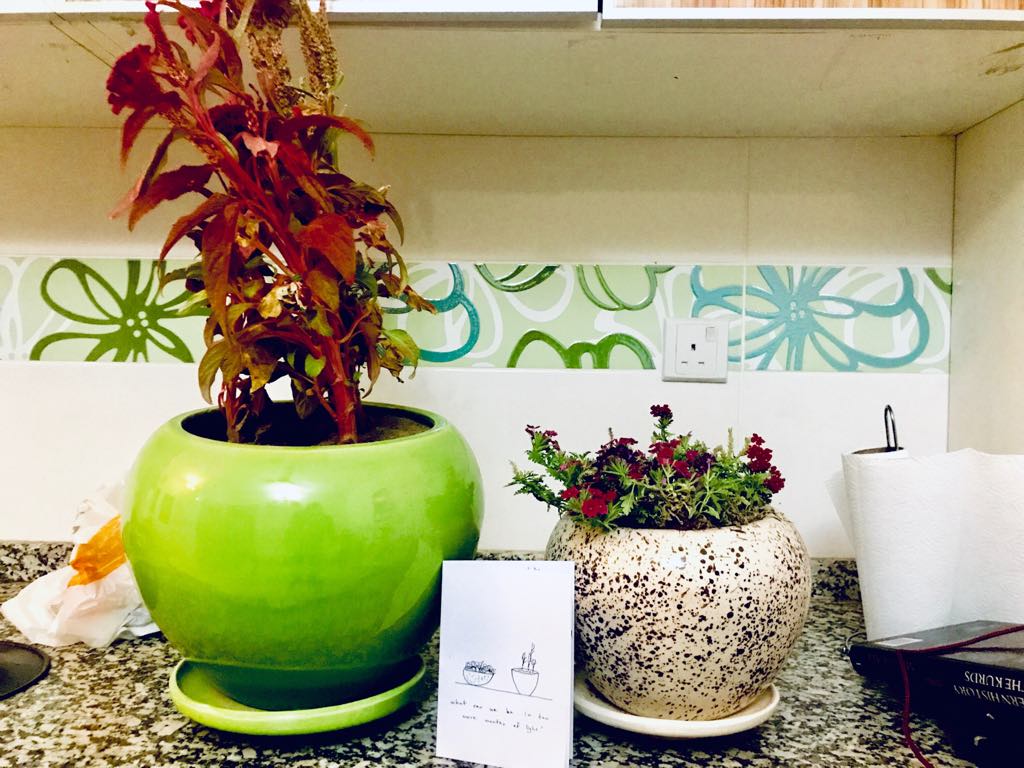
The pots were easy enough to find; the first one jumped out at us, a squat black-and-white speckled thing designed by someone with Roscoe-esque sensibilities, while the second one, a taller lime-green figure, was the brightest creation in the back room of the nursery. I found small flowers in red, pink and purple that kind of spread out with a vine-like energy for the first pot, but Aram found these tall, almost brain-like magenta flowers for the other one. She would like these.
After paying the man, we hugged the shoulder of the highway and drove against the traffic for a bit to get to a dark, rich mound of planting soil. The flowers were already baking in the trunk of the car when we pulled them outside to stuff them in to their appropriate vessel. We were vigorous, and within a few sweaty minutes we were both covered in caked mud. They were stuffed back in to the car.
The good news is that we found exactly what we were looking for, but the bad news is that we only had 20 minutes left to drop off the package and get back to school. Speeding through red lights with traffic police miraculously distracted by their smartphones Aram and I were able to set the flower pots on the kitchen counter of our apartment and still make it back to school with enough time left over to scrub off the evidence.
Sorry for dipping out today, Mitsu. Thanks for taking care of me when I was sick. I hope you like the flowers.
Thursday 22 August: Day 42
Pick a partner. I’m going to write a subject on the board. You have 30 seconds to talk about this subject; if you stumble over your speech or start saying filler words, your partner will snap their fingers and get you back on track. After 30 seconds, switch speakers.
This is how we start classes. It’s a fun and easy way to get students dislodged from their Kurdish-language environment and primed for a lesson. The hardest part of learning a new language is the fear of sounding like an idiot, and these “snap speeches” are a great way to overcome this fear.
After working with a partner, we try the activity as a group of four, then a group of eight, and finally as the entire class. Same principle, but now you need to speak for a minute in front of the entire class. And this is where the magic happens. Everyone is petrified of speaking on the spot, but instead of choking, the student audience starts encouraging the speaker, showering her with encouragement. If the speaker starts freezing, someone will gently ask a question to give her something to talk about. The environment is so unironically positive and productive, as if all of the things that teachers say about education was actually true.
My heart is warm.
“pallpisht” – support
 certification
Leave a comment