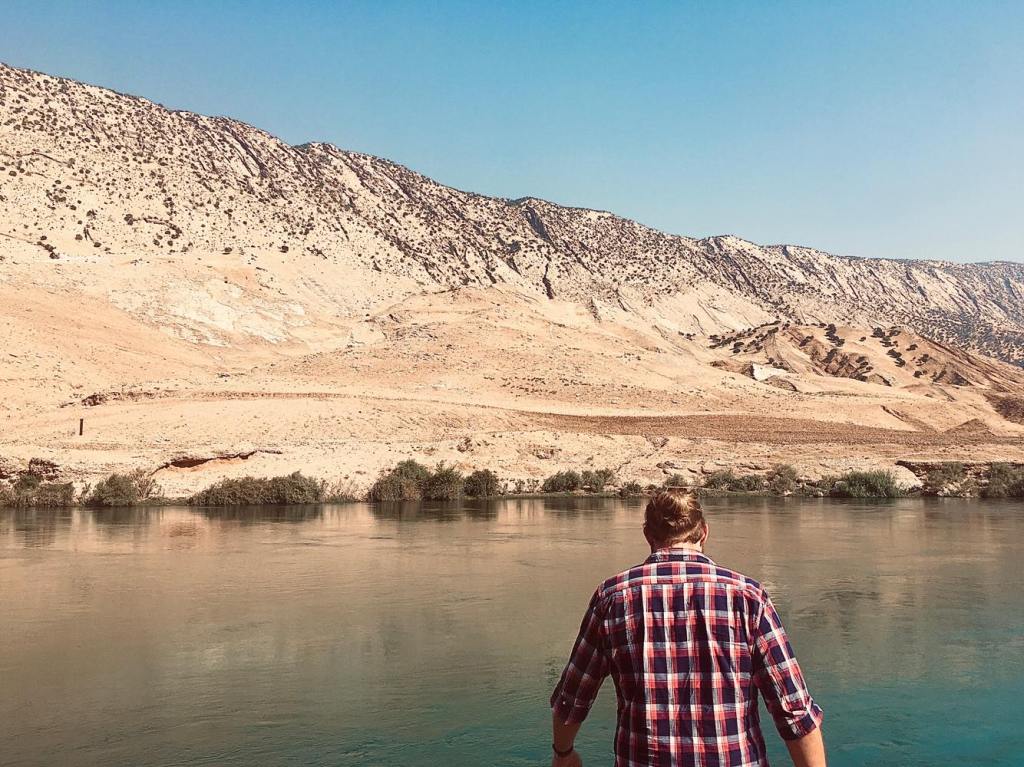
Thursday 26 September: Day 77
Today is the final exam for one of our last classes. One of the students who didn’t study enough came to me halfway through the exam and informed me that she needed to leave immediately but that she would be back on Saturday to re-take the exam. I said that she could leave, but that she couldn’t re-take the exam, since that wasn’t fair for all of the students. Somehow this response confused her. We grabbed Aram, our resident translator, and she explained that she could stay for another 15 minutes but then she really really had to go and she needed to come back tomorrow or else she would fail. Aram and I both are struggling to hold back laughter now and diplomatically explain that she’s wasting her remaining 15 minutes by telling us she can’t finish the exam.
Lost in translation?
Exam
Friday 27 September: Day 78
When Ako’s 90-year-old mother sat down in her living room and welcomed us profusely, the sleeve of her black shawl slipped upwards and revealed three perfect circles tattooed in to her forearm.
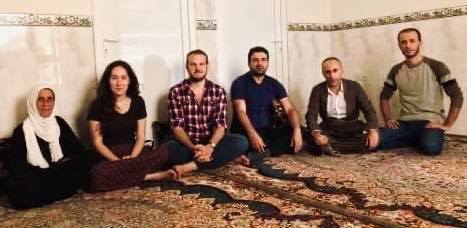
Ako explained that it was customary for younger women before the era of British colonialism to tattoo themselves with a needle and the ashes of burnt bread. The symbol had no significance, but the action was in some way a preservation of a cultural practice whose origin and even value have lost significance.
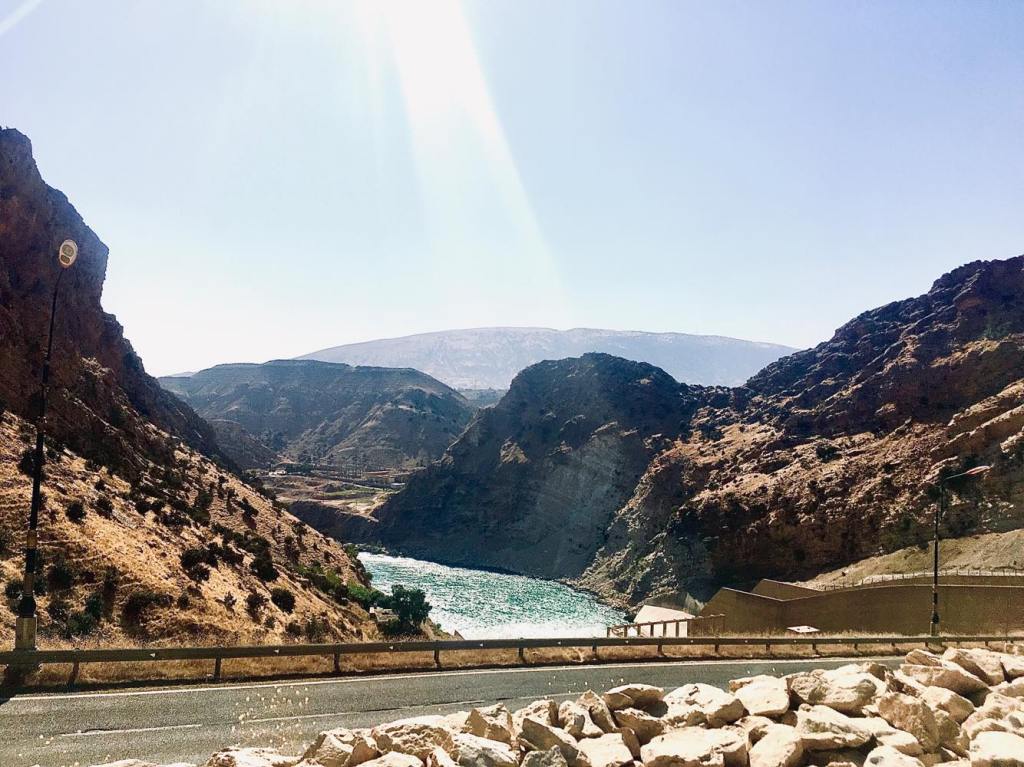
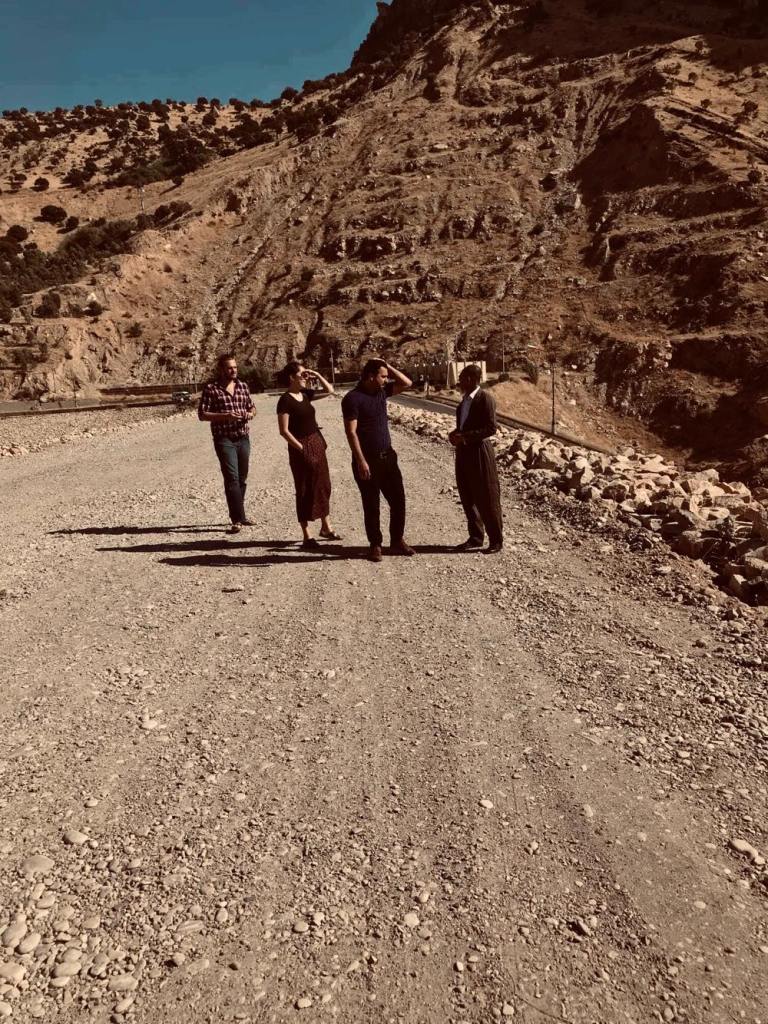
Later that day we drove to the mountains on the Iranian border to visit Sartek, a community that defies easy classification. The people who live here usually live somewhere else and own a small plot of land in these hills, usually as a second – vacation? – home for bonfires and evening picnics. From the road, all we can see is tight, colossal cliff walls that threaten to collapse in on us at any moment and damn us inside the Sedona-adjacent unearthly sediment, but a creek spills over buttresses parallel to the road now jammed with traffic and lined with simple concrete shops. We park and walk between slowly dislodging traffic shuffling forward like pack animals and suddenly turn off the road to follow the creek to the Source. Ako and Aram lead us through this uneven, brambly stone path our hair as likely to get caught on branches sagging with ripening pomegranate bulbs as in a vicious cord of thorns, and the path changes from stone to brook, wood to steel to plastic sheet, all pointing towards the Source of this jubilant little creek like coincidence in a daydream, our environment at once an Eden of fruits and matter but also smashed with these fenced-off “vacation homes” that look like refugee pens in a sci-fi novel. It’s all so hard to describe.
The sun sets to a lavender scar between the orange-brown-black walls of this paradise and we find the Source by crawling under a broken segment of chain-link fence. Our fellow travelers performed ablutions in the clear bubbling spring and we just watched, voyeurs to something we couldn’t yet understand. But like these prayers, the journey to the Source, the bread-ash forearm tattoos, Sartek itself – everything we’ve seen feels older than time itself, old enough to be beyond our understanding of its value. We’re still humbled to see it.
“behast” – paradise
Saturday 28 September: Day 79
Feast or famine. The undeniable lack of resources that plagues the developing world manifests itself in the exhaustion of a community when resources are scarce, complimented by the unfettered joy of a good harvest. It’s a pattern we’ve seen in Rwanda and are seeing now in Kurdistan, although through a surprisingly different medium: social media.
In the States, social media has become what a driver’s license was in the 1960’s: a necessary prerequisite of identity, a proof of being, that forms a new dimension to social networks underlining all that we do. With the explosion of social media, our younger generations are replacing the older, nationally-limited social networks of neighborhood, church and university with a digital community that brings nascent electronic networks across the developing world together. Traditional domestic media competes for our attention with millions of sources simultaneously producing more content (and often better content), organically, than anything a newsroom or a studio could organize, leaving an antipathy for traditional media sources that favors the limitless refreshing of a news feed over the choreographed dissemination of a media corporation. In terms of information, it’s all feast, all the time.
In Iraq, a stranger relationship with social media has developed. Make no mistake, social media is as ubiquitous among Kurds of our generation as among Americans of our generation, and yet unlike the States, where generations born before this hyper-dissemination of information began now find the established social networks and media outlets losing ground to the innocuous spread of social media, older generations of Iraqi Kurds have absolutely no idea what Facebook is. Young women and men send pictures and messages on Snapchat that their parents will never be able to see, video chat on Facebook Messenger after their parents have gone to sleep, post hijab-less selfies on Instagram to an audience of thousands, and even sell digital currencies on mobile games like PlayerUnknown’s BattleGrounds (PUBG, or “pubgee” as everyone here calls it), using their profiles like savings accounts detached from the volatile national economy and hidden from their financially restrictive families.
So while American parents take classes on how to send a tweet, a second, secret society exists in the Cloud here, unregulated by the technologically archaic bureaucracies of the Iraqi government and unrepentatively dismissive of social norms that socially conservative Iraqi parents didn’t even know could be broken in this way. The gap between generations here is simply staggering – most people ten years older than us don’t even have a smartphone, and most people younger than us are using the newest Samsung Galaxy phone to message their friends on Viber about the best websites to download pirated Western blockbusters, impermissible on content-controlled corporate media channels.
What does all of this mean? Everywhere I’ve been I’m left with the impression that it is our generation, the Millennials, who are leading the charge to upend third-rail assumptions about their communities. In Iraq, that charge is potentially explosive, so at odds with the public, unconnected social networks that define and enforce public life. This “underground” – or “above land” – society has survived invasions, insurrections and genocidal extremism with greater resiliency than the institutions that govern public networks, and it seems that nothing will bring this generation of budding savants back in time.
“social media” – social media
[You’re welcome, Dad. What other topics do you want me to write about?]
Sunday 29 September: Day 80
Dark roads aren’t waiting to kill us. Cats pick through trash and hurry to find their mothers. Trucks stacked with crates of chickens scrape walls and tug at low power lines like feet in river-bottom grass. Brake lights make shadows red and reveal black-paint graffiti on the wall next to a temporarily illuminated shoulder. Shops, white from halogen, are islands of brightly colored cakes in plastic wrappers that bleed vibrancy onto the bare aluminum insulation of the opposite wall. We step over a black hole and on to another street, follow the scent of warm bread and find three men slapping disks of flat dough on the inside of a cement bubble of an oven, orange coloring all when the lights flicker off, the disks tossed like plates at a wall on to the table for hungry customers. Dark streets, universes inside universes, unfolding and disappearing like your fingers in my hand.
“saqam” – street
Monday 30 September: Day 81
Nazdar: former student, gifted writer, engineer at the start of a career. We’ve been talking about using the building adjacent to EAI as the future school for months, emptying the scarcely visited shopping center and filing it with color and children. Nazdar and I visited the building to take measurements.
The results are not promising. One wall, facing the street, is entirely window. The other three are solid cement butting up to neighboring buildings. There’s no ventilation, so years of cigarette smoke stain the walls and disturb the senses – installation of a ventilation system would be both prohibitively expensive and novel in Kalar, a city reliant on window units. There’s a ladder behind a door that a kid could fall through, brake his back and die on our front steps.
Nazdar sees all of this within 10 minutes of pensively dreaming up a solution: open-area, no walls, ample light, dozens of plants cleaning the air. I can see her vision materializing as she takes a broken measuring tape and forces it straight over a floor of broken glass and rusty nails atop neglected linoleum, sweat dripping from the lip of her neglected hijab and running down the rim of her wide, academic eyeglasses. A female engineer is a rare sighting in the US but is practically revolutionary in Iraq, so being in her presence is humbling, and hearing her English – practiced and refined in my English class – makes me proud.
We need to find a new site. We don’t need a new architect.
“binar” – building
Tuesday 1 October: Day 82
Our newest cohort of students begin classes today. At our insistence, EAI will be starting new classes at the beginning of each month to make the flow of classes more mechanical. We’re excited, because we’ve spent two weeks preparing lesson plans and supplementary materials, and almost three months trying to wrest EAI into a robust institution.
Mitsu is teaching an Elementary class and a Pre-Intermediate class, and I’m teaching an Upper Intermediate class. Our mornings are free for lessons and a few hours of administrative work – this month, that means writing repeatable lesson plans, creating digital backups, uploading our student documents onto a share drive for other teachers to easily access and getting rid of mounds of paperwork, putting together an Open House event and trying to prepare our new school’s proposal for the Ministry of Education.
“despekerdin” – beginning
Wednesday 2 October: Day 83
And then the protests began.
Like the wild demonstrations in Moscow this past summer – the only time of year when Russians can comfortably take to the streets – it seems as though Iraqis have been waiting for the brutal summer to cool down before they revolt against their government’s rampant corruption. To be clear, the protests going on in Baghdad and other major Southern cities is not affiliated with any political movement and hasn’t affected life in Kurdistan at all. They’re still a little scary, but we think that they’ll blow over.
Thus is the crux of sectarianism. Many Iraqi Kurds feel neither allegiance nor anger towards the national government, treating the Arab state like an administrative technicality. Nobody here calls themselves “Iraqi”, because Iraq has not and never really was a country. For the Kurds, it’s better to cast lots with the undefined, ignored dream of an independent state than the all-too-real gangsters running the show in Baghdad.
[Interesting note: a common and loud demand among the protesters is for a Universal Basic Income (UBI), which would have the government using its pilfered oil revenues to pay every citizen a dividend, just like Alaska’s oil royalty system. It’ll be interesting to see how far these demands go here, as opposed to the United States, where Democratic presidential candidate Andrew Yang is also advocating for a UBI.]
“xopishandan” – protests
Thursday 3 October: Day 84
I need to be asleep right now. The power is dead so the AC is quiet. We cracked the window but stupid drivers feel the need to rev up their engines between the speedbumps. For some reason the pipes in the building are moaning as if, I don’t know, they need to wake up for work in 3 hours. It will come. It will come.
“bori” – pipes
 certification
Leave a comment