Friday 18 October: Day 99
The ceasefire negotiated between Mike Pence and Erdogan broke down within 24 hours. A picture of a boy charred by Turkish chemical weapons is circulating around social media. American leaders are deafeningly silent, other than the occasional false equivocation. And yet somehow, we’re able to enjoy a golden, brisk afternoon, with clouds covering us from the sun and little kids kicking a ball in the grass near our feet, and I am reminded that at any given moment someone is experiencing their very own apocalypse. This must be the greatest injustice.
-apocalypse
Saturday 19 October: Day 100
Mitsu’s 100 Day Update
Today we went over to one of my students’ houses. His family lives in a small town on the outskirts of Kalar – in America we’d probably call it a suburb, but in a small country, and more importantly, a rapidly expanding town, it’s considered its own little village. I wouldn’t be surprised if when Chris and I come back to Kurdistan in ten or twenty years after we leave, it’s been engulfed by the creeping sprawl of Kalar. It’s easy to think optimistic thoughts like that when you see as many construction sites and infrastructure projects happening here – though our little backwater is nothing compared to Erbil, which looks like it’s all one giant construction development. It’s harder to think optimistic thoughts like that when you turn on the news – everyone here seems to be holding their breath, that the other shoe might drop at any minute, that the bad old days might be back before Rizgari turns into a neighborhood of Kalar.
It seems a marker of Kurdish culture that people are always waiting for the next bad thing to happen. As Chris has talked about in great detail before, being a fiercely independent, warlike tribe perpetually sandwiched between some of the greatest empires history has ever seen means that at a moment’s notice, outside powers (or powers within your own leadership, for that matter) might turn your life upside down. This has permeated into all aspects of Kurdish culture to a remarkable degree. “Being” and “becoming” are the same words in Kurdish (Heidegger and Sartre would have a field day). While, like all over the world, American pop music is well known, far and away the most styles of music are slow, melancholy laments about loss – whether in Kurdish, Arabic, Farsi or English. Adele has a huge following, as do some of the sentimentalist crooners, but Beyonce and Taylor Swift do not. Most relevant to Chris and I’s daily life, the concept of planning in advance, as we are told time and time again, is not something that has ever been important to Kurdish people. Of course, living in Africa gave us a sense of living in a culture where people are not slavishly reverential of our calendars and clocks. But it was easier to forgive people in Rwanda for this – people were usually sheepish when they were late, apologizing with a grin, and in the back of your mind you knew that the late students may well have been hauling water for kilometers all morning, or helping mom with the washing, or taking care of their brothers and sisters. Kurdish people, however, tend to shrug off their tardiness, and never make excuses for their absences or lateness. We often have students tell us “I might leave for university next week, we haven’t gotten our acceptance letters yet,” and I’m transported back to 2010, thinking my acceptance letters where dangerously late when I got them 6 months before my first class started.
When life has been essentially stable and devoid of chaos for hundreds of years, people have the luxury of being able to predict what will happen in an hour, a week, a month, a year, and so we are able to make plans and revere them like gods. In a culture where one phone call between foreign leaders destabilizes an entire region, you realize planning is a fool’s errand. I keep thinking of the Yazidi women who were held as sex slaves by the Islamic State Caliphate in Mosul, who after they escaped publically and to international media named and condemned their accusers. They had planned that they would be safe and protected, with their rapists and abusers safely behind bars. The morning they woke up to see Daesh soldiers escaping from their prisons in Northern Syria, they realized that their assumptions about the future had put a huge target on their backs. If you can’t plan on your own safety, how can you plan for anything?
One thing you can plan on in Kurdistan is that you will get fed well when you visit a Kurdish family. Even if it’s just to stop in and have a quick conversation, expect to be offered water, then tea, then dates, then nuts, then fruit, then more tea, then a meal (regardless of how much you claim to be full), then more tea, until you’re so caffeinated you can feel your eyes vibrating. But when you go to a Kurdish family’s house for dinner, expect to eat the equivalent of what I imagine Terry Crews eats on a daily basis. A plate of rice big enough to feed five, a mountain of chicken, several different types of soup, always including my favorite, tomato & okra, salad, and enough nan to make into a comfortable pillow. You are closely inspected as you eat, and at the mere hint of you throwing in the towel, the hostess starts to put on a great show, telling you that you are offending her for not eating enough, that you must hate her food and hate Kurdish food in general and hate Kurdish people and dishonor her and her family. So you eat more, because how could you not? This is doubly mindboggling given that Kurdish people also do not find it rude at all to tell you that they think you’re getting fat – so as they pile your plate high with food, they tell you “you know, you really have gained a lot of weight.” I wonder why?
Suren’s family did not disappoint. His mother was apparently nervous that we might not like Kurdish food, so she made us several different types of chicken, including delicious fried chicken legs (here, hilariously, called Kentucky, named after one of the only American fast food chains in Kurdistan, for now). When I was invited to the kitchen to hang out with the ladies after dinner, she glowed with pride as I told her (with Suren acting as translator), that Chris’ part of the country is famous for fried chicken, and hers measures up with the best of them. She told me that she always wanted to learn English, but when she was 12, she came home from school one day, and her parents told her that she was to be married the next day to her cousin, who was 10 years her elder. She was pregnant before too long, and she never had the opportunity to go back to school. Suren’s sisters, however, are studying to be nurses, and will not follow in her path, she says. Suren, a sweet guy of about 24 with excellent English and a burning wish to study English in Canada, tells me that when he gets married, he wants to share household responsibilities with his wife, to equally divide cooking, cleaning and childcare. His sisters and mom nod in approval, and his sisters chime in that these are requirements for their hypothetical future husbands as well. This is the prevailing attitude in Kurdistan – like America, the youth are far more socially progressive than their parents (though the difference here is far more stark than back home, of course), there doesn’t seem to be the disgust at the previous generation for doing it a different way like there is in America. Young men and women don’t say that the old ways were barbaric or sexist or wrong – they just say that that was their way, and the new way will be different.
As we drive back towards that lights of Kalar, I realize that this is the biggest takeaway I’ve found here in the last 100 days. It’s the first time I’ve experienced a truly conservative culture that is not judgmental of difference, something that 100 days ago I would’ve told you was an oxymoron. The number of young ladies with their hair, ears and necks covered even in 110 degree weather who tell me they love my knee length, sleeveless dresses, the looks of disgust on people’s faces when I describe gay conversion therapy, the offers to hunt us a pig if we miss pork, all point to a brand of conservatism that actually speaks to me. It says: That’s their way. This is our way. And that’s ok.
Sunday 20 October: Day 101
The first rain:
Every alley is a roar, no corner protects us – the dust of a major street picks up, bends itself over like a wave and then breaks all at once, a gust on her side kicking off the covers of an electric dream, scattering it on the street floor. The wind moves everything, trash leaps out of gutters, scarves are unwound and hurridly held together, trees moan and shake with joy, all at sunset orange, nothing is still –
– and then everything is, suddenly and jauntily still, like a child caught sneaking when the kitchen lights are flicked on, and the dust trash and leaves in the air drop like stones for the briefest of brief moments –
– and from this wink a new universe erupts in smile, one where liquid sunset dropping on cheap roofs disproves theories of structural integrity and makes mopheads out of musty carpets not pulled inside quickly enough. Fragrances of wet garden pot soil and cut grass-vegetation mixes with exhaust taped on to water drops and this ridiculously floral eruption assaulting us from everywhere disorients the senses. Lightning strikes, and again, and again, the now-black sky randomly giving way to floaters of hyper-liberated electrical currents cast upon the eyeball of the world. Thunder is like gunshots is like cheap exhaust pipe backfires as the only feeling becomes Wet and the only identifiable sound becomes Loud and with this Roar-Wink-Smile, all of Iraq erupts in a toothy grin, because the long dry season is over and wet autumn has finally, irreproachably begun.
-rain
Monday 21 October: Day 102
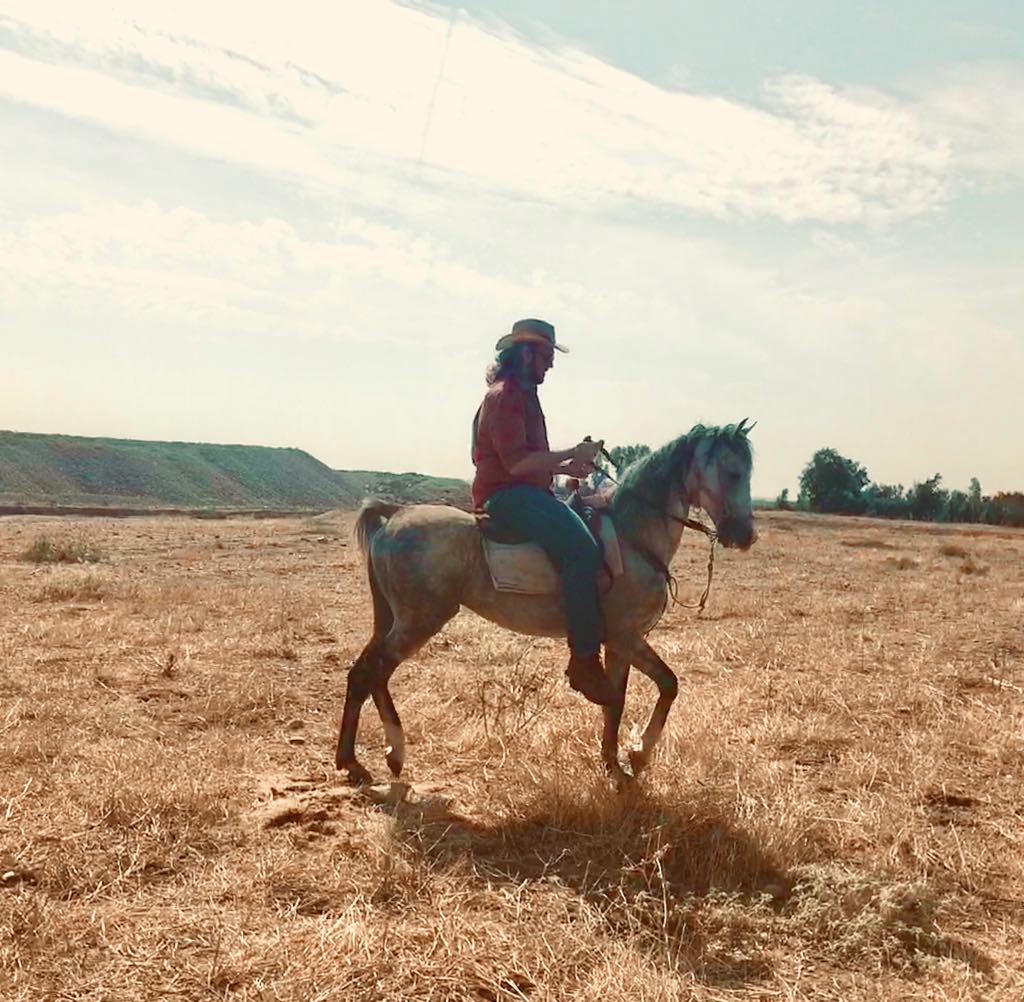
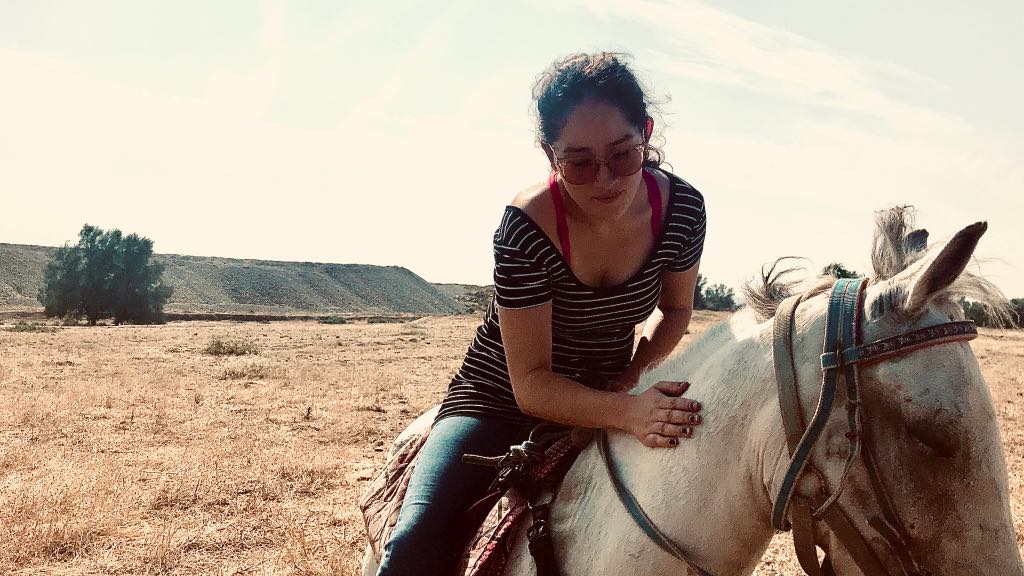
Today is our anniversary. Mitsu is celebrating the day with a surprise: I arranged for a friend to take us out to his family’s farm and let us ride horses. We crack open fresh pomegranate under shady trees and jump out of the way of a lusty stallion chasing the mare and Mitsu responds to the pack of wild dogs brooding in the abandoned industrial lot past the river by routing them like a Roman cavalryman, her black ponytail moving through the air as if it were reed in a river and her back as straight and firm as her love for life.
I celebrated our anniversary by taking a few laps around the lot on the mischievous male before ripping all of the inseam of my jeans open, struggling to mount the saddle in the first place and laughing until I cried the entire time. While Mitsu scared away mutts, my friend and I followed in a car and got stuck in loose gravel and had to pray to get that sorry taxi moving again. The Rea gift was being humbled, being reminded that Mitsu is a verifiable badass and an inspiration to all lesser forms of life, and while the assembled crowd of men laughed at my exposed underwear and pasty-white inner thigh they didn’t say a word about my Valkyrie of a partner running circles around a group of boys who had never seen a woman on a horse.
“mayn” – mare; “esp” – stallion
Tuesday 22 October: Day 103
The coolest thing about being in love is getting to admire the hero and the pauper inside someone, and being the subject of that dichotomous admiration myself. Yesterday Mitsu valiantly galloped while I held on for dear life; today, as she recovered from some truly uncomfortable blisters, I got to be the man who changed her battle wounds and rocked her to sleep.
How has it only been a year?
-anniversary
Wednesday 23 October: Day 104
The challenge of exercising here is finding a place that men and women can exercise in the same space at the same time. Most gyms only allow women to work out in the morning, or maybe they’re woman-only. We like exercising together partially because of the difficulty of finding multiple free time slots and partially because we inspire each other to do better.
We couldn’t find that magical gym for the both of us, but I did find a kickboxing class in the basement of a woman’s gym. So while she’s pumping iron in a room full of women who hide Lululemon yoga pants under full-body coverings, I’m listening to 30 Kurdish men grunt and attempt to mime each other, struggling to keep up the entire time. Little steps.
-fighting
Thursday 24 October: Day 105
“But that’s the problem with faith – saying ‘this is true because so-and-so said it’ is circular logic. If you want to prove free will, you gotta find another way.”
What is the soul? The mind? The body? Does the soul originate as a byproduct of the mind, indistinct from our mental processes, or is it a distinct thing made of distinct stuff? If we can say that the body is not free – subject to urges and manipulated by the mind – then how can we argue that free will is inherently present? If the mind comes from the mechanisms of the physical brain, and the brain is made of the same stuff as the body, then aren’t our minds subject to the same limitations on volition as the body? And the soul – if the soul is just part of the mind, aren’t we inherently composed of the same volition-less stuff through and through, superficially organized as distinct to preserve our fragile sanity?
Perhaps our bodies and brains are as material as the couches that we’re sitting on, our minds are the effect of material chemical causes which feel animated and distinct – a derivative of the reactions that occur on a neurological level – and our souls are the highest, final derivative of these mental interactions, the pinnacle of a peak snowcapped by the liquid malleability of our minds, under which immovable matter is supporting great weight.
What if the relationship remains vertical in nature but is reversed in order? The nucleus of our atomic being is the soul, the force binding all, awash with the electrons of our minds, constantly interacting with the psychological clouds of other souls. Matter – our bodies – is just the effect of this interactive mental causes, moved along inexplicably by an all-powerful, universally present force.
Maybe there isn’t a relationship between the three at all. Maybe we are all Soul, separated by a series of temporary physical barriers and mental tricks. Maybe we are all Mind, the hallucinations of Hindu gods still sleeping. Maybe we are all Body, automatrons who invent concepts like liberty and transcendence like dogs invent relationships with their masters. Maybe the Soul, Mind and Body correspond to different keys on a musical scale our ears can only hear the faintest echoes of, our maybe they correspond to three different questions being asked of the universe – Why? How? What?
Or maybe, just maybe, all of us are so awash in the beauty of what we know to be true – that there is right and wrong and justice, that there is powerful, all-enveloping love, and that the philosophical machinations of six Kurds and two Americans in the lobby of a school at the farthest corner of the Earth are all elaborate acts of worship to these Truths; that the goal isn’t to know, but to ask, and to lose sleep in the magnificence of the question.
I’m going to go with that one.
-soul

 certification
Leave a comment