Friday 20 December: Day 162
I’m asleep before the plane takes off . They don’t ask me to buckle my seat belt. My eyes flutter open and a hundred oil flares, bright like Hasira, are arranged like a sacrificial glyph around Kirkuk. Sleep. I look again, and a grapefruit-red sunrise is casting over the cloud tops. The landing jolts me awake.
It’s Friday, and as will become very apparent, Jordanians take their Fridays very seriously. We had planned to take a minibus to Aqaba – the beachside town straddled on the nexus of the Saudi Arabian, Jordanian, Israeli and Egyptian Red Sea coastlines – but none were running. We couldn’t even find a fourth person for our shared taxi. We did take our time getting to Aqaba; the paved highway that connects Amman (the capitol of Jordan) to Aqaba was flawless, lined with industrial centers beyond which only dry grassland existed. Our driver and fellow passenger were kind, stopping for tea (of course) several times and politely rolling down the windows while they smoked.
We barely slept the night before ad spent the car ride dipping in and out of consciousness. The Wadi Rum, its rocky, foggy landscape punctuated by illogically strewn mountains the texture of brain matter, kept us awake with awe. Fours hours from landing at the airport, we arrived in Aqaba.
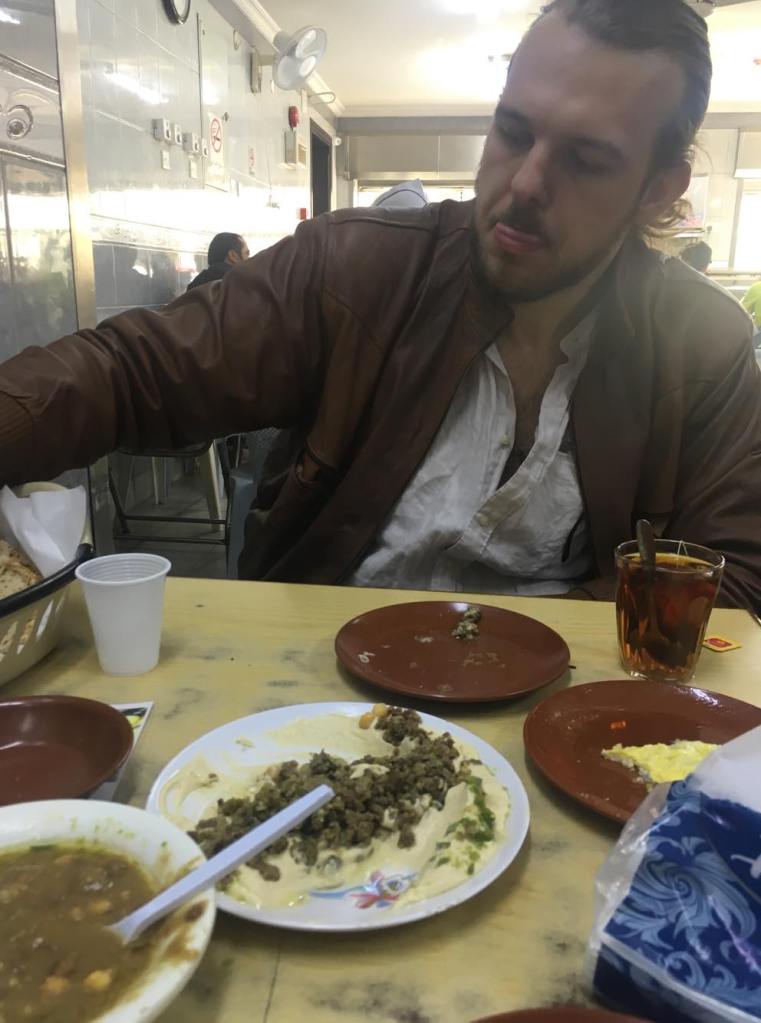
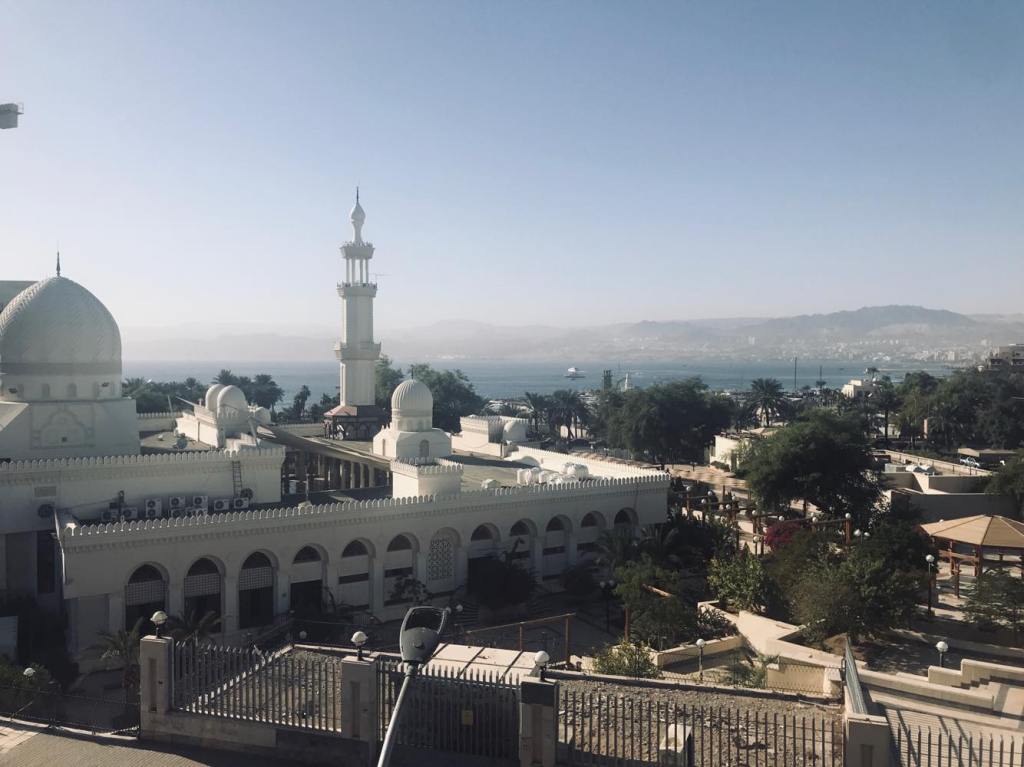
Have you seen Lawrence of Arabia? Aqaba is the sleepy fishing town where Lawrence organized the first blow that would bring down the Ottoman Empire from the inside. Well, its not a sleepy town anymore; today, Aqaba is a bustling seaside resort, its skyline a mix of apartment roofs out of a cubist fantasy and towering, imperial resort hotels forming a wall along the Red Sea. From the drive in to town the Red Sea is pristine and narrow, shared by the four reluctant neighbors in a cross-cultural respect for its beauty and economically advantageous geography. We scooped creamy hummus, grilled meat and fried egg with naan and found our little hotel easily, adjacent to a marble-white mosque.
Arabs, Africans, Europeans and at least a few American families walked down the street. Women wearing loose-fitting niqabs took selfies with their husbands near bars catering to foreigners. No one was in a hurry – its Friday, after all – and the temperature hit its year-low at around 80 degrees F at 2 pm. Sailboats and cruise ships strolled in and out of the dozen marinas, and the call to prayer was the last thing we heard before our nap took hold.
…
Evening. The busy park in front of the McDonalds was almost as packed as the fast-food chain. We missed American food. We promise ourselves not to go back. We strolled to an expat bar and listened to a bunch of drunk Italians talk about business as Mitsu’s skill at pool drew the respect of the bar’s owner. We talked to him about Kurdistan; the animosity that exists between Kurds and Arab Iraqis doesn’t seem to extend to Jordanian Arabs, and he asked a lot of questions about our job as we held the attention of the bar.
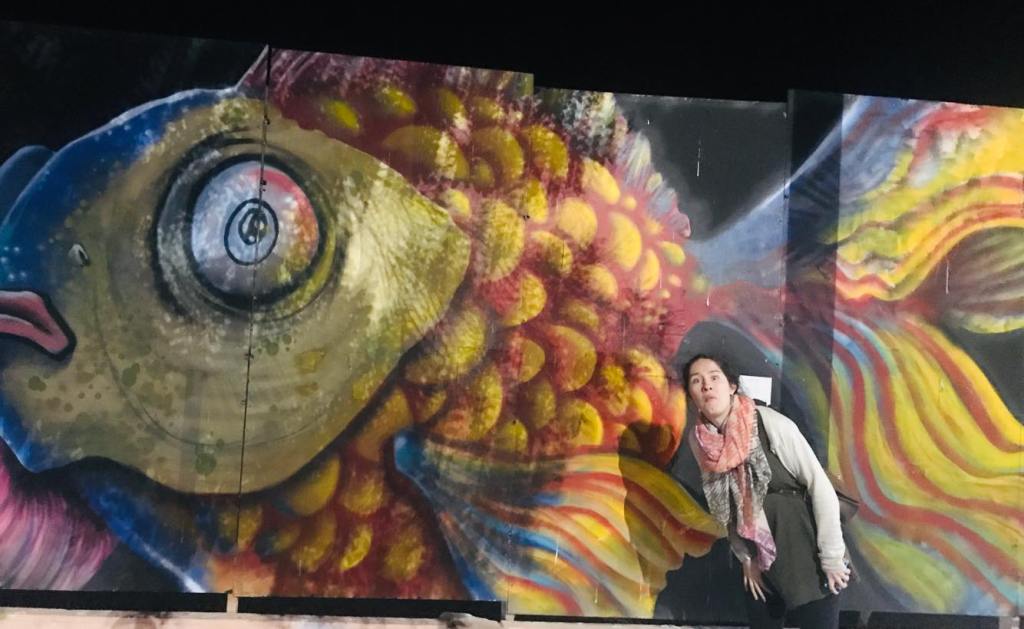
The water, even at night, was warm. Families played in the sand and young men smoked hookah pipes next to the shore. A group of turbaned grandfathers sang and played lutes for us all to enjoy.
We made it to Jordan.
- شكرا لكم – shukran – thank you (Arabic)
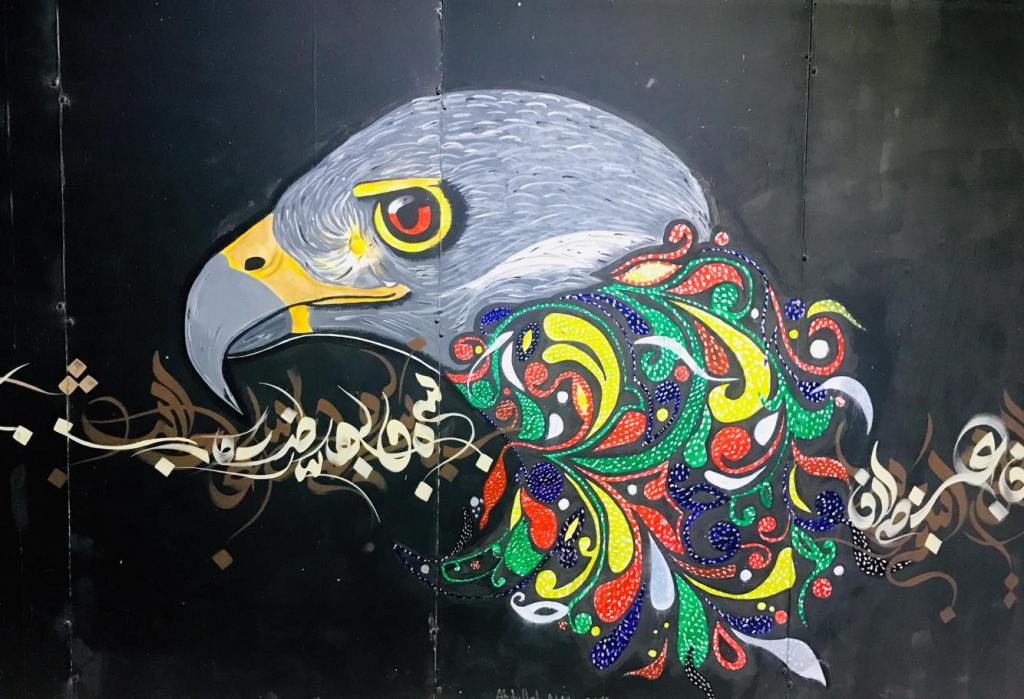
Saturday 21 December: Day 163
We slept through the call to prayer. The curtains billowed slightly, morning breeze war and welcoming. The Red Sea is a jewel in the morning light.
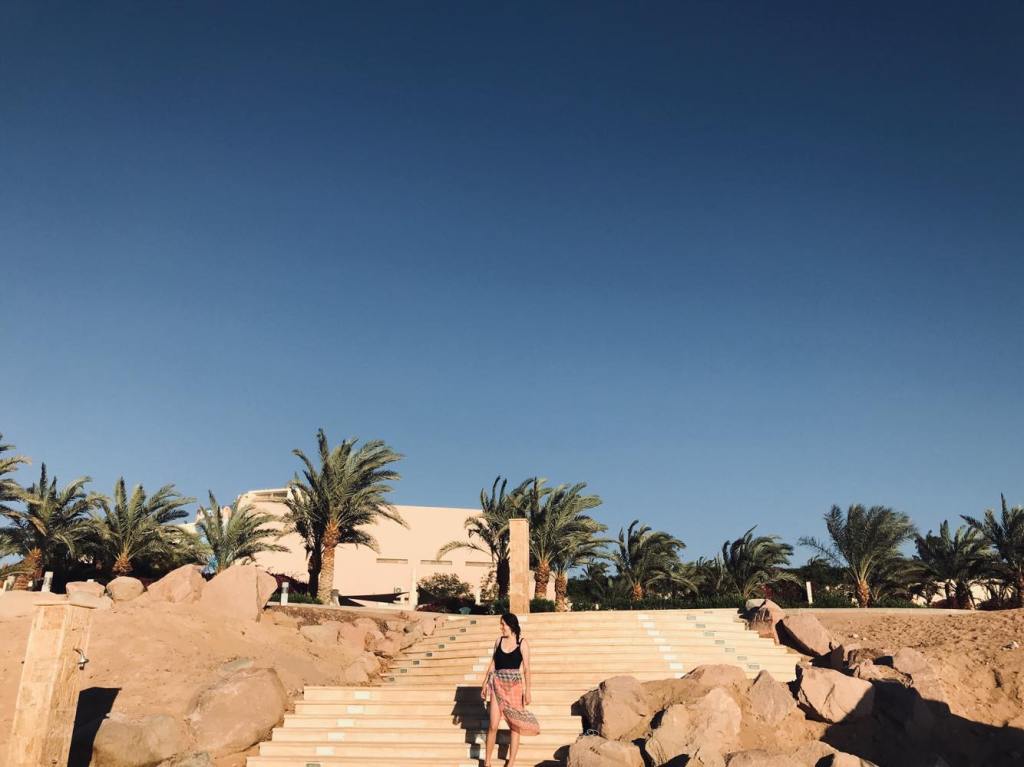
We made our way to a popular seaside resort. Today’s agenda consists of margaritas (the first at 11 am), snorkeling and gawking at virulent old European men in speedos. A Zumba class takes shape, led by a lively woman from Belarus with a thick accent that must’ve sounded like home to many Eastern European vacationers.
A sea turtle moves Buddha-like under our bellies, schools of blue envelope us and barracudas glare menacingly between the aisles of coral we move through. Black urchins occupy every nook of the living city around us and sand sharks lurk at blind corners, waiting for the lone fish to leave the flock. The air is cold and we make a kilometer-long lap around the shore, experiencing the bliss that comes with warm water and warm sun on our backs. Life is grand.
Mitsu is salty, red from the sun and the soft blushing of cold drinks. Other couples look like they’re trying to vacation away from their partners; she laughs that impossible ringing laugh of hers and jumps in the deep end, even though she’s scared of swimming. Our eyes crinkle from joy. If I’m lucky, she’ll make these lines permanent.
Tomorrow is the first of three days we’ll spend becoming scuba certified. Tonight, we’re sitting in an open cafe, smoking shisha and studying. A young Jordanian stops by for a chat, notices our textbooks and offers to get us a free copy of the test results. He says that we came at the wrong time, and puts his hand on Mitsu’s cheek to demonstrate the cold. Mitsu chortles.
Where else would we rather be?
عفواً – afwan – you’re welcome (Arabic)
Sunday 22 December: Day 164
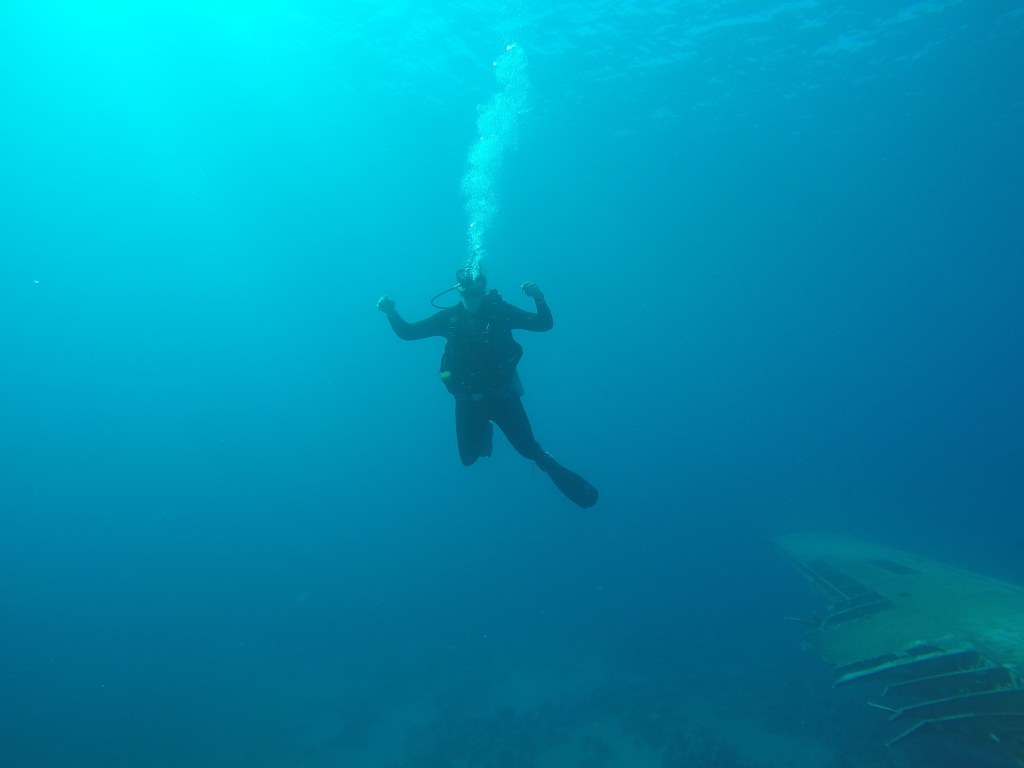
The first time I achieved neutral buoyancy while scuba diving is something I’ll never forget.
Our instructor is Sam. She’s a hilarious, open Aussie who has made a career out of teaching diving courses. She helps us pick out our gear in the morning, thoughtfully ensuring that everything is comfortable, and leads us to the beach with Talil, her grizzly Jordanian boss, in a breezy minibus that the crisp desert air seeps in to. We skip the swimming pool and take our first dive along the barrier reef on the shores of the Red Sea.
A crowd of women gathered on the dock as we prepared how to take a giant step off the end. Everyone was wearing hijabs – two young women playing in the surf next to the dock hadn’t taken theirs off either, despite the warmth. I, of course, thought they were just interested in us as foreigners; later, we realized how weird and novel it must’ve been to watch a large man following two women, one clearly his teacher, in to the water. They counted us down and laughed like kids with each splash.
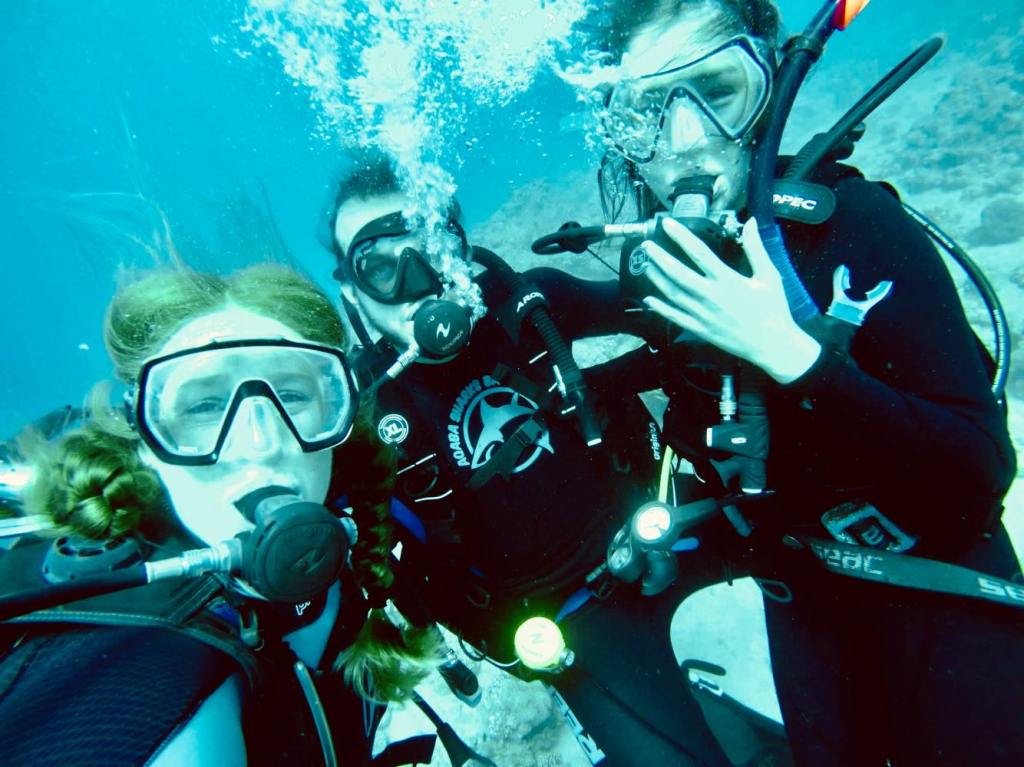
We learn how to clear out our masks, equalize, recover a lost regulator and communicate without speech. In our black wetsuits and cumbersome BCDs, our masks mirroring the sea if viewed from the side, each of us barely resemble our walking selves. Mitsu is still limber and graceful, her legs undulating like a sea otter, and Sam’s ginger ponytails float over her ears like octopus tentacles. I achieved that sensory-deprivation tank sensation at a meter above a bed of gold coral, a sea anemone waving at me with a thousand little palms, my back six meters below the surface.
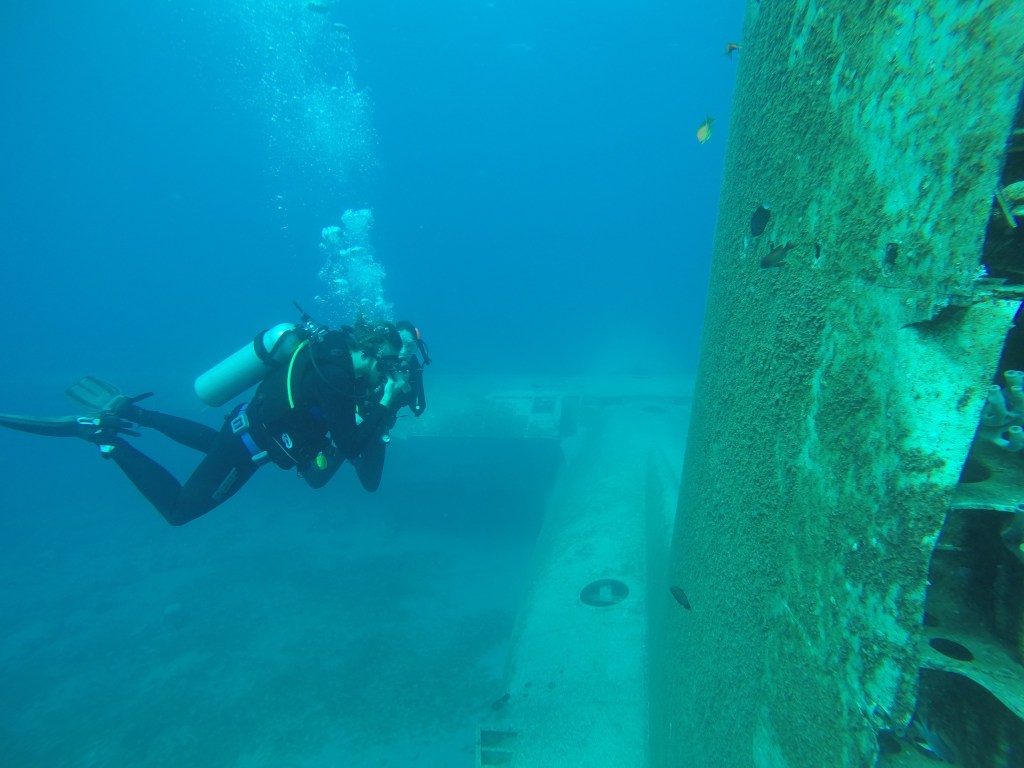
Our second dive was more skill-oriented. We removed our masks and swam blind, but when I peeked the world was still a colorful watercolor (I get what that means now). We practiced breathing with our regulators at a distance from our mouths, the impossibility of inhaling bubbles making us smile. We simulated an out-of-air situation at 10 meters, which is scary. Up until that moment my brain had associated deep water with death, and the instinct is to panic. Mitsu almost lost control when I passed her my emergency regulator, her eyes widening with this primal terror – and like a statue taking form by the hand of a master, she regained composure, found her strength and finished the exercise.
Our first day of scuba diving is ending at that same outdoor cafe, our noses in our study books and a whole new universe of experiences flowering in our imaginations. The men smoking near us let out jeers and cheers when a favored player scores a goal on the TV, the sounds so observably different and clear out of the water.
Record depth is 12.6 meters. We go back tomorrow.
مافي مشكلة – mafia mishkala – no problem (Arabic)
Monday 23 December: Day 165
Our instructors were clear: Be at the diving shop at 9:30 am to travel as a group to the boat. We were being “upgraded” to practice our long-stride dives off the back of a boat, and we were going to be fed some delicious seafood at the same time.
We learned how to set up our rigs, how to deal with basic malfunctions and how to not fall over while wearing a cylinder when the boat was rocking. In the water, our goal was to intensively practice a variety of skills. The scariest trial was simulating a no-air situation; I didn’t pass my second emergency air regulator to Mitsu fast enough and I could see her eyes shoot wide open as she struggled with the hose. She regained her composure, the two of us kneeling on the sea floor 18 meters below the surface, with the same determined look a football player might walk off the field with after a bad injury.
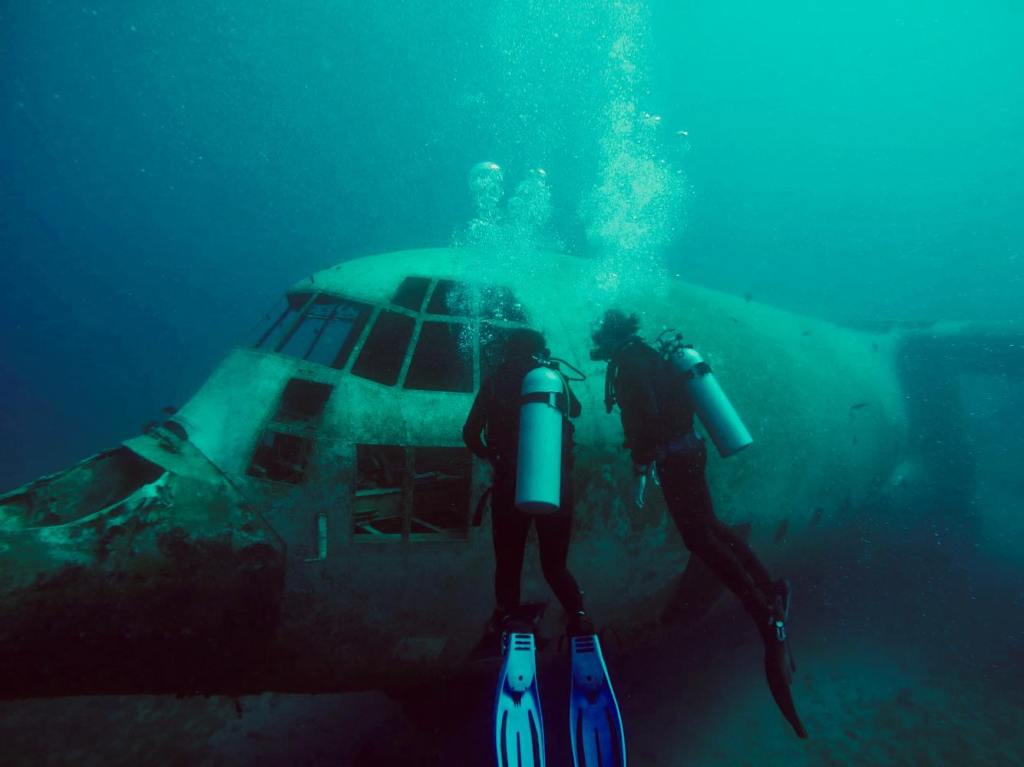
At the end of our dive was a sunken C130. The visibility was poor and it kind of came out of nowhere, like your grade school in a dream. During our training we’re not allowed to go inside structures (not safe, very dangerous), but our instructor poked around for a minute.
And then, like a shark bending around the corner, three skin divers – divers with nothing but a weight belt, a snorkel and a pair of flippers – emerged from the reck and casually stopped to glance at the cargo plane before calmly swimming up to the surface. All of that at 60 feet under water. Scuba diving is cool, but skin divers take it to another level. I didn’t know humans could do that.
We made it back to the hotel at 4 pm, intending to take an hour nap before opening up our textbooks again. We woke up 6 hours later.
البحر الاحمر – Albahr Al’ahmar – Red Sea (Arabic)
Tuesday 24 December: Day 166
Our last day of diving instruction. Out on the boat again. After a few simple skills and a swimming test, our last dive is for fun.
When you’re close to the surface, and the sky is clear, the light is divine. The “god rays” spin, collapse and stab in to the water like spears of warmth, creating a kaleidoscope effect on the sand. At eye level you can see this refraction all around you, magnificent in size and all-enveloping in their effect. Impossible to describe accurately in words.
But the small things matter, too. Tiny, docile jellyfish with grain-sized black “brains” cluster in threes and vibrate through the water like stardust. Seahorses, the size of my hand, mechanically elongate and contract, feeding off bites of seaweed undulating with the current. Fat fish aggressively burrow in the sand looking for dinner, their digging stirring up a cloud of silt that masks their visage before darting out of the dust like a cartoon cannonball.
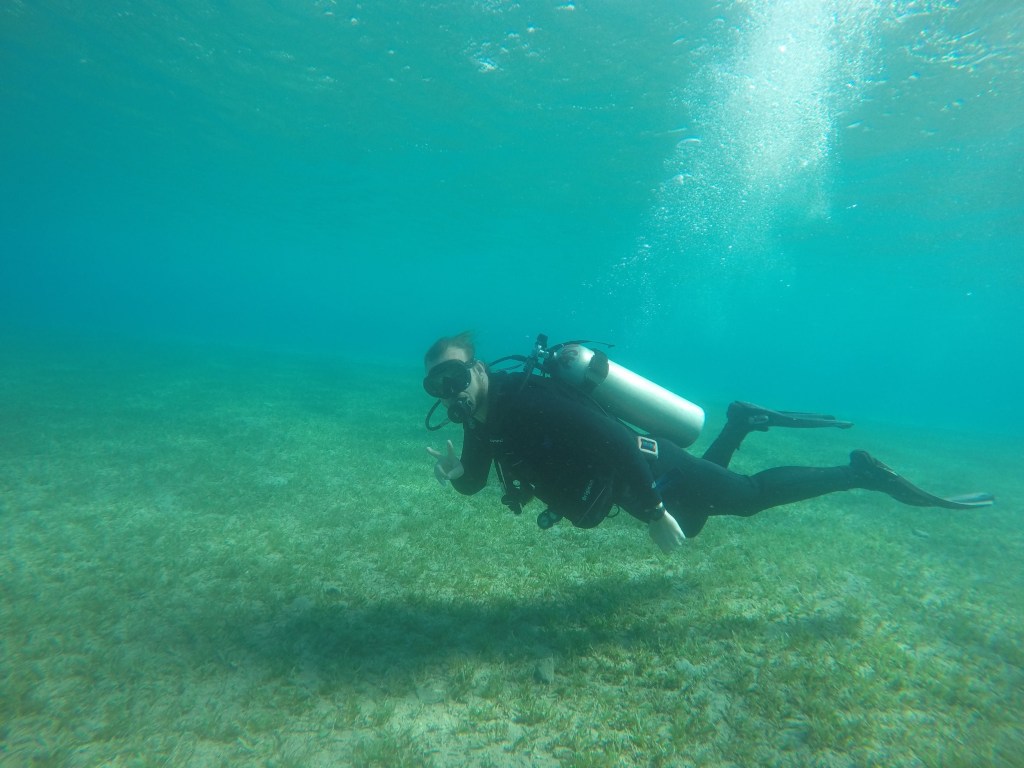
On the reef wall in front of us an entire ecosystem of algae, coral, anemones and urchins spread out and interact like the gears of a wristwatch. The skin-colored stalks of vegetation end in small bulbs that open to catch prey individually yet move with the larger plant as the invisible force of current scatters and then collects these tiny little trees.
And below us, the abyss: a dark, forbidding drop off to the bottom of the sea, so deep that the air in our tanks could compress to a hundredth of their surface-level density and suffocate us within moments. Stare at the abyss too long and direction seems to lose significance, like the darkness of space.
Above us, the distant waltz of the sun’s laughter spears down below the surface. Below us, a blackness beyond comprehension absorbs all light and motion. And in front of us, a biome with the diversity of a rainforest moves with the life of a city. To be here, experiencing these truths and powers, is an embarrassment of riches.
الحياة – alhayat – life (Arabic)
Wednesday 25 December: Day 167
Our first Christmas in the Middle East.
We wake up late. Fog has enveloped Aqaba overnight, so the Israeli city of Eilat stirs in and out of existence and the white buildings of Jordan’s city seem to be missing corners.
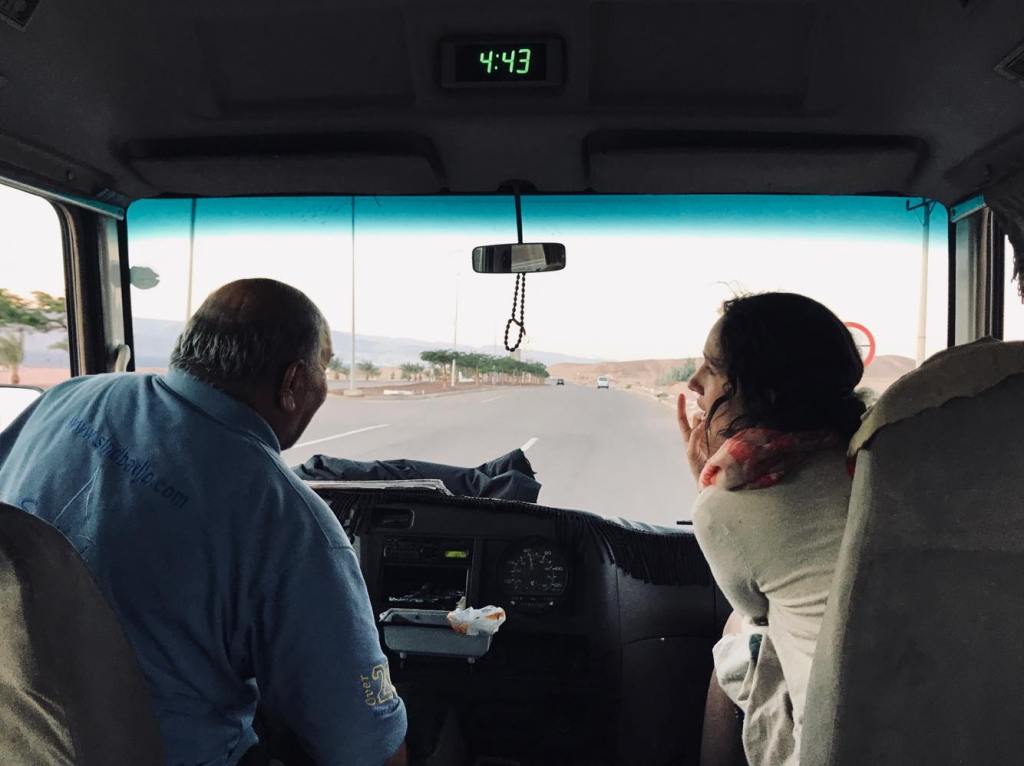
The bus takes us to Wadi Musa, through the foggy desert: a strange landscape, where the rounded, sedimentary mountains look more like bubbles of smoke and the horizon a dark line on wax paper. An older white couple forgets how to count, argues with the gnarled bus driver about the number of available seats, and complains about it the entire ride. Silent Night crackles on the radio.
Wadi Musa is a commercial stopping point for tourists traveling to Petra. One hundred and fifty years ago, this small city didn’t exist. Bedouins – dark skinned nomadic traders that roamed Jordan and Arabian Peninsula – lived in the ancient Nabatean city hidden in the mountains near where Wadi Musa exists today, unaware that the Nabateans had once managed a trading network from Italy to India, or sacrificed goats in carved cisterns on the mountain tops around their tents, or that Moses (Musa) had allegedly been turned away by the city’s inhabitants on his way to the Promised Land.
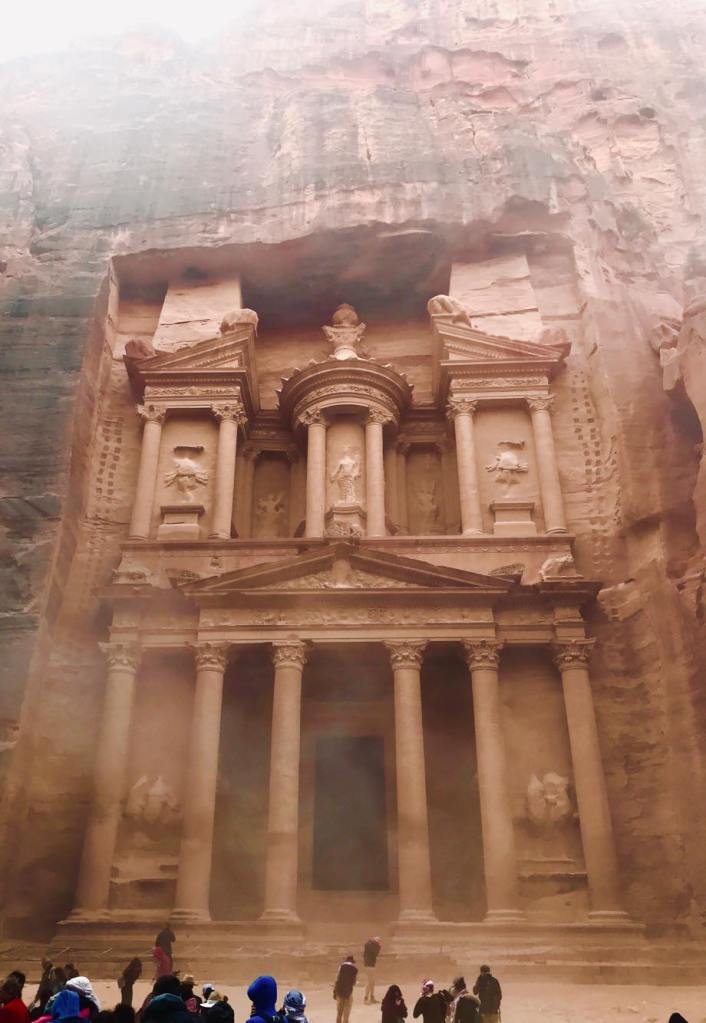
Petra is the lost city at the center of a dead empire. Now, in 2019, over a million tourists visited the city known for its cryptic Treasury that opens up at the end of a winding, secret gorge and for endless tombs and sculpted temples throughout an other-world, winding geological wonder. Wadi Musa (“The Valley of Moses”) wasn’t a thought until a pioneering Swiss explorer tricked his tour guide into disclosing the location of this place, spurning a relentless fascination with “the Orient” that the Bedouin culture is still contorted by to this day.
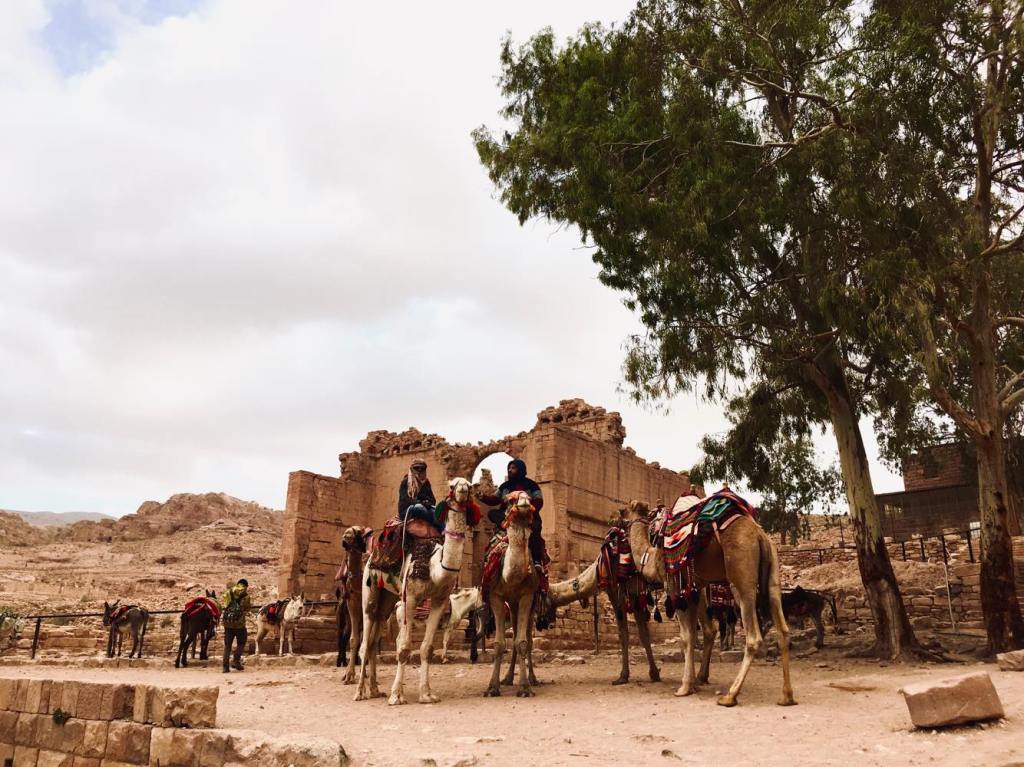
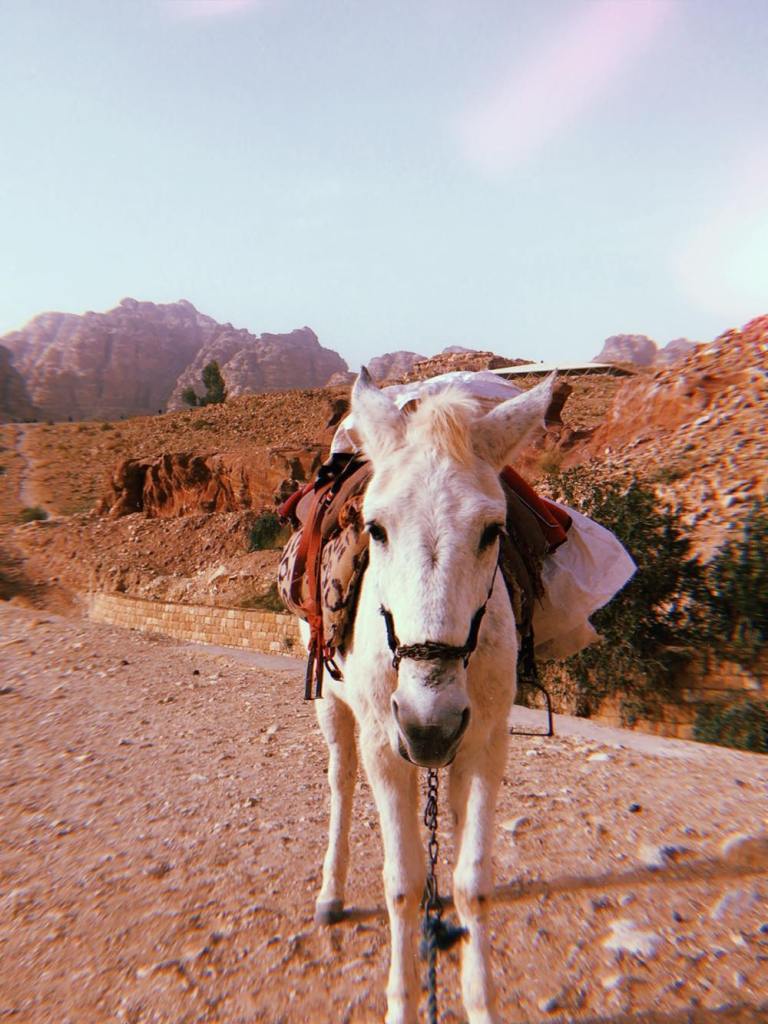
The Bedouins probably did drink the same mint tea that Mitsu and I are currently enjoying. They probably did race horses down the paved highways of Petra, whip donkeys up the steep, marbled hills of the necropolis, and must have still winced when a strong gale buffeted a wave of sand in to the slit of the scarves that were wrapped around their heads.
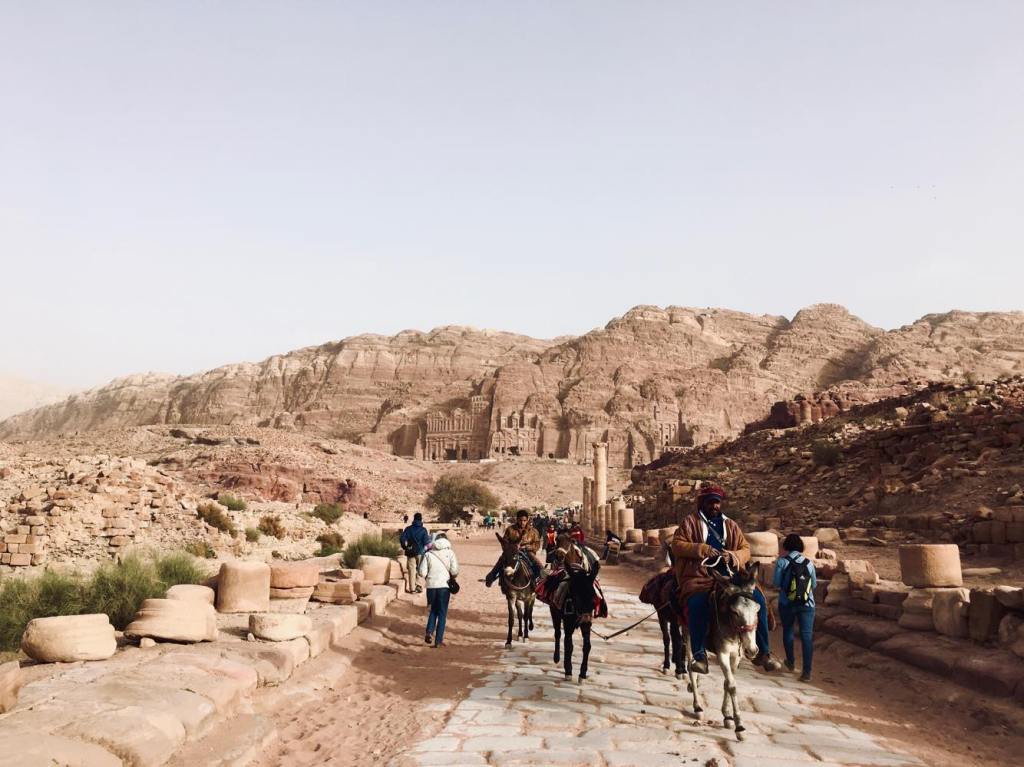
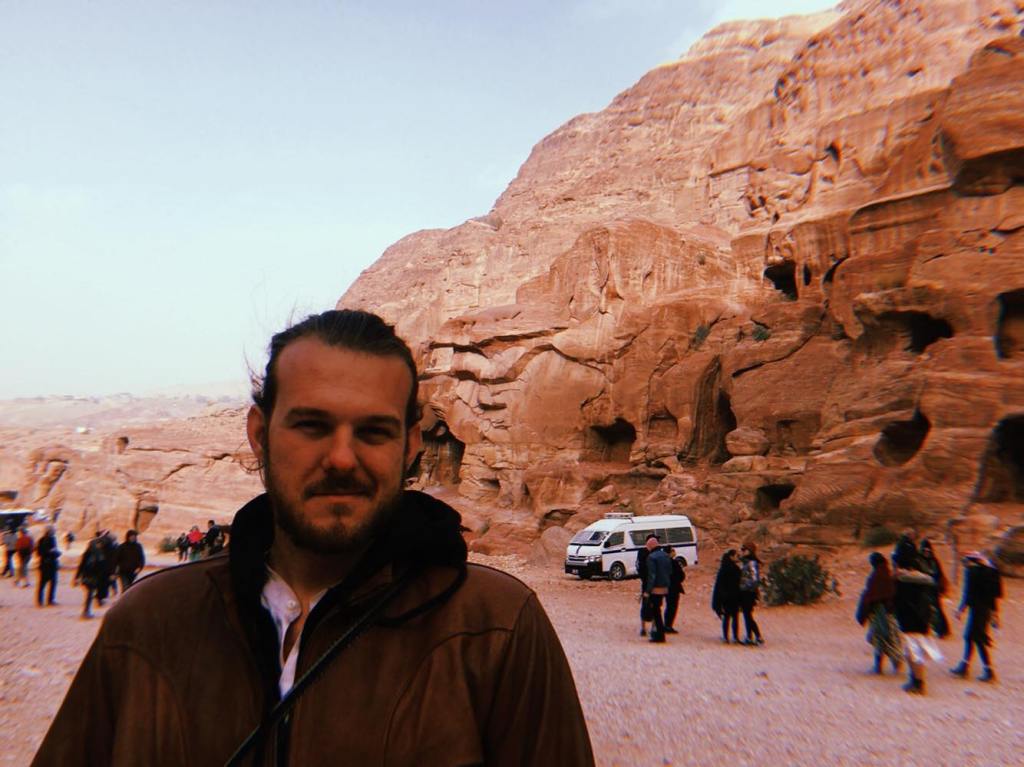
Today, hundreds of tourists – from literally everywhere, ranging from the elephant-pants tattooed variety to the beige safari-styled, a preponderance of ill-wrapped scarves fashionably complimenting down jackets and pearly-white teeth – are walking with us through the Siq, this snaking tall chasm that eventually (just as the wind starts to pick back up) breaks in to a clearing holding the massive Romanesque facade of the Treasury, that emblematic building of Petra. Horse-drawn carts race down the Siqh, scaring tourists, and the whip cracks echo through the hallway like thunder.
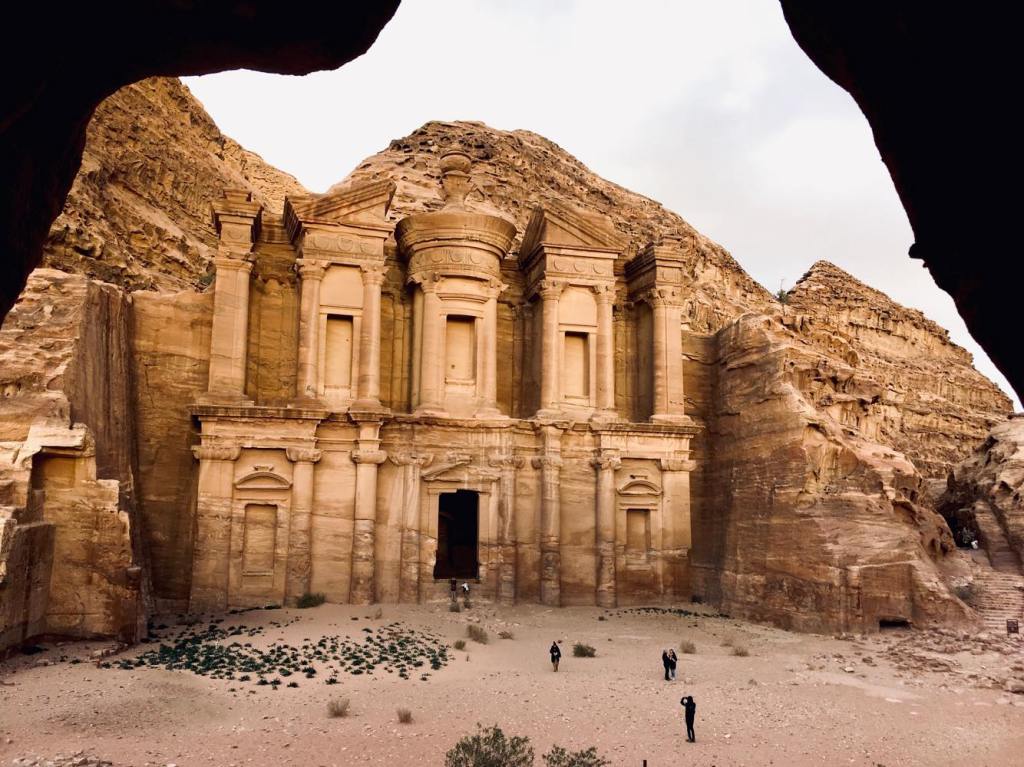
The Treasury itself is impossible to describe accurately; it is a towering display of sculptured mastery, three distinct levels of columns, relief statues and friezes. The inhabitants of Petra left their mark on the facade first, the Nabatean design, then the Bedouin inhabitants, the Crusader’s Christian fixtures, the Arab’s bullet holes along one wall, and most recently, the Royal Jordanian cement used to buttress a column after a terrible earthquake. Today, the tourist economy has led to the construction of several tea shops in the vicinity, and travelers themselves have immortally changed the site with heaps of plastic waste. Still, as the wind whips up layers of dust that spirals and bends in front of the shaded Treasury, I can’t help but feel as though we were the first people to ever set eyes on this long-lost ruin.
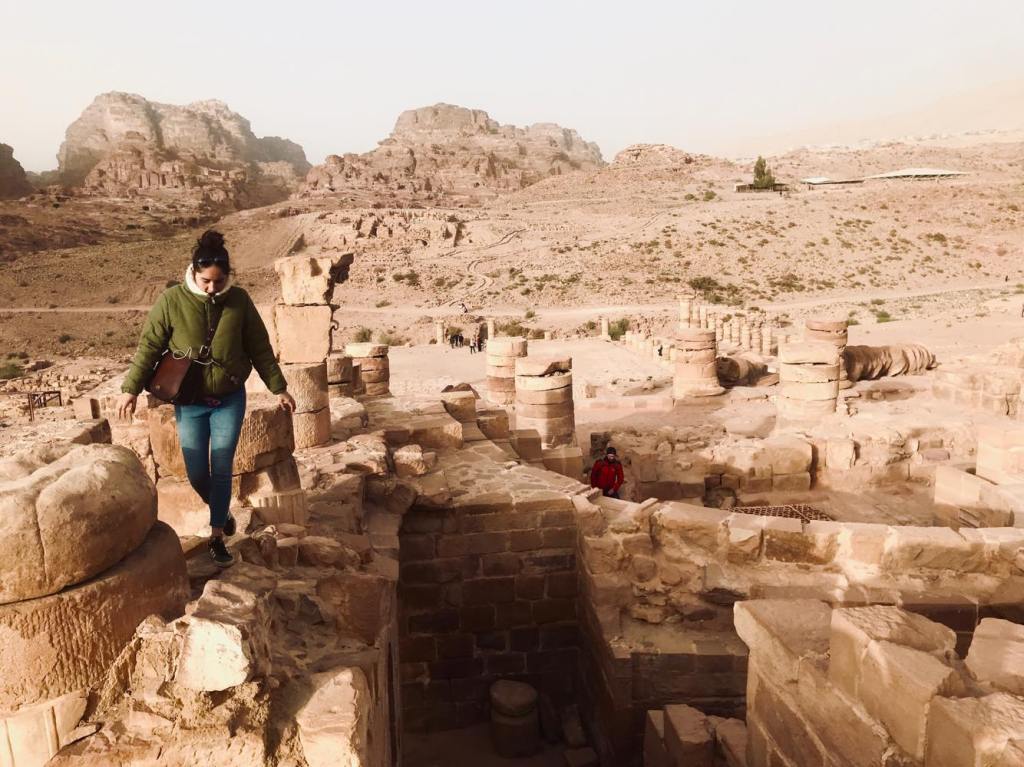
Moving past the Treasury, the sheer magnitude of Petra becomes apparent. A paved road, lined by similarly ornate tomb facades high up in the bundt cake sandstone of the surrounding mountains, passes remnants of other civilizations who also felt enthralled to settle this place. A Byzantine church is sunken into a hillside, its mosaics still ornate and turquoise; a Roman temple, the columns toppled like stacks of cookies, is on the left; an Egyptian vault, one of the only free standing structures, sharply contrasts with the organic cellulose of the surrounding hills. Every cave must be looked at twice – the first to marvel in their sheer wonder, as varied in size and placement as coral at the bottom of the sea, the second to question if a dead empire buried a king within it, still waiting to be re-found.
We spent the afternoon with our mouths dangling open at all we could see. Tomorrow, we will go back.
البترا – Albatra – Petra (Arabic)
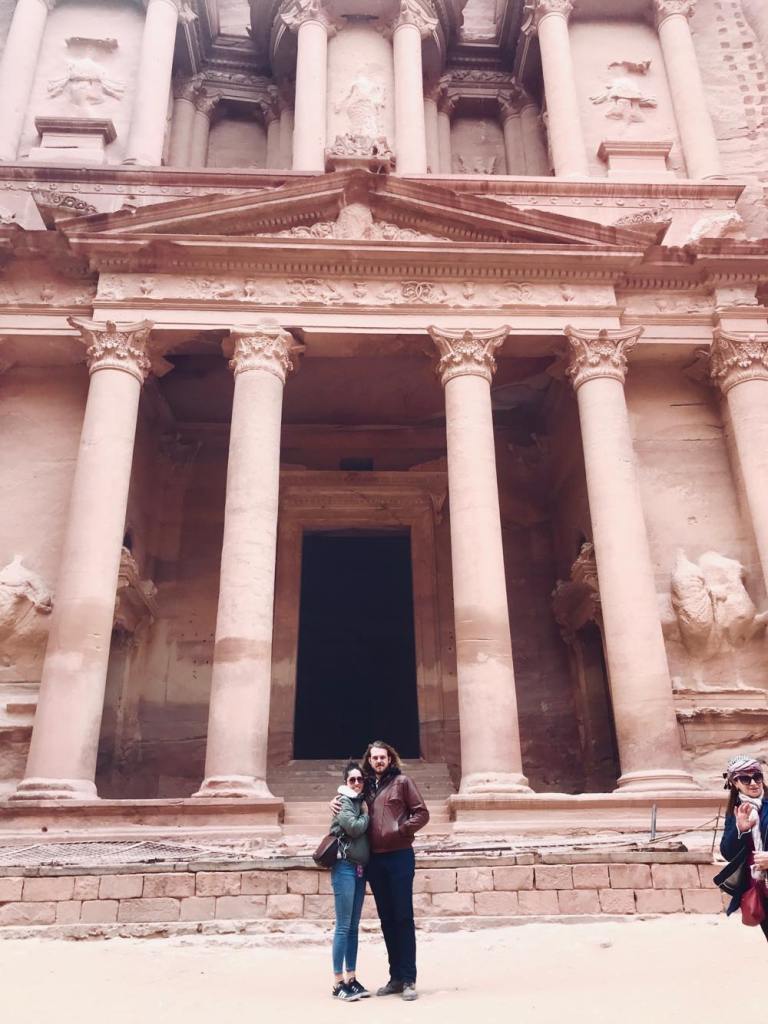
Thursday 26 December: Day 168
There are two hikes that we wanted to do today.
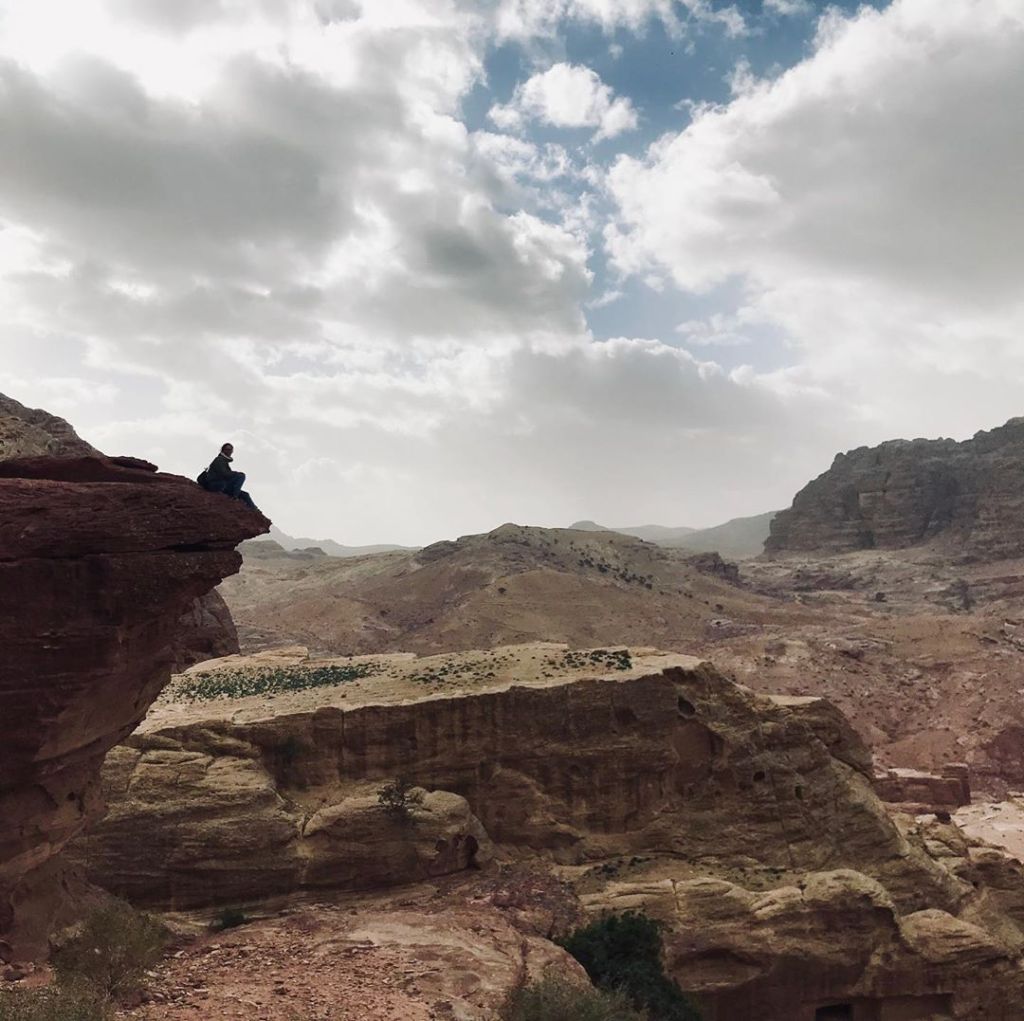
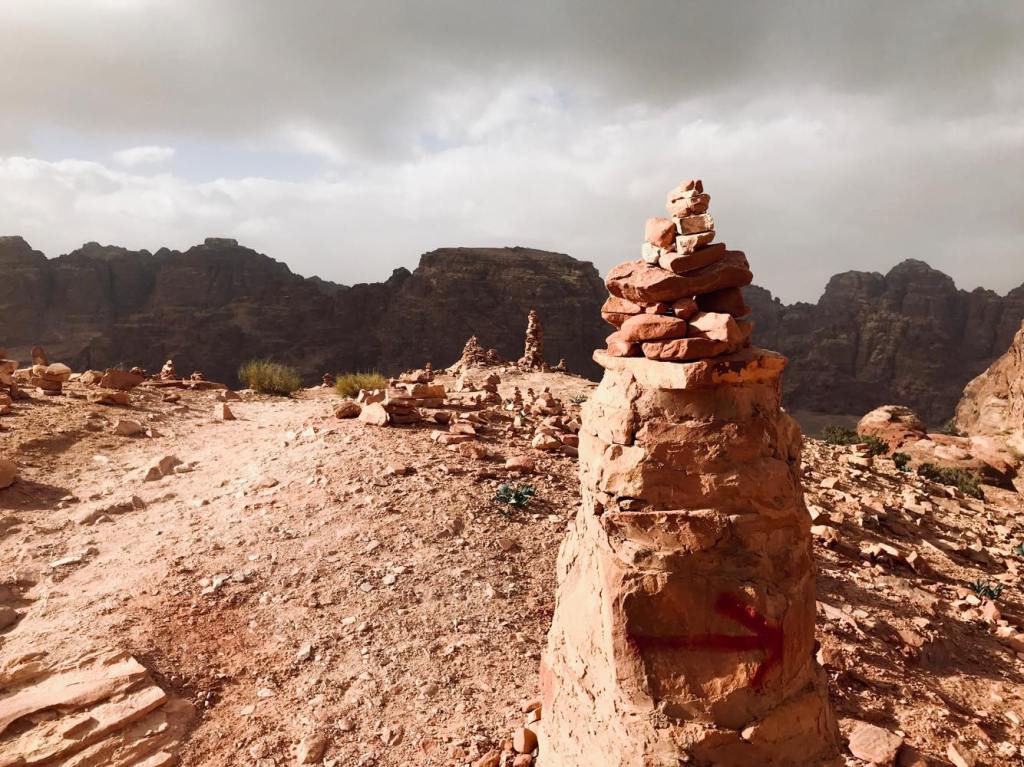
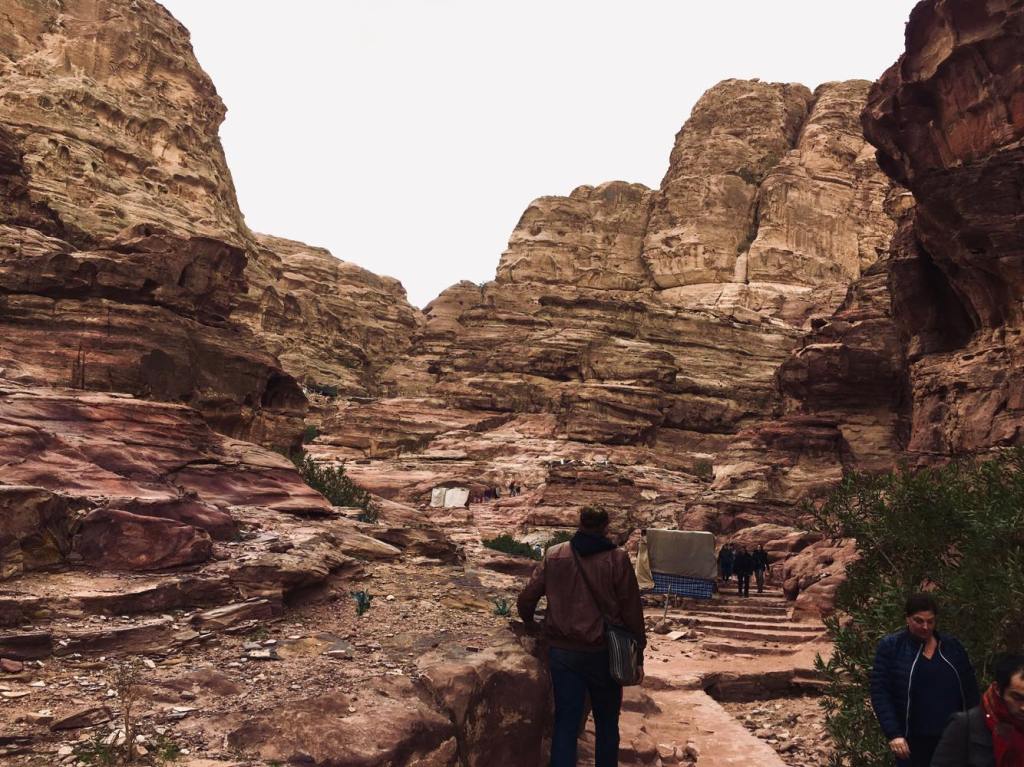
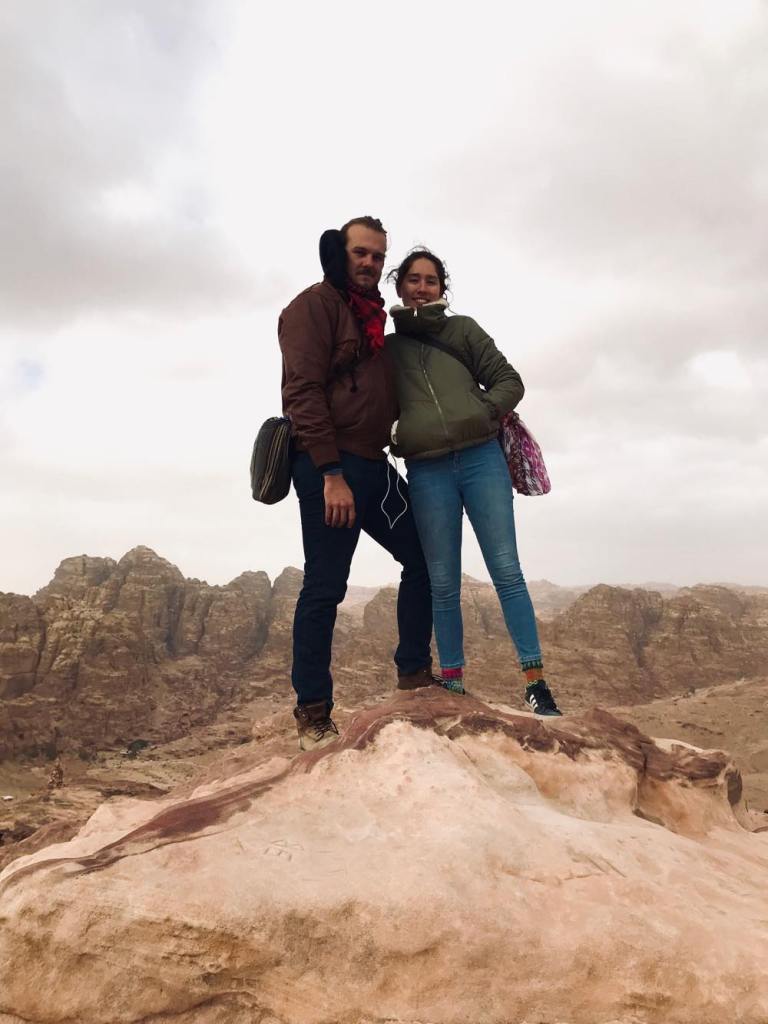
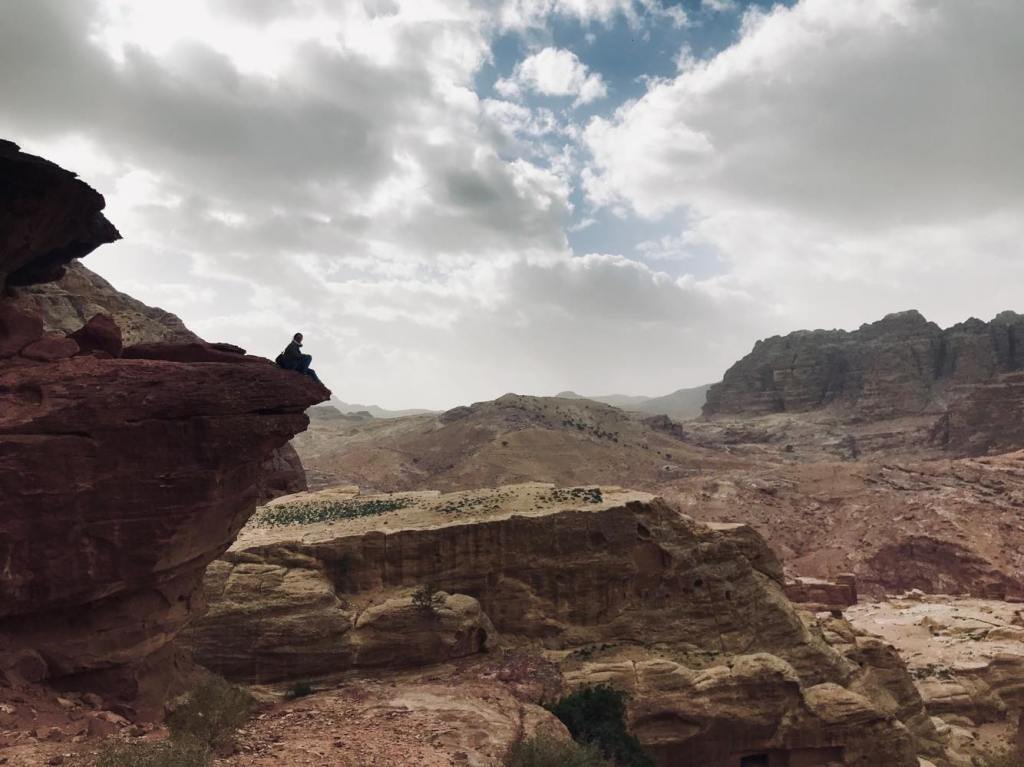
The first was in the morning. We went to the “High Place of Sacrifice,” a mountaintop altar designed for killing animals and collecting their blood. The walk to the High Place was mythical; we left the central paved colonnade early, surrounded by Bedouins on camels and donkeys ferrying overweight tourists, and walked up these ancient steps chiseled out of the mountainside thousands of years ago as the morning matured. The first leg of the ascent took us from the flatness of the main city to canyons that magnificently erupted out of nowhere, each turn giving us a new frame that put the scenery of the necropolis in to perspective. We reached the summit to find a flat, windswept opening that invoked the story of Abraham sacrificing Isaac: it is easy to hear the voice of God swimming between the dark hills and sand dunes. Mitsu played with cats and the universe did the rest.
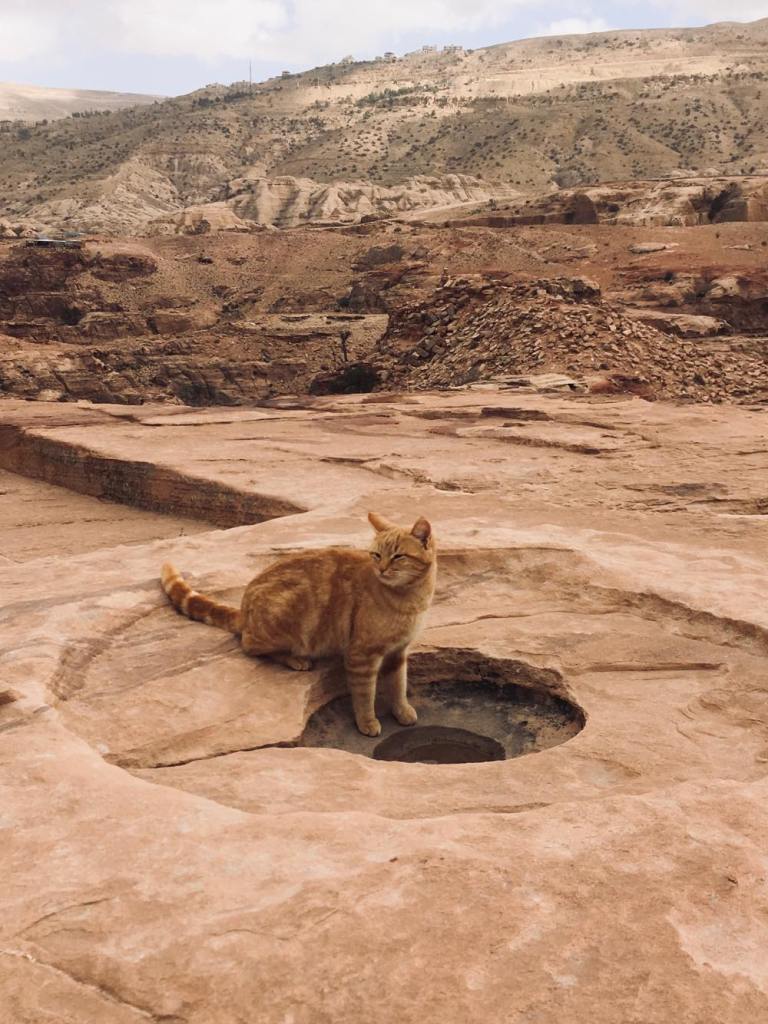
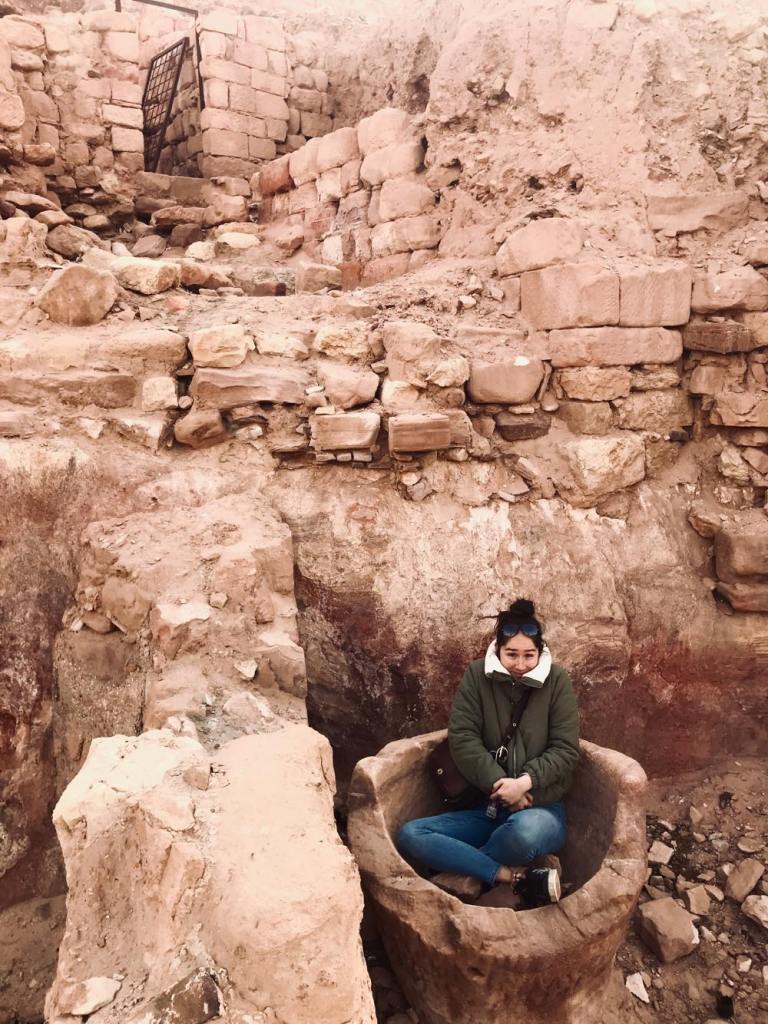
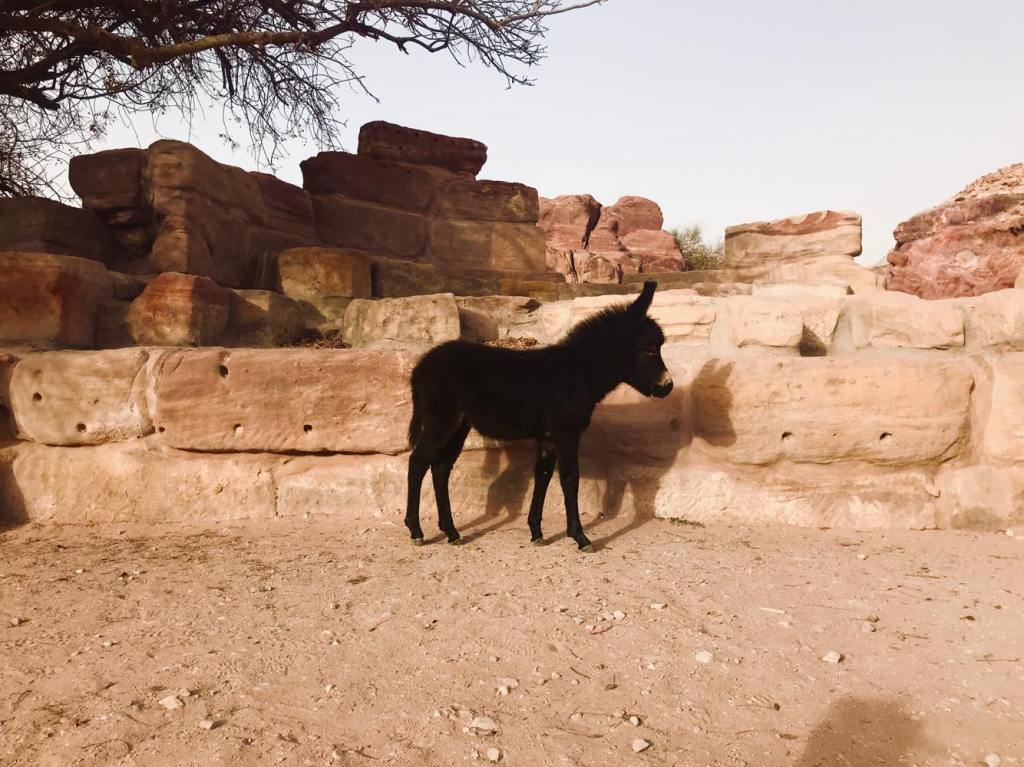
Most hikers return the way they came; we turned east and went down the mountain into a “neighborhood” of tomb structures, where the Nabateans ate feasts on top of the stone-enclosed coffins of their royal ancestors. We ate lunch in one of their tombs – poetry – and kept going down, exploring the small enclosures and their impossibly thick, subterranean darkness. Small caves that seemed designed to protect nomadic families from the darkness pocketed the countryside and small boys herding goats came by to say hello.
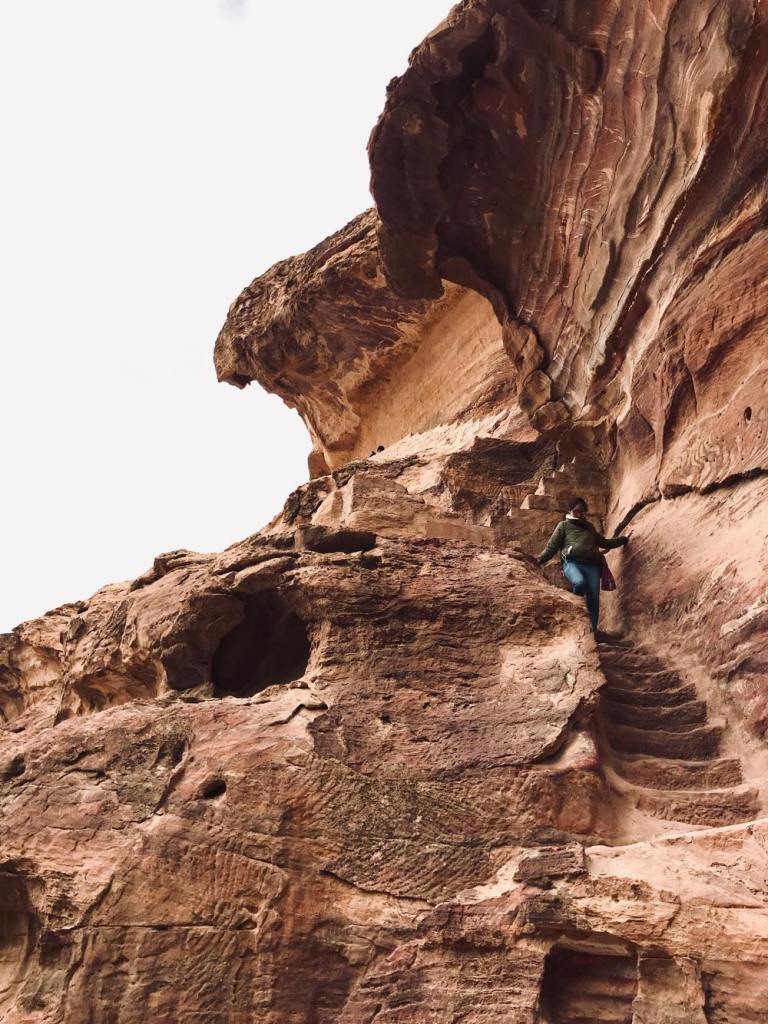
The second hike was to the Monastery. Like the Treasury, the Monastery is a columned facade carved in to the side of a hidden mountain, only tucked away at the peak of the back of the city. Our information was that the park officials wanted us out by 5, but the hike would take us two hours and we went for it anyways. Hustling up the never-ending steps, Mitsu and I walked past shops selling Bedouin trinkets closing up for the day, determined to see the final tomb. And finally, after sweating through our layers of jackets, we saw it: a sandy clearing at the top of the tallest peak and the vastness of the lower planet at the doorway of this impossibly huge tomb, untouched by the patterns of habitation that marked the Treasury. The sunset was golden and the dust devils that whipped up around us looked like showers of wealth absentmindedly discarded by an opulent regent. We sat in awe.
The sun set quickly. By the time we reached the central paved road, the countless mountainside tombs had disappeared into the darkness. Bedouin families, still living in Petra after all these millennia, lit fires for warmth in the graves of their ancestors, as they have always done. The Treasury was no longer pink, but silver and gunmetal gray. Light did not penetrate the winding passage of the Siq; above us, the walls of the canyon parted to reveal a river of stars, and it was so dark that I could not see my feet, like I was floating down a river in to a dream. At one point, two Bedouins lit a small fire in an alcove on the side of the passage, a window into the past colored dancing orange; a minute later, a rider on a black horse, his face unrevealed by the cigarette flaring in his mouth, trotted past us before breaking into a gallop, his presence more ethereal than human. The spell was broken slightly when he hit play on his phone, and a remix of “In Da Club” by 50 Cent blasted out of the speaker attached to his saddle, a reminder that the 21st century has spread to every corner of this world, like it or not.
For a few steps we were out of time, detached from the cause-and-effects of the world we live in. We’ll never forget it.
petra – stone (Latin)

 certification
Leave a comment