Friday 17 January: Day 190
Iraq is in flux.
The Parliament voted to expel American troops from Iraq immediately. The vote was technically a majority, but all of the Kurdish politicians and most of the Sunni Arab politicians boycotted the vote, so quorum wasn’t met. The vote was further complicated because the language of the agreement between Iraq and the Coalition forces stipulates that Coalition forces have a year after the vote to leave, meaning that the Parliament’s vote was illegal. Furthermore, the responsibility of rejecting the Coalition forces falls to Abdul-Mahdi, the Prime Minister. However, Mahdi resigned from his role in December (following months of mass protests) and only remains in a caretaker role, meaning that his authority to execute Parliament’s expulsion is dubious. In order to expel the Americans, Parliament would need to reconvene and swear in a new Prime Minister, but again, Sunni and Kurdish politicians are boycotting. The responsibility of clearing up this mess falls to the Supreme Court, which is also hamstrung by the same ethnic and religious divides as Parliament.
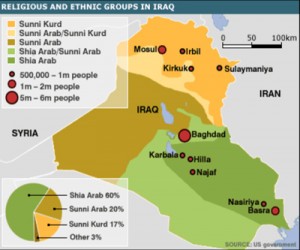
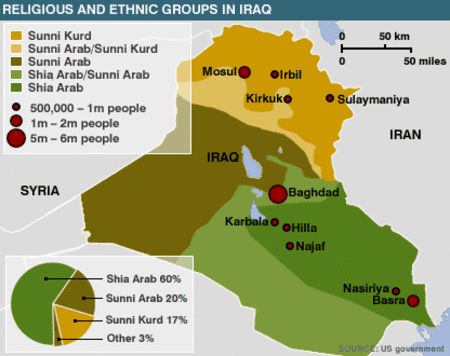
This is what sectarianism looks like. The gridlock is intractable. There is a lot of talk about formally splitting up Iraq: a northern Kurdish state, a central Sunni state and a southern Shia state. This would allow all three groups to have full autonomy over their own fate. But this solution has problems too. The Turkish government will never allow Iraqi Kurdistan to become independent, due to the precedent it might set for their own Kurdish population. The PDK, the Kurdish party controlling Erbil and characterized as a puppet of the Turkish government, is resisting talks of partition. The Kurds would also want control of Kirkuk, which has the lion’s share of proven oil reserves in Iraq and is thus heavily contested between Kurdistan and the federal government.
A hypothetical Shia-dominated state in Southern Iraq would have control over Iraq’s only port and would likely be the richest of the three new countries. Controlled by Iranian-sponsored politicians, southern Iraq would effectively become a satellite state of Iran, which both Saudi Arabia (which shares a border with southern Iraq) and the US would not tolerate. As the only viable exit point for international markets, southern Iraq would exert a powerful control over Iraq’s economy and in this light may only further Iran’s control over Iraq, which partition is supposedly a remedy for.
Central Iraq is majority Sunni and is also the least stable and least developed portion of the country. Without Kirkuk, central Iraq would be a resource-starved state which could very easily foster the resurgence of ISIS, which is still active in parts of central Iraq and is only suppressed by a combination of Coalition and federal troops. Without this support, central Iraq would depend in to chaos – and with no political clout, Sunni Iraqis would be left without Kirkuk and certainly without Baghdad, which is geographically located within central Iraq but is religiously Shia and would likely side with an Iranian-backed southern Iraq.
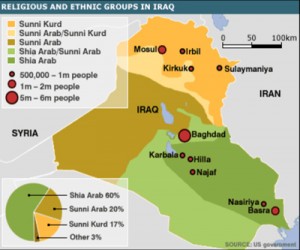
So what does partition mean? A simplified political arrangement, an independent Kurdistan and a framework for future stability? Or the beginning of inter-state conflict, currently held back by a weakened federal system?
Need to watch the news.
سەربەخۆيى – independence
Saturday 18 January: Day 191
It’s 9 pm. Mitsu and I woke up late and went to the gym, and then headed over to Radio Deng to record advertisements and our English Corner mini-lessons. We’ve spent the past few hours cleaning, eating dinner and catching up on our writing. And the reward for our hard work: a cheese board. We found cheddar, gouda and blue cheese, all imported, at the Carrefour in Suly. We’re feeding each other cheese and crackers and watching the Mandalorian, coxed up by the heater under blankets, feeling blissfully domestic. This is what we’ve been craving for a month. This is perfection. Baby Yoda is our spirit animal.
خاو دەبێتەوە – relax
Sunday 19 January: Day 192
Insha allah. Before I left, my uncle told me that I would get used to hearing this expression. Still haven’t.
It literally means “if God wills it” and is commonly used wherever talking in the future tense. Faithful Muslims say it as a reminder to themselves and others that “the Lord giveth, and the Lord taketh away.” In Kurdish (and maybe Arabic?) there is no “hard future” tense like in English.
Let’s say that I hold my phone over the balcony. If I drop it, the phone will smash on the ground. I will feel like an idiot, and I will go to the store to buy a cheap burner phone and think about what I’ve done. Three “wills,” all of which are used correctly in English. The laws of physics dictate that the phone will fall and break, my past experience leads me to believe that I will feel like an idiot, and a rather complex combination of experience, reason and cause-and-effect says I will go to buy a new phone.
Short of God having mercy on my stupid decision, the phone is going to fall and smash. Saying “God willing, the phone will fall” is redundant. And saying that “I will feel like an idiot if my phone falls” is a conditional – if this, then that. Perhaps God will strike me dead before the phone hits the ground, but barring this unlikely circumstance, it makes little sense to say “God willing, I will feel like an idiot.” More likely is that something awful happens on my way to buy a phone – only here does it *kind of* make sense to say “God willing, I will buy a new phone.”
The problem is that many Kurds don’t see the difference between the three circumstances – or perhaps more insidiously, believe that seeing a difference is proof of a lack of faith. So they say “God willing” regardless of what future circumstance is taking place.
As a teacher, this is infuriating. When I give homework to my students. Some of them say “Insha allah, I will do it.” If they sign up for a mandatory exit interview, they say “Insha allah, I will come.” I understand that Muslims give supreme deference to God’s plan, but in English, this just sounds passive aggressive.
إِنْ شَاءَ ٱللّٰهُ – insha allah (Arabic)
Monday 20 January: Day 193
And now, that feeling sets back in, that rhythm of life: the schedule, the expected rarely punctuated by the unexpected, the alarms and mounting responsibilities. I can’t say I’ve missed it.
كێش – rhythm
Tuesday 21 January: Day 194
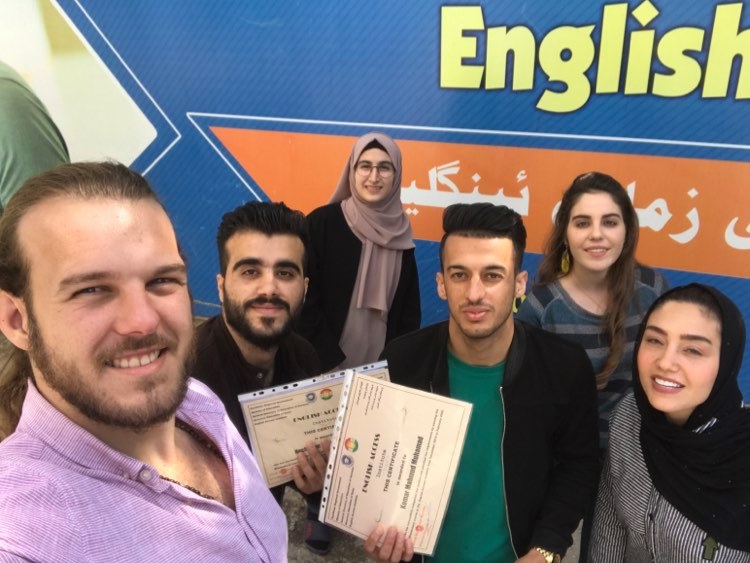
One week left of the class that started back in November. Their final exam is on Sunday, we’ll have a small party on Monday and then we say goodbye.
Level 2 is interesting. Each level of English class has different characteristics, almost like personalities. Level 1 students are scared and hesitant, sometimes resentful (if they have studied English before) and often embarrassed to try and make words with strange new sounds. Level 2 students are often relieved, excited to see their hard work paying off and eager to learn more. Level 3 students are beginning to se that “math” behind more complex grammatical ideas – they become scared again, and they put their noses to the books, ready to be through this difficult phase of their education. Level 4 students have made it – their conversation and writing ability may be weaker, but generally they are confident in their understanding and capable of expressing abstract ideas. And Level 5 students are basically just in class to relax.
I’m going to miss this group. Teachers learn a lot about humans and relationships in the classroom, and these students are great teachers in that regard. I hope they come back for Level 3!
هەڵوێست – attitude
Wednesday 22 January: Day 195
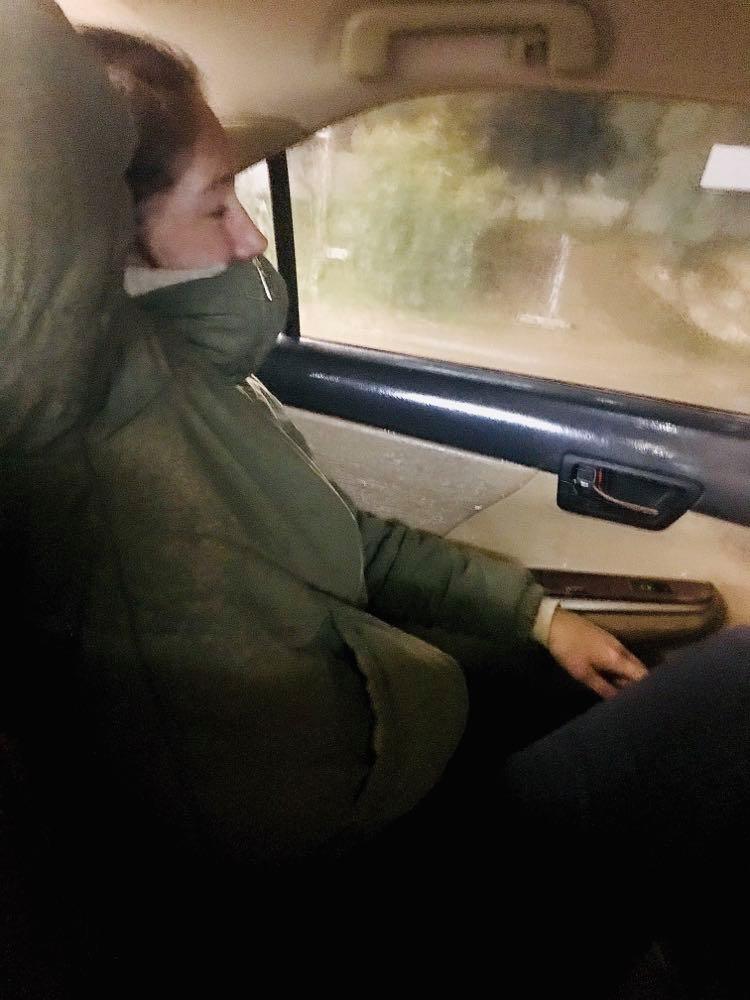
Woke up at 4 am. Climbed in to the back of Aram’s car, head rolling with the turning of the wheel, jolting me awake. Arrived at the Ministry of Education in Erbil at 11 am.
Today is the day that 7 months of work potentially hangs on. We’re meeting with the technocrat responsible for approving licenses for applications to open new private schools. This person will decide if Mitsu, Akam and I will be able to start the first English-language, progressively-minded K-12 school in Kalar. This is an important meeting.
Well, the Minister wasn’t here today – it’s 11 am on a Wednesday, mind you – and neither is her assistant. Who works before noon on a weekday, anyways? Thankfully, her assistant’s assistant was in the office. He was nice enough; interested in our project for altruistic or potentially profitable motives, I’m not sure, but regardless he spoke to us for over an hour.
Here’s what we learned. In 2016, the Kurdish Regional Government (KRG) realized that a total lack of regulations had allowed tens of thousands of “private schools” to open throughout Kurdistan. Half of these schools were flat-out fake, creative solutions around a residential property tax or regulations requiring businesses to pay taxes for selling coffee but not if it’s “out of a school.” The other half were schools in the loosest sense – backyards where religiously orthodox families kept their children during the day to avoid the harmful effects of education, for-profit institutions that make Betsy Devos look like Mrs. Rosewater, “science academies” which preach that evolution and climate change are false – shams like that.
So for the past three years, the Kurdish government has placed a moratorium on all new private school licenses. This may seem like a rational response, as the government is now committed to reviewing existing licenses to verify their accuracy. In theory, they are in the process of amending the license requirements and will publish them at the start of April, giving new applicants (like us) a two-week window to submit applications before Ramadan begins and the application window for 2020 closes.
The assistant’s assistant is giving us hope that we still have a chance to submit our application and get it approved, and he sends us over to the Engineering department to review the schematics for that hotel we found earlier. The engineer tells us that any new kindergarten must have a 4000 square meter area, or property the size of the White House. In Kalar, that’s impossible to find. We know – we’ve been looking. She tells us that we can buy an existing license – several dozen are held by party elites who dispense them to relatives or vassals for political power and profit. We’ve already been approached by an interested sponsor. He wanted $1 million and 60% of the revenue.
So that’s our situation. Akam, Aram, Mitsu and I left the Ministry utterly deflated, unsure of where to go next. I’ll revisit this soon.
وەزارەت – ministry
Thursday 23 January: Day 196
Positive thoughts.
In April, Mitsu’s parents Jim and Susan will visit us. We’ll check out Kurdistan for ten days and then fly to Rome for a week. I’ve never been to Rome. Apparently there’s a sunken Roman city we can scuba dive around and we’re hoping to check that out. Jim and Susan will head back east, maybe to Kurdish Turkey, while we spend a combined week in Florence, Vienna and Prague. Finally, we’ll meet up with my mom in the Netherlands for two weeks around Mother’s Day before returning for the summer classes.
Focus on positive things.
بايەخ – focus
 certification
Leave a comment