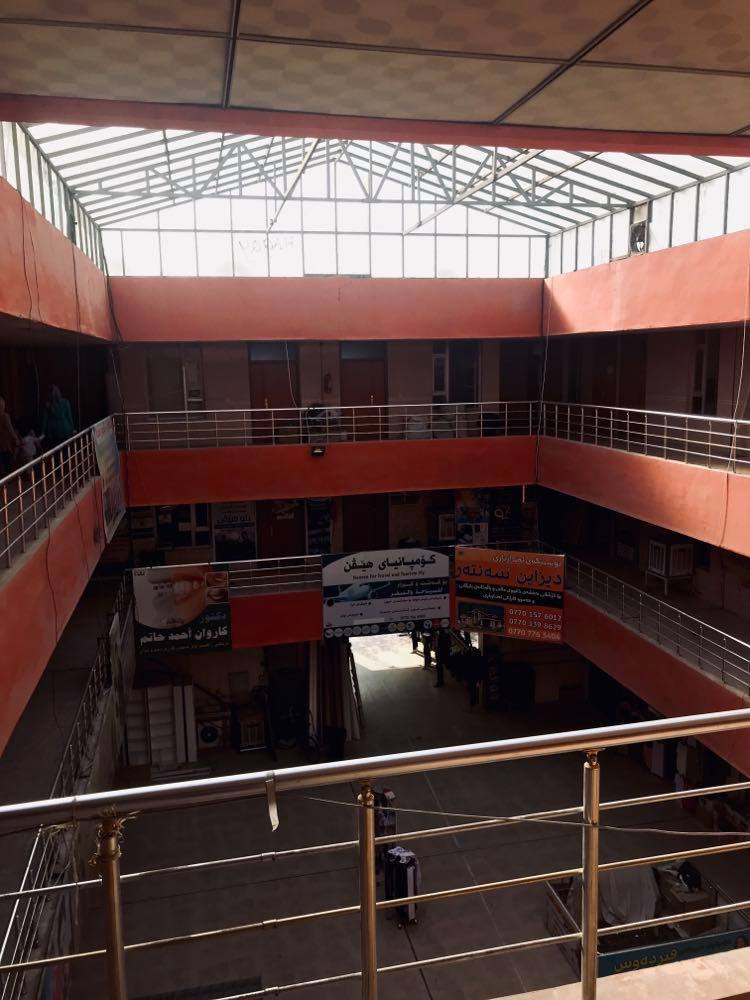
Friday 24 January: Day 197
Sometimes my students will be reading a passage and see the word “bar”, say “cafe” instead, and continue with their passage. It’s funny because they already know what the word means – how else would they know to skip over it – and it’s almost like not saying the word will protect them from its evils.
Another commonly skipped over word is “gambling.” Gambling is a sin in Islam, much like wasting money on selfish frivolous things is a sin in most religions, and even playing games is considered by some to be haram. I find this ironic. Kurdish men don’t usually wear seatbelts when driving and never wear helmets on a motorcycle. If there’s a car accident, people will die as a result. Isn’t that also gambling?
قومار كردن – gambling
Saturday 25 January: Day 198
At the cafe.
There is no ventilation here. The smoke of two hundred water pipes creates a humid atmosphere, a living demonstration of the greenhouse effect, each set of lungs a billowing smoke stack which buffets and adds to the aggregate pollution. Laughter sends out haze in waves, which distort under dim colored light in swirls like milk poured in coffee.
Ali is telling us about his favorite books and movies, but then we cut to it and he’s sharing his doubts, his petty self-hatreds, his dreams. English is the medium of his honesty, an accent Californiaized by all of the movies he watches, and the usual pride which shelters men’s emotions doesn’t have any vocabulary – he’s real and vulnerable, each sentence a cry for help and a victory over loneliness. Has anyone ever talked to us like this kid does?
پياو – man
Sunday 26 January: Day 199
Chickens get their wings clipped and are placed in revolving guillotines with the silhouette of a revolver’s chamber, seven little scared birds clucking away before the butcher uses an axe to sever each one with a single blow. They are lowered in to boiling water still alive, hand around the neck, to make plucking their feathers easier. Chicks are boiled in oil and, once dead, cut apart for fresh, tender meat.
Goats and sheep are hung upside down and then cut at the neck, their bodies spraying blood on their clean coats. Their brothers and sisters watch in nearby open cages, the blood splattering on their faces. And then it is their turn.
For religious ceremonies, the animal – often a cow, but occasionally a goat or a sheep – is sacrificed. This involves a family gathering around the panicking, scared animal and praying over it while the blood is drained from its neck.. Muslims believe that when cut in the exact correct place, the animal feels no pain. If this is true, then the animal simply bleeds to death, fully conscious, while watching children and parents praying over its dying body. The scene reminds me of a Purge movie: a father is paid $10,000 for his daughter’s medical bills in exchange for allowing himself to be sacrificed by a wealthy family, who all stand around him and pray (holding hands) before taking turns hacking him to death with a machete.
And this is just what I’ve seen, or what close friends have shared about their family’s experiences. I’ve also seen dozens of videos showing animal abuse, passed around with the same locker room masculine ego that boys talk about one-night-stands with back home. The contents of these videos have given me nightmares and I don’t need to write them down to remember them. I have no faith that all meat sold to me in Kurdistan is ritualistically slaughtered or is at least allowed stillness in its final moments.
And at the end of the day, the only justification I have to eat meat is for my own pleasure. Meat is delicious. I can’t pretend otherwise. But I can find protein in other places. I don’t need to create more suffering on this planet for my own pleasure.
I’m giving up meat on my 25th birthday.
گۆشت – meat
Day 200 – Mitsu’s Day 200 Update
The penultimate day of our level 2 class is supposed to be a “dialogue project.” The idea is simple: I want to see that my students can be creative and have fun with English, and are confident enough to stand up in front of the class and be silly while practicing their language skills. I ask every student to work with a partner for an hour and write a 2-5 minute dialogue. The only rules are that they must speak entirely in English during the writing process, and that their dialogues be entertaining and that they play a character who is not just them with a different name. This project has had varying degrees of success. invariably, someone tries to cheat and read a Googled script, which becomes abundantly obvious when students start using far more complicated vocabulary than I know they are capable of. Some students phone it in and dink around with their partners the whole hour of preparation time, and are giggly and embarrassed by their lack of effort when they perform. But usually, the scripts are good, if not a little bland.
This Elementary class, however, did not disappoint. Their numbers have dwindled significantly after our vacation in Jordan turned into a month long absence thanks to our evacuation. The students that remained are great – hard workers a lot of heart. I’ll miss them a lot.
For the dialogues, they split along gender lines – the two 20-something ladies pairing together, while the two high school boys and the businessman made a group of three. One woman and one boy in particular are particularly talented in English, and both have abundant wit and leadership skills, so I knew that they would take charge and work some magic. I wasn’t wrong.
The boys wrote a silly, cute script about a bumbling teacher and two high school students. The teacher pompously ignored every difficult “gotcha” question the impish boys threw at him, and one of the boys bribed the other so he could cheat off of his test answers – only to have the more studious boy steal his money and leave him high and dry. We were all laughing, performers included. Kurdish people can be quite serious sometimes (we always joke that we don’t know if we should smile or not in pictures we take with our friends here, so we always have to ask “American faces or Kurdish faces?”), so it was amazing to see three men being so lighthearted and jovial. They all got great scores.
The tone of the ladies’ presentation couldn’t have been more different. They chose to write about the different problems that women face within Kurdistan and Iran. The first woman, a Zoroastrian born in the western (ie Kurdish) part of Iran, talked about how her neighbors and coworkers in Iran treated her “like a dog” when they found out that she wasn’t Muslim, and that the police constantly hounded women for the way them dressed in public, or harassed them if they went out without a man. The second woman played a war widow, and talked about being repeatedly sexually harassed at work, being stalked online by men who met her on the bus, and how she was afraid to wear colorful or attractive clothes in public, not for religious reasons or because her family would care, but that if she did, men would gape at her in public or catcall her. She told me after class that the last part was true.
“My father is a very respected mullah, but he doesn’t care what I wear. I think he wouldn’t care if I didn’t cover my hair, or if I wore more revealing clothes. It’s not his business.” She motions to her dress, which is modest in cut but cotton candy pink, and says “the only reason I wore this dress today is because my brother drove me here. If I took the bus, I would wear all black. If I wear something like this, men try to sit next to me or touch my leg. They think I must want attention. I just want to wear a pretty colored dress.”
If there’s anything I’ve learned here, it’s that not only are ideologies, even powerful ones like religions, not monolithic. It’s that even the same choice – to wear modest clothes – can be motivated by a litany of different reasons. I know for a fact that some girls here cover themselves because their families have told them they should. I know other girls cover themselves because it is required by their faith, and others that do it as a marker of their devoutness. But that was the first time a woman had said this to me – that it’s a way to be invisible to predatory men.
I didn’t quite know how to respond. I told her that Kurdish women need to learn the African woman stare – the one that makes leering men transform into sheepish boys by just a mere glance. The look that manages to convey the phrase “you ain’t shit, boy” in the most emasculating way possible with the flick of an eye. I told her that Kurdish women need to laugh at men who look at them that way and say “Wait, you think YOU have a chance with ME. You must be dreaming.” Turn your humiliation into their humiliation. But really, it’s a problem that can only be solved by teaching boys, not men. It’s a hopeful sign, then, that the two high school boys nodded in agreement the entire time the women were talking, and said that women face too many difficulties in Iran and Iraq. That things need to change, that it’s not fair. I doubt these two would open mouth stare at a woman at a woman wearing a red dress on a bus. Let’s hope they’re representative of their generation.
Tuesday 28 January: Day 201
Korbani – I sacrifice myself for you. I’ve been trying to figure out what this means for months. When Kurds greet each other, they fire off several greetings immediately, talking over each other and smiling humbly. They naturally care about their manners, it doesn’t feel like a forced kindness. I love it.
Korbani is the big gesture. When Abraham was commanded by God to stop his zealous sacrifice of his son, God gave him a sheep instead. God said that the sheep was a placeholder sacrifice for the son.
Kurds say “korbani” to remember this. It literally means, “take me as a sacrifice so that you don’t have to lose something you love”. And it’s always said earnestly. I love it. I love this place.
قورباني – korbani – “I sacrifice myself for you.”
Wednesday 29 January: Day 202
A busload of oil workers was kidnapped in Diala, about 45 minutes southwest ok Kalar. ISIS is claiming responsibility. The workers were all native Iraqi Arabs, so the joke going around Kalar is that the kidnappers took one look at the workers and realized they wouldn’t get any money from them. Not sure what happened to the poor men.
Bad joke.
نوكتە – bo kye – joke
Thursday 30 January: Day 203
The water collecting in the dirty street cracks is frozen. Men are bundled in several coats and put their hands back in their pockets between drags of their cigarettes. Women wear several layers with their dresses, their hijabs wrapped tightly around their necks between faux fur collars. Visible breath and car exhaust mingle in a contiguous eye-level haze. Kalar is below freezing.
The generator is dead. Our heater is off and national power shows no sign of coming back on any time soon. Schools are closed – we fumble through competing requests to close the institute and keep it open. We’re wearing three layers inside. No one is coming today.
Well, one man comes. A Syrian refugee, a Kurd from Rojava, comes to our door. He speaks a gruff Kurdish that is strange to Chaman’s ear. He wants money, and at first he won’t leave. His beard is dirty, his skin is leather-tan, his clothes are impossibly thin and unsuited for the cold. We stare at him in silence. What are we supposed to do? He turns, eyes glazed, back to the cold.
سارد – sard – cold
 certification
Leave a comment