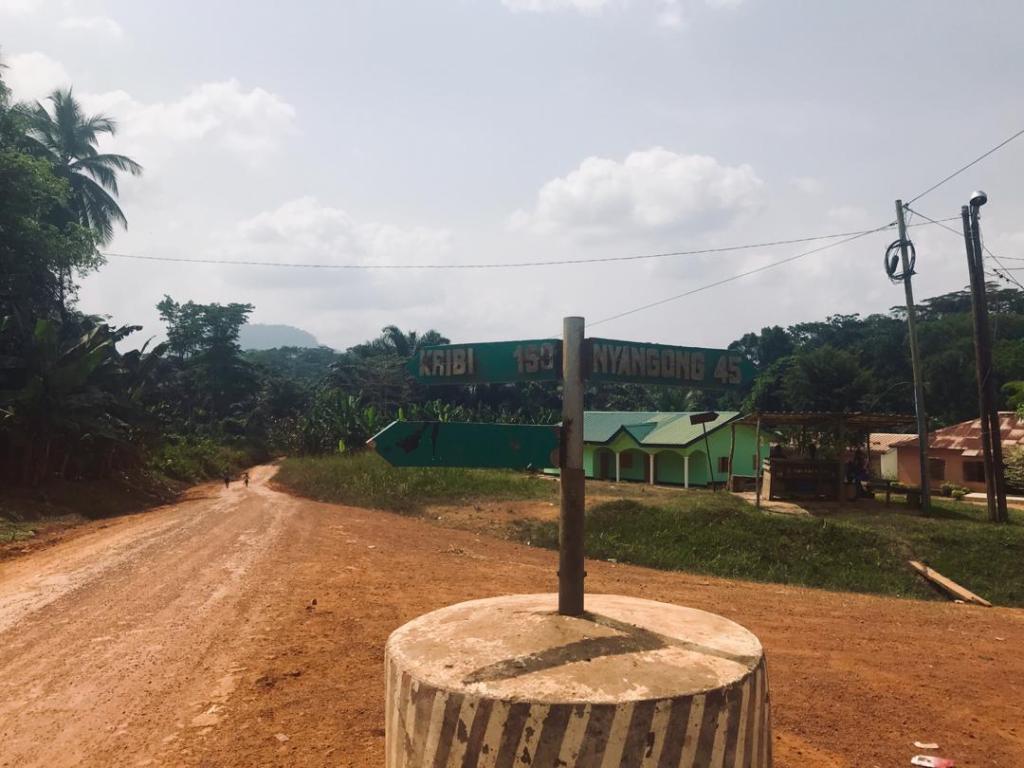
The third part of a five-part story of a long walk.
Sunday 27 December: Ebolowa
8:30
Emotional and sensory rollercoaster the last few days. Let me remember…
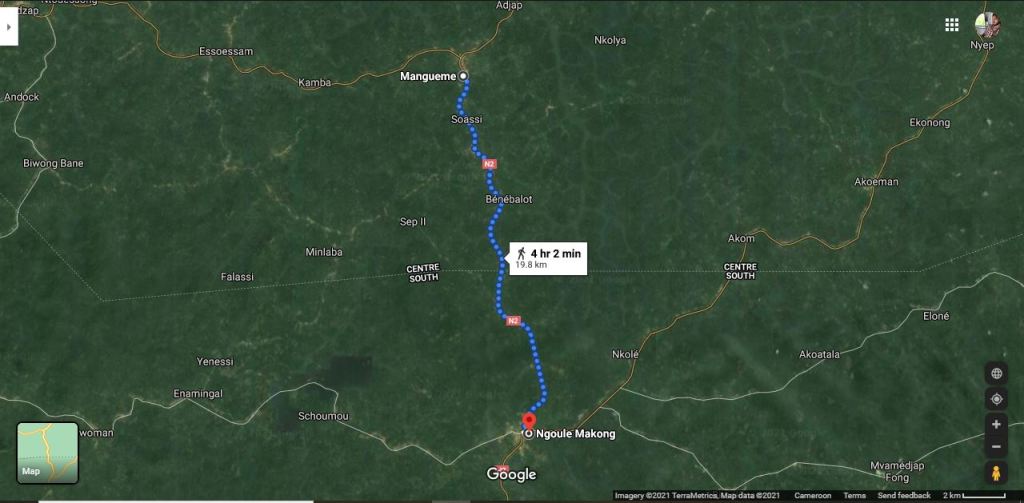
On Christmas morning, I walked 20km to Ngoule Makong. The air was thick with fog, giving the windy trunks and snaking vines this otherworldly origin, as if they belonged so some great sea monster beyond the veil. I started noticing these tiny birds, no larger than my hand, that can hover and flutter with impossible alacrity. They will land on the side of a tall stalk of grass, bending it slightly downward with their little frames, so that the grass shapes from an “I” to an upside-down “J”. As more from their flock join them on the stalk, it bends to an “n” and then all four birds fly off like miniature helicopters, so very exact in their movement.
An hour after leaving, I passed a small Catholic church in the countryside. Soon afterwards I noticed one, then two, and then dozens of people walking towards the church, all in their best and brightest attire. Everyone waved hello to me, saying bonjour and jeaux noel, their smiles wide and sincere. A nice family called me over to their home and offered me hot coffee, freshly baked bread (not everything about the French presence here was evil), and a chunk of lean, well-seasoned pork. The oldest woman was impressed by my journey and taught me Mbakiri, the Anawudu word for “good morning.” I practiced the expression by saying hello to church-goers passing the home, seeing big smiles from far away. Leaving full, I started saying the new phrase to everyone I met, getting lots of laughter and hand shaking as I passed.
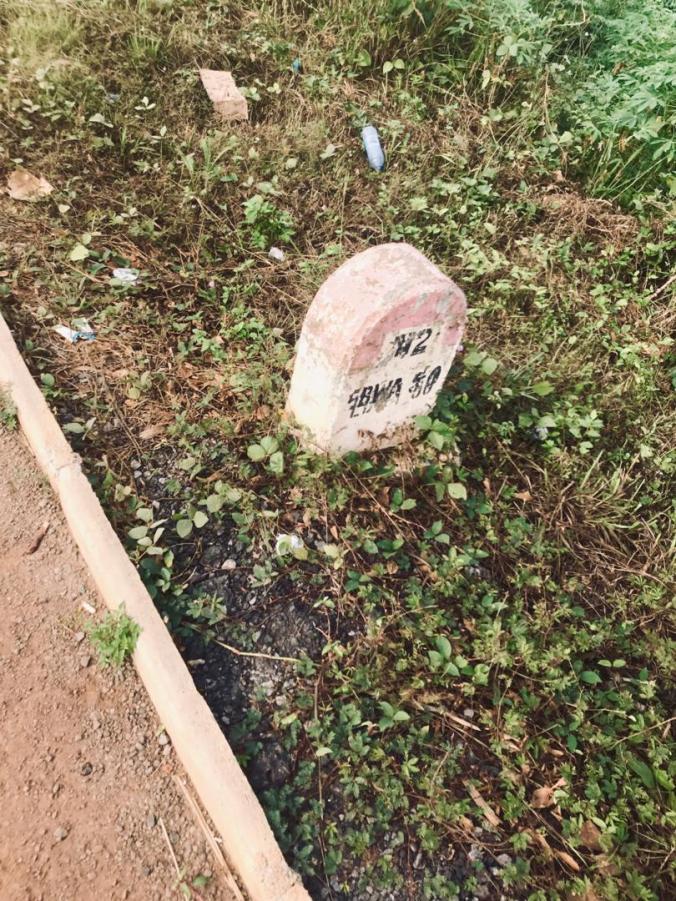
I arrived in Ngoule Makong hours later. My thighs were raw from chaffing and I sat down at Chez Alphonsine, the first restaurant on the road into this small town. Some church-goers had given me a fresh papaya earlier – I cut it open and cleaned out the seeds, and offered some to the elderly Alphonsine in broken French. Meanwhile, a man with a sweat-caked shirt arrived and recognized me from a brief rest I took outside Mbalmayo, nearly 100 km further north. He paid for my lunch, and I gave him some papaya.
The only hotel in town had a vacancy and the proprietor was at church, and the young boy watching the place didn’t have a key, so he grabbed a hammer and smashed open the padlock of two rooms to let me in – the first room was already occupied.
…
11:45
In the evening I returned to Alphonsine’s restaurant. She spoke in that lovely, grandmotherly way that all Cameroonian grandmothers have spoken to me so far, slowly and clearly enunciating her words. I ordered dinner, rice with pork, and started dancing around the dirt lot adjacent to her restaurant so that I could find a decent enough connection on my phone to call home and wish my mom a Merry Christmas.
Rose approached. She was tall and lean, dressed in her Christmas best with a gold laurel running through her bob cut. Her four-year-old daughter clutched her hand. She tried to make conversation in a smooth, handsome accent and then sat down at my dinner table and waited for me when I was finally able to reach mom. Our call was unfortunately short, so I went to join her.
Rose and I spoke in my broken translate-write-attempt kind of way. The pork was lovingly cooked but was mostly thick, fleshy fat, unfortunately, which brought back memories of Christmas in Rwanda two years ago. I picked at my food while talking to Rose about her children, her schooling in Yaounde, and my hike so far. When I couldn’t stomach the pork flesh any longer, I accepted Rose’s request to escort the two back through the unlit dirt streets. Her family – father, two sisters, one brother, close to a dozen children – greeted me warmly, but as no one spoke English I struggled to follow their conversations I turned my attention to the French-dubbed Mexican and Nigerian telenovelas, waiting a respectful time to leave.
When I stood to go, Rose waived her family goodbye. Confused, I asked her where she was going; “to meet some friends in town,” she said. Walking across the grassy field leading back to town, she said that she wanted to go back to my room with me. I was a little shook, as I had told her about Mitsu and some of the far-flung places we’d been together in what I thought was reasonably clear French, so I told her that I just saw her as a friend. She laughed and continued on with me.
As we got closer to the hotel, I stopped and asked that she go back home. She was angry, and said that she needs money badly, but she turned to leave. I hastily went to my room and turned the two bent nails against the door (which is how people lock doors around here). Less than half an hour later Rose returned to my room, sobbing, yelling that she was sorry but needed the money, that she would do anything. I was afraid this would happen. Still dressed, I went outside and hugged her and led her back to the dirt path. My backdoor is locked and boarded up. I gave her my number for her family to share on their single shared smartphone.
Sure that she was gone, I sorely waddled back to Alphonsine’s restaurant, a full week’s worth of exhaustion suddenly felt squarely in my blistered legs. I needed a beer.
…
12:30
Boxing Day would not prove to be any more relaxing.
I left Ngoule Makong early, ready to be gone of the town and the bad dream that was the night before. Nemeyong was 22km away. It was not easy. The first hour always feels the best. I can stand straight, my stride is long, the weather is cool. The large town gave way to metal shack exurbs and then mud wall villages soon enough. I continued listening to Peter Singer’s The Life You Can Save. I danced to Cameroonian hits. Anything to get my mind away from the broken mother from the night before.
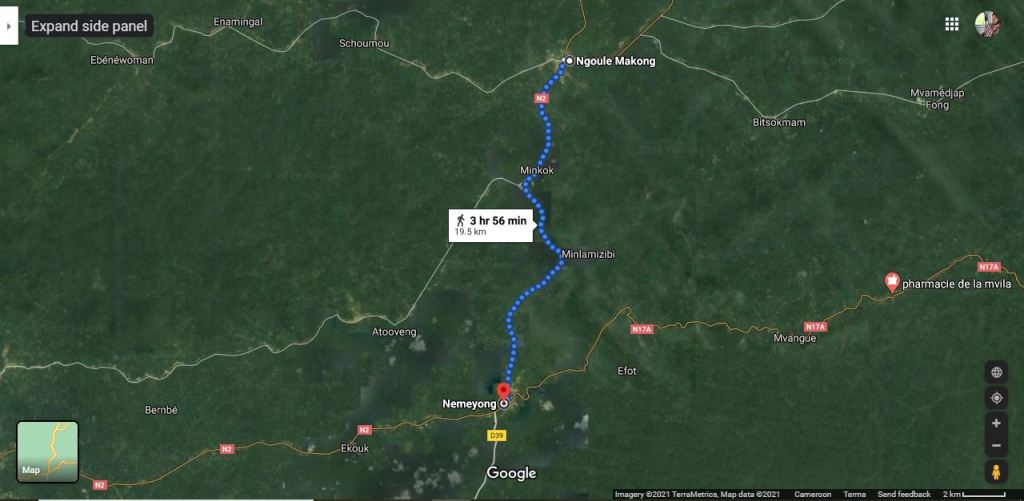
This time, the fog was oppressive. My was as dark and sticky as my friend’s from lunch yesterday. I could feel myself growing flush and lightheaded. A small, isolated wooden shack emerged like an oasis about halfway through my hike; a boutique, with fresh water and fluffy bread with margarine as a snack. Later, a single plank of wood balanced on two cut tree trunks was enough to justify a rest. A friendly father stopped at my side and walked away from hearing my story gleeful, offering a cigarette out of admiration.
I arrived in Nemeyong around 2:00 in the afternoon, later than I would have liked. I picked a tidy little bar to rest in and ate a wonderful lunch of fried plantains and the popular fish-heavy vegetable mush, slowly sipping a cold beer gifted to me by the elderly matron of the bar. For a moment, everything was peaceful.
Sitting with the matron, telling my story, the crazy drunkard of the town approached for the first time. He just kind of wavered, mumbling, before loudly exclaiming something strange in French. One of the other guests at the bar explained that he wanted to take my skin and become white. The matron waved him away, but he started humping her leg – which she and everyone else at the bar laughed at – and he told her (explained to me later) that he wasn’t going to leave until I bought him food.
The man was evicted by several of the guests at the bar. People resumed drinking in peace. The matron’s brother and sister, on their way to Ebolowa to return to school, stopped by to say hello. A fat man wearing trainers that were folded down on the side to show off a rusty pistol sat down to visit with the family. His two young prostitutes followed and squealed when they saw me; one rested her arms on my shoulders and another stepped over my backpack to sit on my leg. Noticing the white man, now, Tracksuit Man turned and asked who I was, explaining that he was part of the Gendarmerie and wanted to “retrieve me” from the bar in two hours. At that exact moment, a wiry septic-smelling arm cut between our conversation and slammed a maggot-writing bowl on the table, causing both of the girls to scream. The cool-headed matron started arguing with this arm’s owner, the crazy man, who was now demanding food while simultaneously sipping from one of the plastic whiskey packets that are so popular in Cameroon.
The Tracksuit Man forced the drunkard to leave, delicately picking up the food container while clutching his putrid brown shirt collar and walked out of the bar with arms extended like he was stepping out from behind stage curtains, his prostitutes following behind. Great introduction to the local security force.
By now I was feeling pretty whiplashed. The bar matron sat down across from me and started asking about Mitsu in a forward way. I just wanted some quiet, but another three friends of hers entered the bar and the matron’s attention immediately shifted to them. One of the men asked me to buy him a beer, and I said no, but the matron had apparently committed me to buying a round for everyone in the bar. I tried to explain that I couldn’t afford that. She didn’t respond positively. Now I had three men and one unhappy lady speaking to me in rapid-fire French and Anawudu at me, and moments later that lovely man returned, adding his contribution to the chaos: he grabbed his now-exposed member and started shouting “N***** N***** N*****” at the top of his lungs.
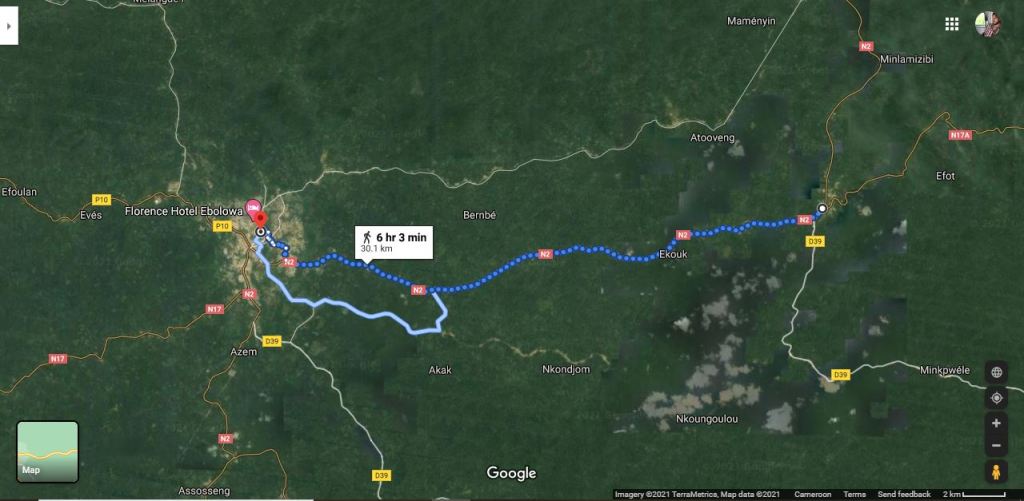
That’s the moment I gave up on Nemeyong. I settled my bill (with difficulty) and jumped on the bus that was pulling out of the town square. I would need to find a place to sleep in Ebolowa.
…
13:15
I found a room easily enough – 10000 CFA for two nights, half of what I was quoted for a room in Nemeyong. The guys behind the counter even offered to do my laundry for me (although this was probably for the sake of their own business – I was filthy). I found a small restaurant owned by Jean-Marie, a diligent business owner looking to practice his English. His cooking was excellent: fresh, fluffy bread, rice with onions, a chunk of grilled chicken and this rich peanut soup with leeks and pepper, probably the single best dish I have tried in Cameroon so far. I promised to return in the morning and went to sleep on a mattress that was so think I couldn’t even feel the wood slats underneath.
…
My clothes are drying and now laying out on my bed waiting to be folded. I got to have a wonderful breakfast of omelet and anchovies and more of that perfect fresh bread, taking breaks from chatting with Jean-Marie about his travels around West Africa (“We are all one country, you know”) to stand outside and watch old men play this large, graceful version of Mancala locally known as Songo. I will return to Jean-Marie’s place for dinner and a beer. Ebolowa has been kind to me.
…
 certification
Leave a comment