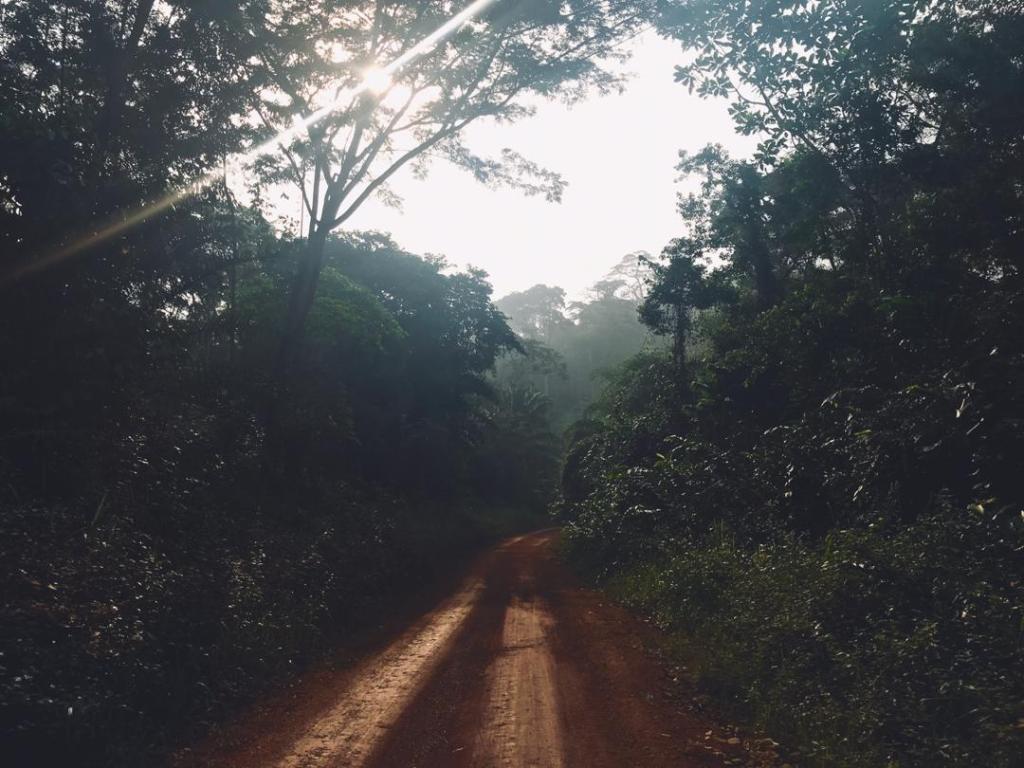
The penultimate chapter of a five-part story of a long walk.
Tuesday 29 December: Mefo
17:00
The medicine I use to treat my chaffing is Faustian. The pain of application is like sitting on hot coals unprotected; this feeling is the antiseptic purging the sore and helping with clotting, but it lasted today for almost half an hour. Wouldn’t wish it on my worst enemy.
…
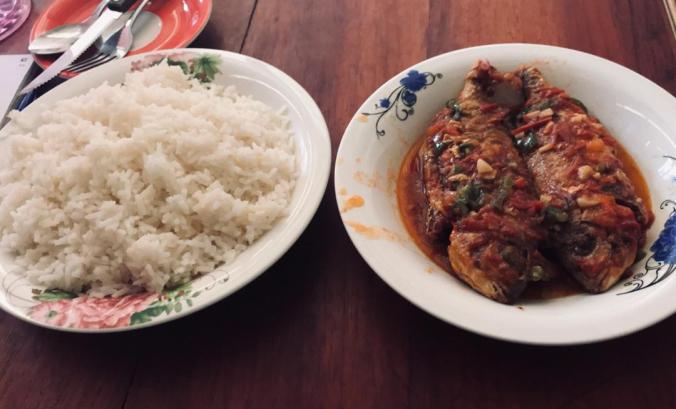
I spent my second evening in Ebolowa with Jean-Marie. He prepared two fish, boiled in palm oil with peppers and onions. The bones were crunchy but chewable, while the meat was buttery and the skin was transformed into this crispy, rich succulence (like Persian moms do with rice at the bottom of the pot). Jean-Marie closed up early, around 5, so that we could get drinks.
He is an earnest man. In an earlier life, he travelled to Ghana and became captivated by the Pan-African Council for Development and Peace, the same organization that Kwame Nkrumah founded over 60 years ago. With the organization Jean-Marie attended conferences in Senegal, Cote D’Ivoir, and Burkina Faso; he led seminars at universities in Chad and Nigeria; he spoke to the President of Equatorial Guinea promoting the PAC agenda.
After some time, Jean-Marie ran out of money. He returned to Ebolowa to be near his child and run a small business. I can tell that he wants to continue this kind of NGO work,that he still hungers for it. He told me that he wants to start an organization this year, Peace in Cameroon, but afterwards will grow the organization into Peace in Africa.
Bon chance, Jean-Marie.
…
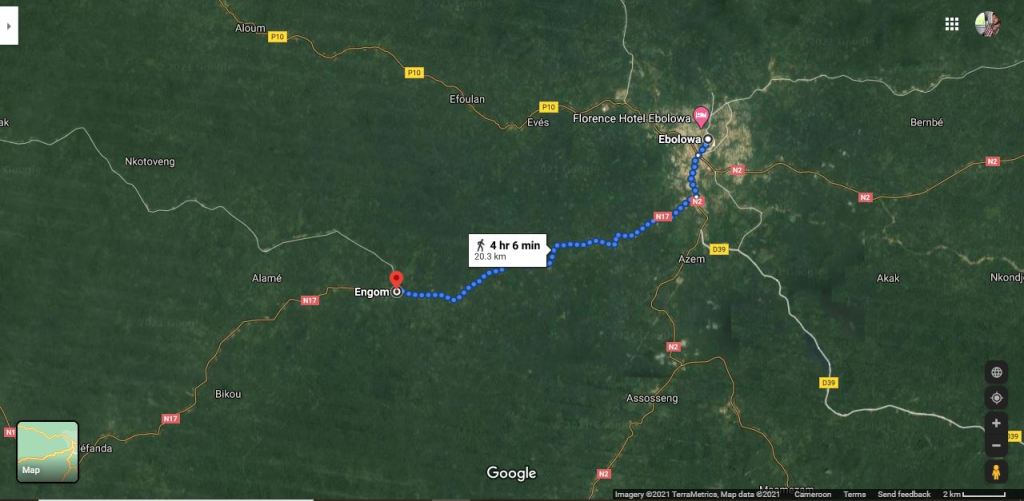
I left early. The road leading west out of Ebolowa is dirt the entire length, with homes and shops lining the banks of the path. Dirt roads are easier on the knees for walking and with less high-speed traffic they are significantly safer. This is good.
Breakfast – bread with margarine and Nescafe. A family eating at the table near me had heard of me back in Ngoule Makong.
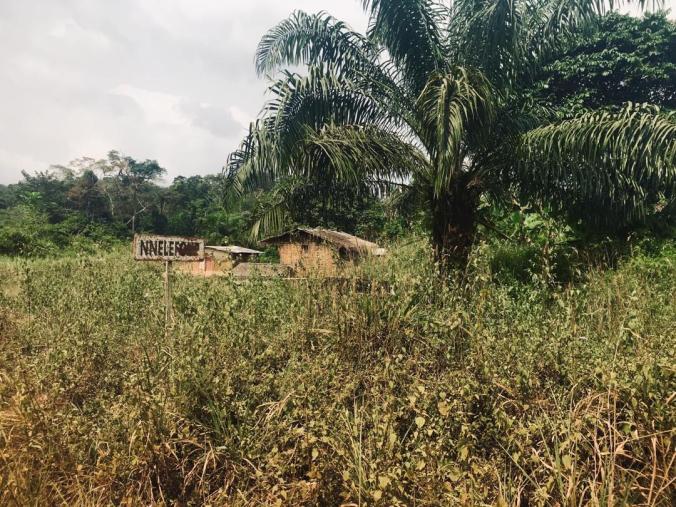
I felt strong. My back no longer ached from the weight of my pack. Steps were not burdens. The climate changed dramatically – still humid, but constantly cool, and shady from slow-rolling clouds and a nearly permanent canopy of trees covering the road.
My first break, nearly two hours in to my walk that day, was where I met Justin. He saw me reclining under the roof of a bar and immediately asked, in perfect English, if I was in the Peace Corps. As a high schooler, Justin had a PCV English teacher named Virginia. He told me about a lesson he still remembers, where Virginia brought in ten different kinds of brushes (to teach what each one was used for), and as he spoke his eyes focused on the corner of his vision the way they do when we picture far-away memories and bend our lips in the sad fondness of nostalgia. Justin now works as a translator for the Office of the President – a path he never would have embarked upon if not for Virginia.
Justin taught me a few more expressions in Mbulu before grasping me in a tight grip, knocking our heads together, and simply saying, “We are together.”
…
My goal was to reach Engom, a usual 20km from my starting point. I made it to the small road-side village at lunch time. The only restaurant in town, just at the entrance to the village, was surrounded by all the men whose wives were undoubtedly out working, and they watched me with the typically mixture of confusion and shock as I approached. A small puppy was playing with the kids as they pumped water from their village well.
The jolly owner of the restaurant gave me a plate of the best beans I had ever tasted. They had clearly been cooked for over a day, and liquefied onions and tomatoes mixed with the palm oil and mayonnaise to create a silky perfection. In the center of the beans was a slab of tender, spicy pork. I had seconds.
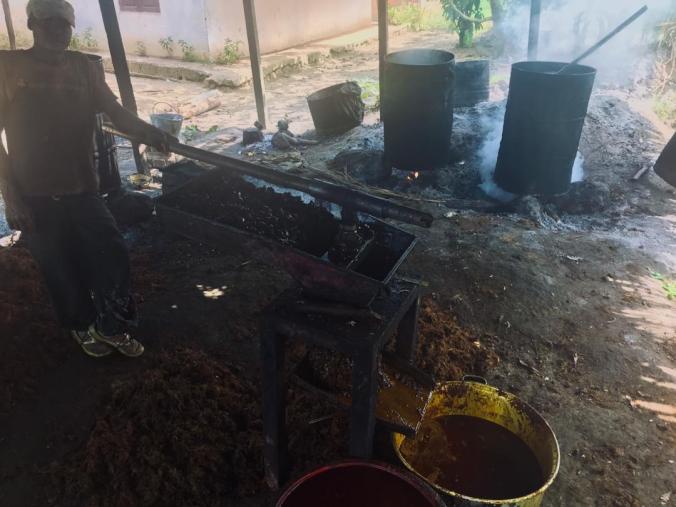
The village men talked to me while I was eating. Engom is primarily a palm oil town. The owner of the press took me to see his operation. First, ten children peel and clean the bright red nuts in a warehouse piled high with thousands of shell slivers and the pulpy, dirty fruits of the palm tree. Their dark fingers were stained orange like strong henna tattoos, and the overseeing mother laid her baby on a small pile of shelled refuse while she worked. The nuts are then roasted and smoked, turning the oily, woody seeds brown and soft, before they are crushed and pulped in a hand-operated crank, the accumulated wood pulp, still steaming, needing to be plucked out and cleaned regularly. With each revolution of the press, yellow-red oil dripped into a plastic tub, which was then dumped into barrels – caked with soot and dead embers – which I can only describe as filled to the brim with bubbling, coalesced blood.
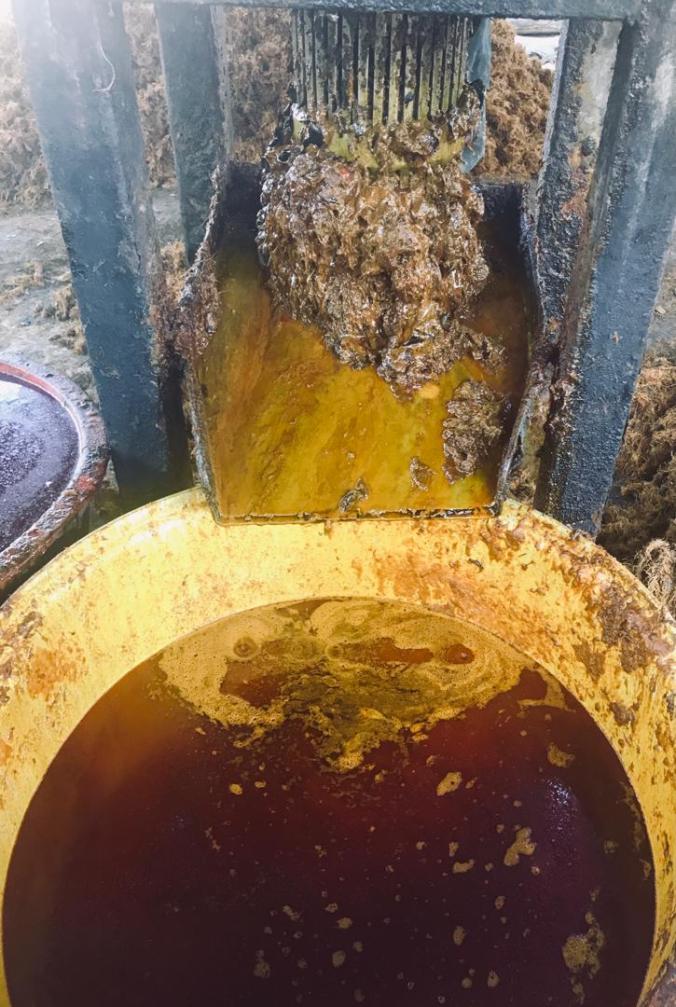
The proprietor of this enterprise was proud of his operation. It is still uncomfortable watching children working in this way.
I was offered two “breens”, elliptical plums, boiled to the consistency of sweet potatoes. Think Star Trek food. I was also offered a kola nut. Kola nuts are traditional gifts that one gives elders when visiting the home – I’d read about these in many places, but never tried one before. The dirty skin is peeled away to reveal an almond-colored brainy heart, which is broken in two. The kola is meant to be chewed slowly and digested, ending hunger temporarily and providing energy. And the men watched as I slowly chewed the nut until was a bitter and then strangely numbing cud; satisfied, they poured me a shot of bush gin, which I put back in one gulp. Cheering ensued.
Maybe it was the kola or the gin, but I wasn’t as fatigued as I normally was after walking this much. I continued on to Bikou.
…
Rain on tin roof. Large plats, then smaller dings, and then finally the ceaseless rapping of nails on a desk, from everywhere, all at once. The sound of heaven.
…
My walk to Bikou was transcendental. Tall canopy trees overshadowed twisting thick trunks and high walls of bushes with ease. Vines weaved together in one place like baskets to form sails that fluttered in the wind and in another place like twisted rebar that subsume and crack aging trunks like an improperly set bone. Small creaks, the water stained brown like tea, lazily slipped down snaking paths and under rusting, forgotten bridges. The color of the universe is green.
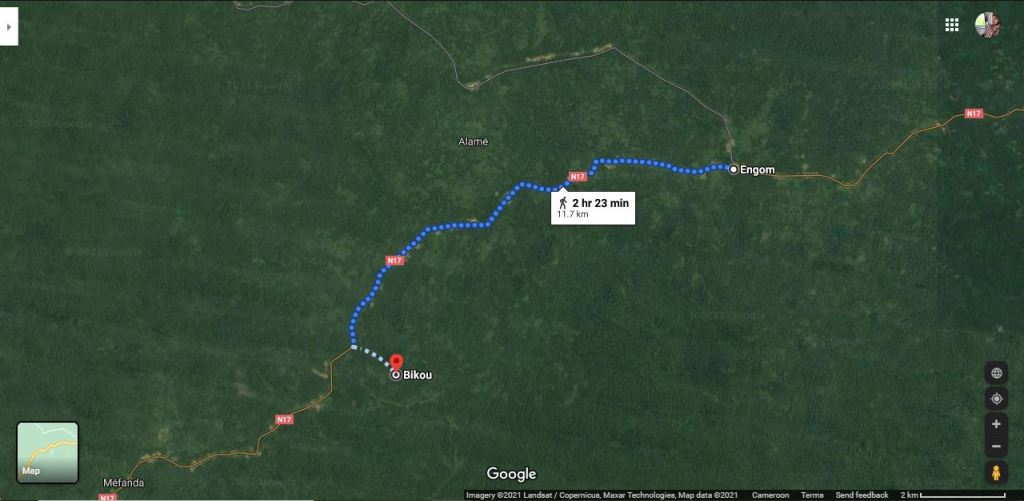
Bikou is a small village tucked away into the elbow of the jungle road, another 20 km past Engom. I came bearing gifts – a meter of cut sugarcane, cut by a grandmother who remembered seeing me all the way back in Yaounde. The father of the village greeted me warmly and hacked the sugarcane into portions for all the children. A young man enthusiastic to practice his Spanish with me (?!) led me to the place that his community bathes – a lagoon, ten minutes of a walk into the forrest. I became naked and first tried to step into the lagoon with my sandals on, but they slid into the icing-thick silty mud underfoot; instead, I clutched on to a trunk as I waded into the lukewarm riviere, careful not to drop my bar of soap into the opaque current. The town nodded their approval with my return.
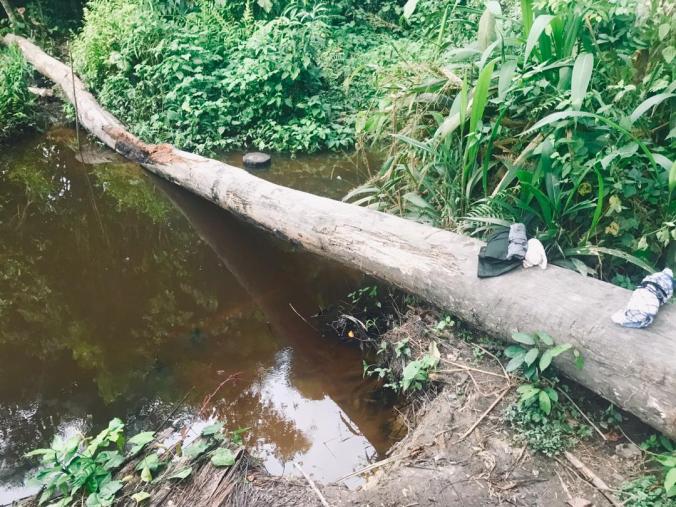
I practiced Spanish with my friend until the sun so quickly dropped below the horizon and then gratefully, gingerly, crawled into my tent. I haven’t dreamed so much in years.
…
I left before sunrise. My body was angry at my ambition from yesterday – the Achilles’ tendon in my right foot is badly swollen, blisters stab with pain, and chaffing has returned. There were less villages on the road today, and they were mostly vacant, the women all out cutting stacks of plantains to load onto back-mounted woven baskets, the men cutting and hauling these mythically large trees on to beastly trucks.
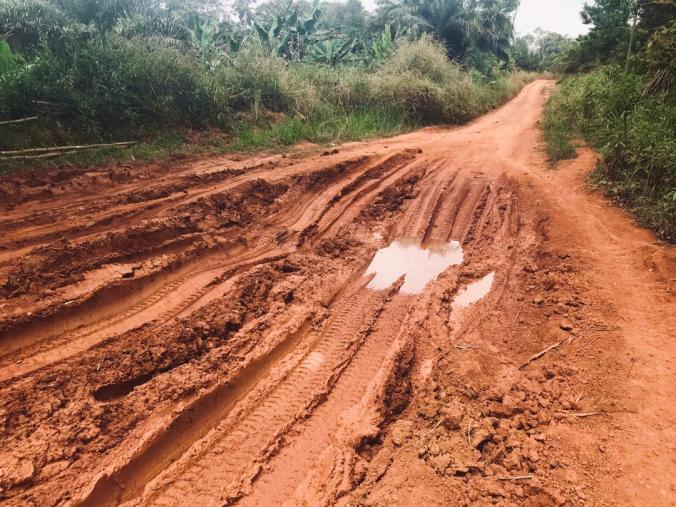
A few hours into the walk I came upon a large crowd. They were gathered around one of those large lumber trucks, the cabin angled downward and away from the long trunk-stacked trailer behind it. The road was too muddy from the night before and the large machine had become stuck up to its cab like an elephant slowly drowning in quicksand. The crowd was jeering at the driver and carefully walking around the rim of the mud pit, sharing their slippery footing with impatient motorcycles and mothers carrying wailing babies. I started around the less-walked edge, thought better of it, and joined the mass on the other side.
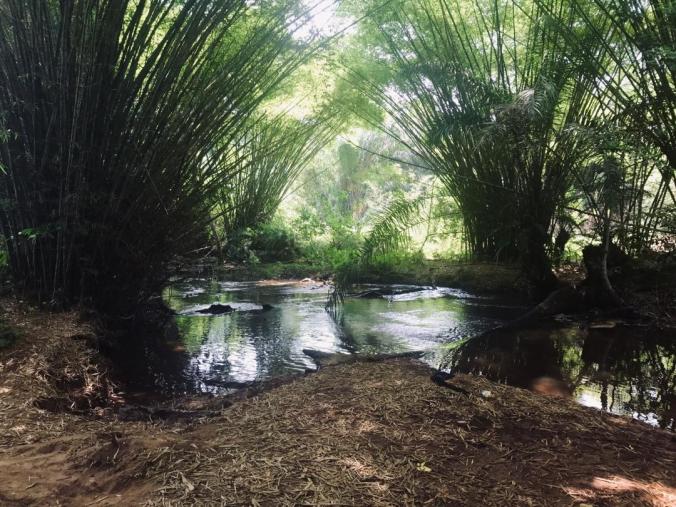
The rest of the walk was painful but not without beauty. An old man wearing nothing but a bath towel walked on to the road from a shadowy green path, pointed behind himself and just nodded. I looked. He had just finished bathing in a small grove, not unlike where I had bathed the night before, only several orders larger. Thick families of what must have been bamboo exploded to a height of several stories and a circumference of an Olympic swimming pool, their thousand stalks each rippling in the cool breeze, like mangroves made of bending spears. I sat in awe.
Later, an hour after I ran out of water, an old woman who heard about me prior to my arrival greeted me with a large pot of crystal-clear water. She gave it to me and smiled; her face was as smoothed over as Appalachian stone in a creek, her eyes as round and as white as pearls. She watched me drink, took back the pot and smiled a thousand-year smile, never saying a word.
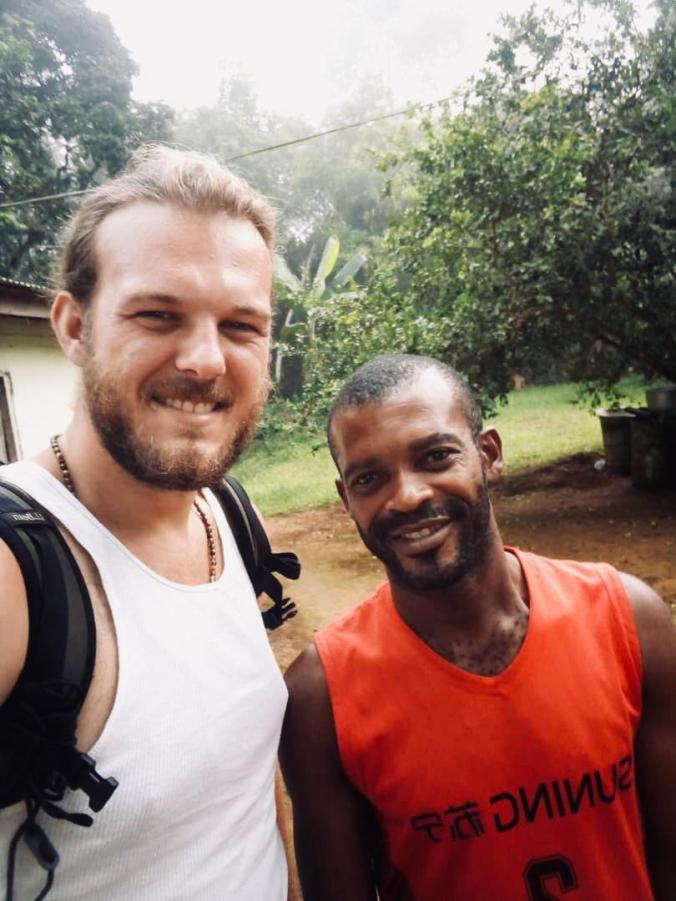
My plan was to reach Mefo, the 20-km point after Bikou, but I couldn’t. Only 2km short of my destination, I met a new friend. Jean-Andre is a tall and rippling with muscle, his bare chest covered in wiry black hair. He offered me a bed in the worker’s lodge I’m writing these past few entries within now. He told me that his primary school teacher was an American in the Peace Corps, and he hasn’t stopped loving Americans since. I accepted his offer, took a bucket shower in the small shack behind the lodge, and was asleep within minutes.
…
 certification
Leave a comment