The fourth and final quarter has begun at the American School of Douala. In the first two quarters, my class and I spent the first ten minutes of every class reading a book that was not assigned for class. The goal was to encourage reading outside of class, bring down higher energy levels after gym classes and get our minds focused on the tasks at hand. For the next two quarters, this practice has been replaced by ten minutes of writing. This practice will bring down energy levels and set our minds to task, but it is also an opportunity to experiment with our creative sides. Students are free to write about anything they want or interpret the prompt in any medium they wish – the prompts are only for those who need inspiration.
I write the same prompts with my students in all three of the classes we practice this activity – teachers should always be willing to do what they ask of students. Below are the prompts from this past week and my favorite of the three responses I wrote with my classes. All prompts were written by myself.
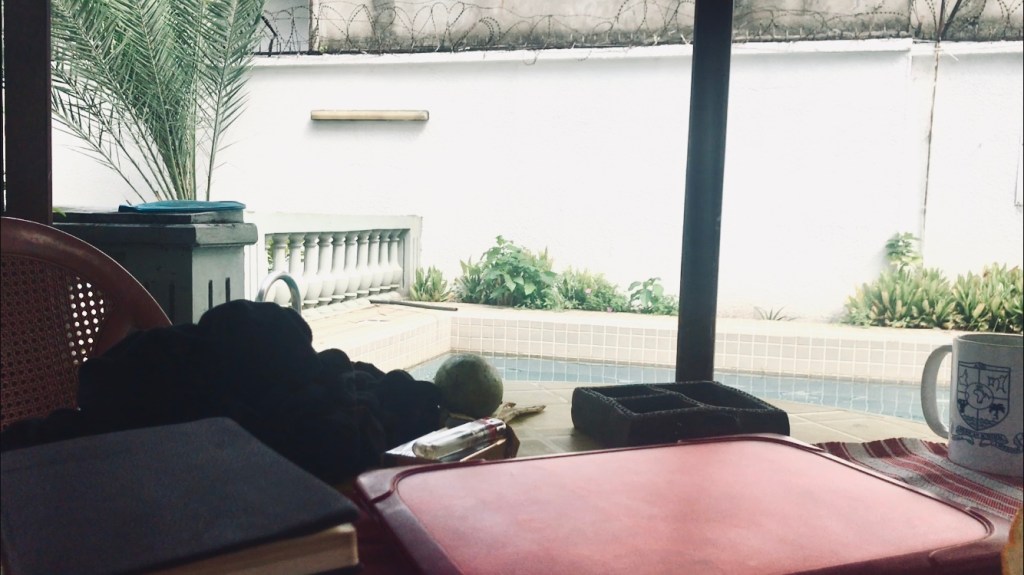
The picture at the top of this post was taken by our apartment’s pool this past weekend. It’s a hard life here in Cameroon.
***
Monday 2 May
Labor Day Observed – No School
***
Tuesday 3 May
Eid Observed – No School
***
Wednesday 4 May
Why do you think we celebrate Labor Day? Do you think this is an important holiday to celebrate?
The Haymarket Affair, European revolts, the Russian Revolution, codification by the United Nations, the never-ending march towards progress and liberation. The reasons are clear.
Labor Day is an important holiday to celebrate. Our interaction with others is economic, and our economic status determines our available range of actions and responses. Within capitalism, every human is priced and commodified according to their economic value. The end of poverty and suffering is contingent on our revolution over and evolution of capitalism, and our individual roles in those processes comes down to knowing and confronting our roles in those systems. We must learn the value and cost of our labor for anything to change.
Labor Day is an insufficient holiday. Like Juneteenth, Pride Month, and International Women’s Day, Labor day should be recognized as a symbol of victory for the subsect of humanity that endowed it, because our labor is integral to the functioning of our world. That this prompt is even worth asking shows how far we still need to go, but also how far we can go, if only we could unite.
***
Thursday 5 May
“The Banality of Evil” – Hannah Arendt. Is evil an active decision, or is evil what happens when enough people do nothing? Does our understanding of evil change how we treat “evil people”?
[Hannah Arendt reported on trials of Nazi war criminals and penned the term “the banality of evil” to explain what she saw as a surprising boredom, acquiescence and systemic quality to the evil deeds that came to light.]
There are many examples of individual evil actions, and even of people who could be fairly called “evil” because of a pattern or habit of doing “evil” things. Real evil, or real “good” for that matter, is seen in human systems as well. Systemic evil is impossible to turn away from and serves as a worthy enemy for the righteous.
Applying Arendt’s idea to current events helps to grasp the full weight of the war in Ukraine, which is more than one evil man’s decision, or the famines in Ethiopia and South Sudan, which can really only be understood through a systemic lens. Singularly evil actions, like the leaked SCOTUS ruling ending legal body autonomy, don’t lose their significance because of the certain systemic harm that will result; these singularly evil actions become more “evil” when the implications of their existence are widened.
The banality of evil also places a greater responsibility on each of us individually in the sense that evil can only really exist if we – if I – allow it to. I think Arendt was trying to say that “evil” systems arise when those participating in the system are apathetic and disinterested, and “good” systems arise when those participating in the system are engaged and conscious and that individual investment is a better determination of moral outcome than any specific ideology or program or “moral quality” of a specific idea. Simple terms: good happens when people care, and bad happens when people don’t.
While systems can become “evil” regardless of their ideological program, there are some programs which specifically aim to reduce personal investment, engagement, and consciousness of a system. Capitalism almost certainly values individual apathy and alienation as perks, not glitches, but capitalism also moves by a will of its own in many ways. Only fascism explicitly operates in such a way that intentionally magnifies these “evil” tendencies in humanity, which is just another reason to bash the fash.
***
Friday 6 May
Scientists believe that certain unnecessary human qualities, like pinky toes and the appendix, are slowly leaving the gene pool due to natural selection. If you could manipulate human evolution, what qualities would you change?
First and foremost, I would want the human body to require less sleep. Sleep has a lot of benefits, but needing less sleep to fully function would be kind of cool. I also think it would be nice if headaches weren’t as common or powerful. Maybe I should just drink less coffee?
I read recently about a group of Peruvians who live in the Andean Mountains, and how they have evolved to more efficiently supply oxygen to the their bodies as a result of higher elevation. That could be really cool. Having redundant organs – an extra heart, extra kidney, extra lungs – would also help us survive as well.
Increasing the rate of regeneration would be fun. Developing an ability to re-grow lost limbs might be interesting. Better night vision, or the ability to process multiple conversations at once, would help us interact with our environment more easily. Hair seems more and more unnecessary every day.
***
 certification
Leave a comment