The fourth and final quarter has begun at the American School of Douala. In the first two quarters, my class and I spent the first ten minutes of every class reading a book that was not assigned for class. The goal was to encourage reading outside of class, bring down higher energy levels after gym classes and get our minds focused on the tasks at hand. For the next two quarters, this practice has been replaced by ten minutes of writing. This practice will bring down energy levels and set our minds to task, but it is also an opportunity to experiment with our creative sides. Students are free to write about anything they want or interpret the prompt in any medium they wish – the prompts are only for those who need inspiration.
I write the same prompts with my students in all three of the classes we practice this activity – teachers should always be willing to do what they ask of students. Below are the prompts from this past week and my favorite of the three responses I wrote with my classes. All prompts were written by myself.
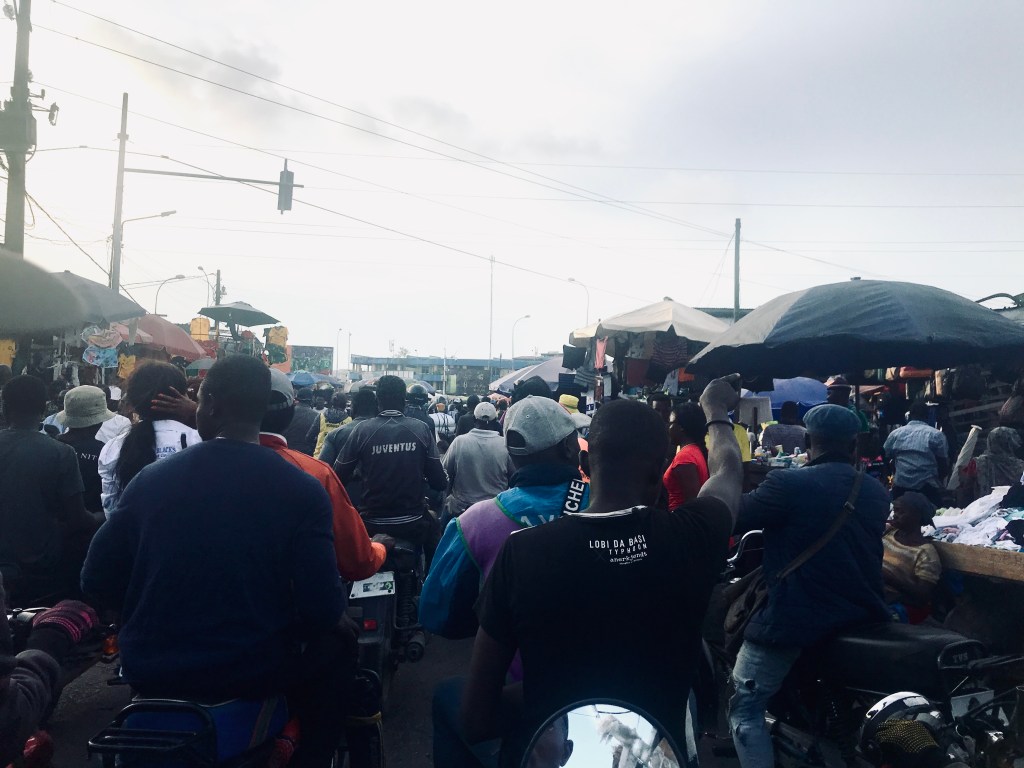
The picture at the top of this post was taken by our apartment’s pool this past weekend. It’s a hard life here in Cameroon.
***
Monday 9 May
What is the loudest noise you’ve ever heard? Where were you when you heard it? What happened?
I wrote this prompt because of a lightning crack near our apartment this past week. The rainy season is in full swing which means there are cool, wet mornings and tempestuous nights broken up by scalding afternoons. These night storms are something terrible. They start with these gales that whistle through the half-built skeleton towers throughout the city. Trees bend into impossible angles and snap onto streets and doors and windows shake with anticipation. The rain is horizontal, turning in different directions and altering the pouring and running of rainwater so that every possible platform becomes a river. Lightning spreads throughout the sky…
***
Tuesday 10 May
“The Pale Blue Dot,” – Carl Sagan. How does the cosmic insignificance of the Earth change the way we look at the world?
I love Carl Sagan. His speech about the pale Blue Dot was very impactful when I first heard it, and I’m excited to share it with my students today. Link included.
Voyager’s lucky snapshot should make us feel a greater sense of responsibility to our environment, since it’s the only garden we’ve found in this vast universe. We have no Planet B, as the saying goes. And while space exploration and colonization seem to be the inevitable direction of progress for humanity, this picture reminds us to appreciate the infinitely small likelihood of our existence here, and to cherish it while we still can.
This idea leads to a stronger, personal change of perspective: to laugh more. All of our problems, opinions, beliefs and fears exist on this pixel of light. It’s a good reminder to not take myself so seriously, to not feel so certain about anything. We should laugh at the sheer volume of things we can’t understand. Life is much too short and too small to do otherwise.
***
Wednesday 11 May
Is rap poetry?
Yes. Yes it is.
I love teaching poetry. Poetry is the oldest form of communication we have. Long before writing, we were sharing stories, teaching lessons, and defining our cultures using poetry. Our relationship to poetry was reciprocal; as we used poetry to define ourselves, we also defined what poetry is, and we expanded the boundaries of what was possible with language as a result. Poetry is the medium that allows us to use our language in a new way, and these new applications make their way to our speech and later writing.
There are few “rules” to poetry, and most rules could better be described as well-repeated patterns. Mindfulness to rhythm and beat and rhyme are popular patterns for poets to pay attention to. Listen to any rap song in a foreign language and these patterns are still completely observable. As if mere observation wasn’t enough, most rap songs I’ve listened to play with and break apart those patterns as well. Rap isn’t only poetry, but rappers are also poets, who consciously and constantly manipulate the rules of language for a desired effect.
One of my students read this prompt and said, “I thought rap was the opposite of poetry!” This made me sad. E.E. Cummings and T. S. Eliot were dismissed as asinine when they started manipulating the conventions of grammar in the early 20th century. Shakespeare originally wrote for paupers, and his later plays heavily criticize his government through allegorical dramaturgy at a time when disobedience to authority was considered heretical, and certainly not viewed as poetry. It seems like the popular notion is to exclude from poetry the products of people we don’t like. I don’t think my cute little 9th grader understood the full weight of his exclamation when he shared it, but his perspective is evidence of the wide gap between “art” and who we consider to be “artists.” And of course, it also reflected the popular desire to commodify art, as “serious” people don’t have time for silly things like poetry and beauty, and any that is consumed must serve some sort of pragmatic function. Poetry has no room for such nonsense. Poetry has always existed beyond our easy definitions, and today, we count witty sentences and un-dotted “I”s as poetic. Why not rap?
***
Thursday 12 May
Tell a story with absolutely no point, purpose, message, or main idea.
He sits in the café. Blue smoke sits in the air. The bench is thinly cushioned and shifts with each new arrival. The light goes quickly, as the sun cuts behind unseen mountains and casts long shadows. The café is loud. There are dozens of people, all men, picking their teeth and slamming fragile tin cups on table tops and scratching their beards and combing their oily black hair and unbuckling their belts before eating hot plates of food. Young waiters stack cups on trays, overflowing with breakable things, and swing these above seated heads nodding along to long diatribes, arrange thirty full cups back on the now-empty trays, and swing the same trays over the same heads having the same talks, breathing in the same pale blue smoke.
He leaves.
The street is lit. The air is dry and thin, and all light seems to travel farther. Everything reflects: grisly spinning furnaces roasting sunflower seeds reflect off parked car windows, flashlights brighten every crack of dusty sidewalk, phone screens bring out definition in tight hijabs and unkempt beards alike. There is motion, absolutely there is motion, but everything is tight together and everyone is familiar to another. Quick hellos seem to take an hour. Dozens of shop doors are open and television light, effervescent, spills out. Everything moves, but slower than these dubbed action movies can cut a scene, so he is taken in by the slowness of it all, the expectancy, the predictability, and most of all, by that blue smoke, which never went away.
He goes on.
***
Friday 13 May
Do you believe in luck? What is the worst luck you’ve ever had? If not you, can you think of another person you know who has had really bad luck?
I believe in luck, because saying otherwise would bring about bad luck. Nobody challenges luck once they become familiar with the precariousness of their own existence.
Today was an absolute logjam of activity, and I didn’t have time to write. I’m not really excited about the prompt, either. I ended up proctoring the AP Physics 2 exam during my afternoon class, and the rest of the day just got away from me. Sometimes, we don’t need to follow the prompt. Sometimes, we need to stare at the blank page and just see what comes out. That’s what this is. What do you see?
***
 certification
Leave a comment