Friday 25 October: Day 106
Kurdish verbs are organized in to 5 chawigs, or چاوگ. Each chawig has different forms for present and future verbs, verbs requiring an object and verbs that can exist without one. Verbs like شەكان (shekan) belong to elfi, the first chawig, while verbs like كردن (kirdin) belong to dali, the fourth chawig. Simply, verbs are organized into chawigs based on their endings (-an is elfi, -dn is dali) but most verbs in Kurdish are irregular.
Take بوون (buun). Buun means “to be,” and is as crucial to Kurdish as our “be” is to English. But unlike English, where “be” is frequently shoved in to contractions or attached to contractions or attached to continuous verb forms as an auxiliary, burn is often conjugated as as the suffix -o (“-eh”), more often than not as a simple puff of air at the end of a subject. And here’s another thing; whereas most verbs at least resemble their infinitive forms as they are conjugated, بوون does nothing of the sort. The past conjugation has an ڵ( “L”) and neither looks nor sounds like the infinite form – much like “was/were” in English.
Learning English is exciting. Learning a new language means learning to accept a set of values, logical conclusions and historical facts, previously unimaginable, as central to the universe of someone else. We learn to understand our world using the words and ideas inherent to our language, which means that using a new language means understanding a new universe, manipulating reality around us like a grandfather’s watch whose back hides an inscription pressed against our wrist as of yet unseen until the turn. Like all discoveries, this one is beautiful.
بوون – to be
Saturday 26 October: Day 107
Zorba the Greek – Nikos Kazantzakis, 1946
A book about cutting down books, burning journals, losing innocence in war and burying transcendence in white sandy shores. I read this story of an over-educated young man and his dancing, fighting philanderer of a friend in daily visits to a smoky tea shop around the corner from my school after Kurdish lessons in the morning. Now, life is a little less stressful and smells a little more like orange blossoms and sweet red wine. Read this book.
…
“No, I don’t believe in anything. How many times must I tell you that? I don’t believe in anyone or anything; only in Zorba. Not because Zorba is better than the others; not at all, not a little bit! He’s a brute like the rest of us! But I believe in Zorba because he’s the only thing I have in my power, the only one I know. All the rest are ghosts. I see with these eyes, I hear with these ears, I digest with these guts. All the rest are ghosts, I tell you. When I die, everything’ll die. The whole Zorbatic world will go to the bottom!”
“What egoism!” I said sarcastically.
“I can’t help it, boss! That’s how it is. I eat beans, I talk beans; I am Zorba, I talk like Zorba.”
…
I could not sleep. I felt I had to account for my acts that very night. I went over my whole life, which appeared vapid, incoherent and hesitating, dreamlike. I contemplated it despairingly. Like a fleecy cloud attacked by the wind from the heights, my life constantly changed shape. It came to pieces, was formed, metamorphosed – it was, by turns, a swan, a dog, a demon, a scorpion, a monkey – and the cloud was forever being frayed and town. It was driven by the winds of heaven and shot with the rainbow.
…
I had not heard hymns sung to the Virgin Mary for many years past. During the revolt of my early youth I had passed by every church with anger and contempt in my heart. As time went on I grew less violent. Now and again, in fact, I went to religious festivals – Christmas, the Virgils, the Resurrection – and I was happy to see the child in me come to life again. The mystic fervor of my early years had degraded into an esthetic pleasure. Savages believe that when an instrument is no longer used for religious rites it loses its divine power and begins to give off religious sounds. Religion, in the same way, had become degraded in me: it had become art.
…
“My third theory,” he went on hurriedly, as he could not bear the silence, “is this: there is some Eternity in our daily lives, only it is very difficult for us to discover it alone. Our daily lives lead us astray. A few people only, the flower of humanity, manage to live an eternity even in their transitory lives on this earth. Since all the others would therefore be lost, God had mercy on the, and sent them religion – thus the crowd is able to live in eternity, too.
…
“The idea [of faith] is everything,” he said. “Have you faith? Then a splinter from an old door becomes a sacred relic. Have you no faith?
Then the whole Holy Cross itself becomes an old doorpost to you.”
…
For me time had found its real meaning: the widow had died thousands of years ago, in the epoch of the Agean civilization, and the young girls of Cnossos with their curly hair had died that very morning on the shores of this pleasant sea.
Sunday 27 October: Day 108
We visited our first public school today.
The low prioritization of education spending means that schools hare student bodies. In the morning, primary students fill the stale hallways with laughter and color on the walls. Four hours later, they are dismissed. Secondary students take their place, moody from adolescence and sitting at the same rickety desks younger legs dangled from. One teacher will teach both levels – a task any teacher reading this will know is Herculean – or only work for half a day of wages.
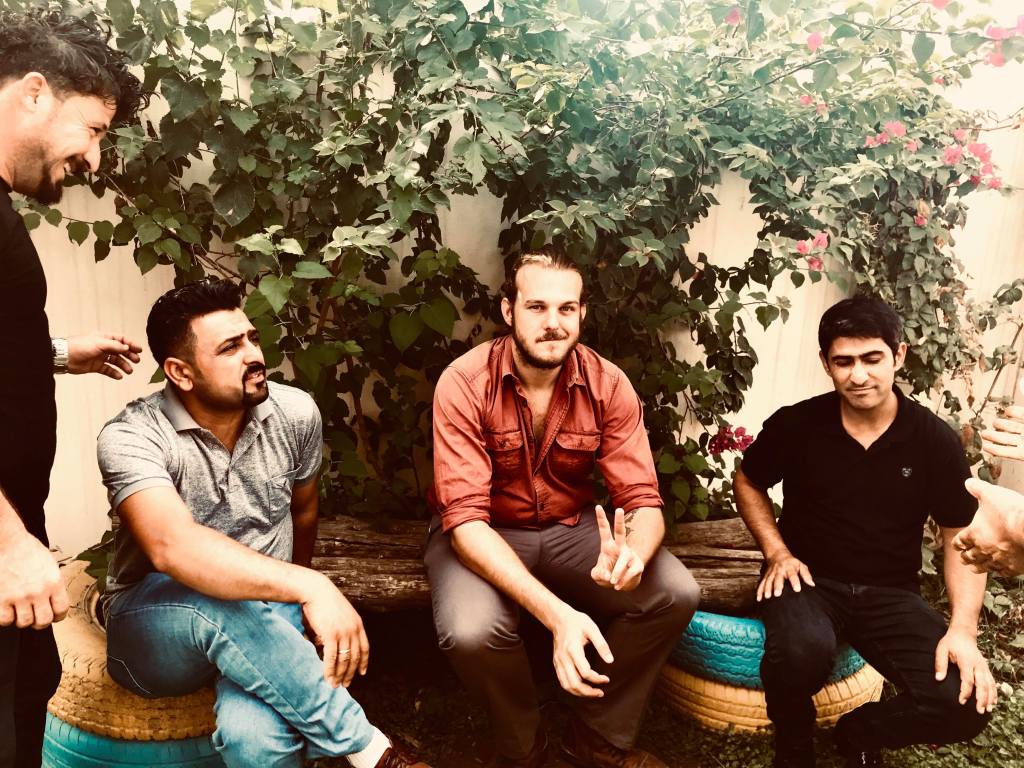
We’re shown the school property. There’s a garden where colored car tires are used as planters and three branches lay loosely on cinderblock to form a bench. The auditorium is packed to the brim with old desks never quite repaired, and a ping-pong table where the (exclusively male) teachers assert their dominance and leave their cigarette butts behind. The primary education is done by female teachers, while the “more serious” work of secondary education is reserved for men – a pattern we’ve seen in other developing contexts.
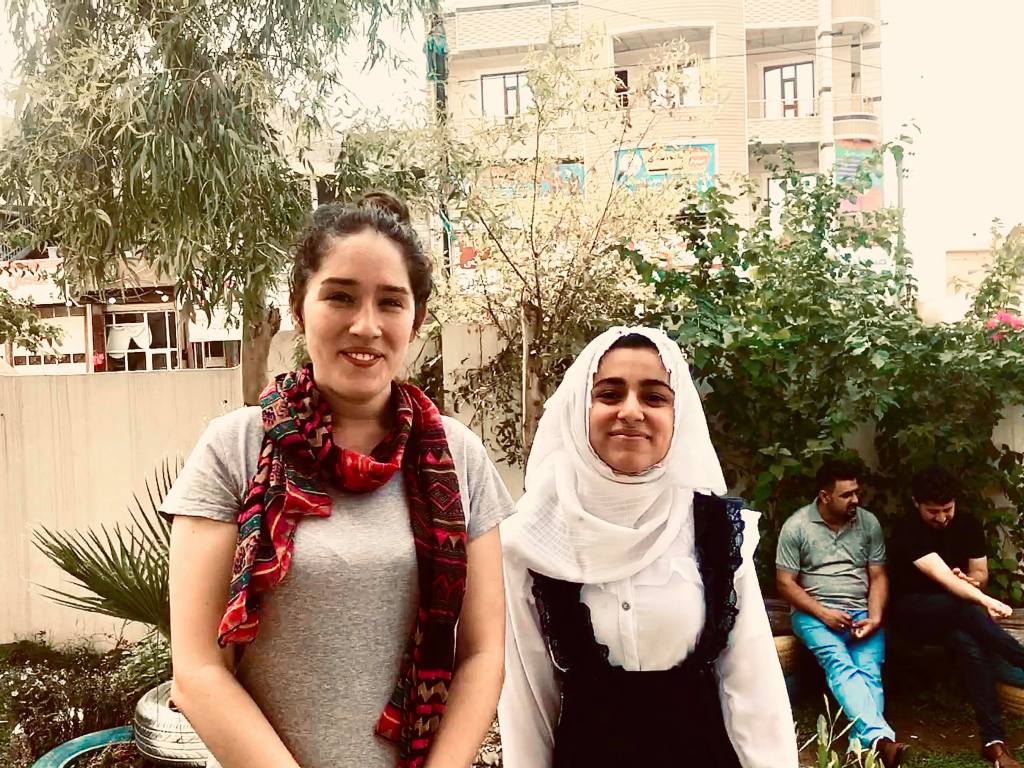
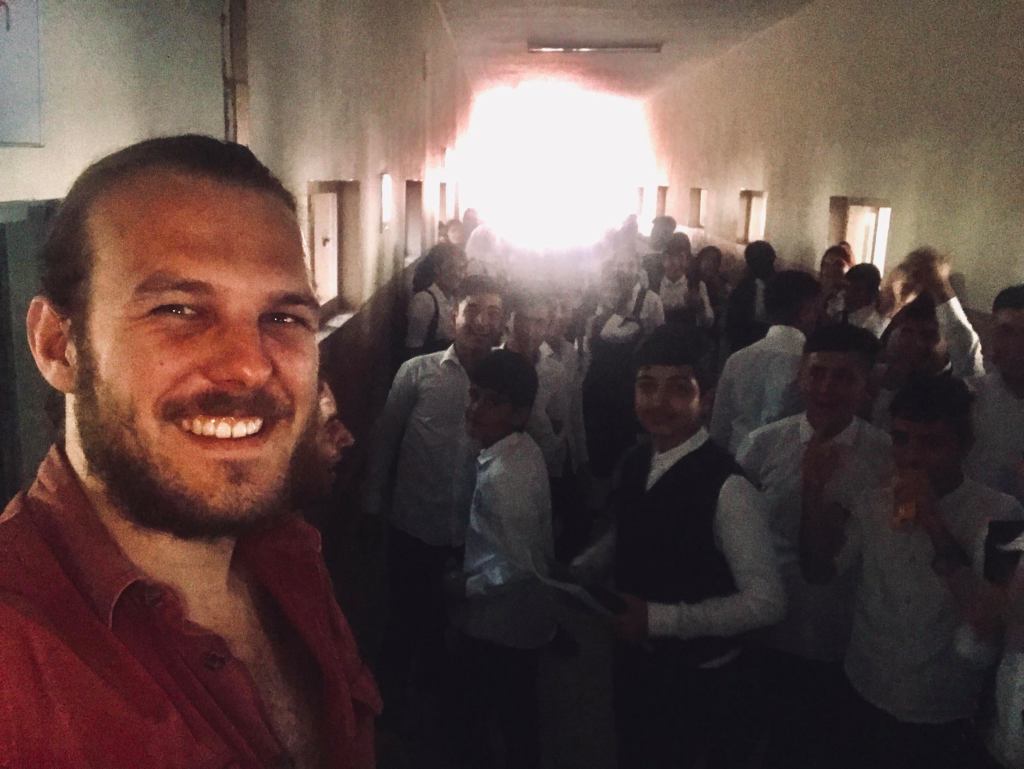
Despite the challenges – external and self-imposed – this school is alive with hope. As leave our lesson observation a hallway crammed with curious students erupts with laughter as I reach up for a 200-person selfie. A young girl in a hijab stops us outside and shares a few sentences of confident, melodic English, her very presence a victory. We leave inspired.
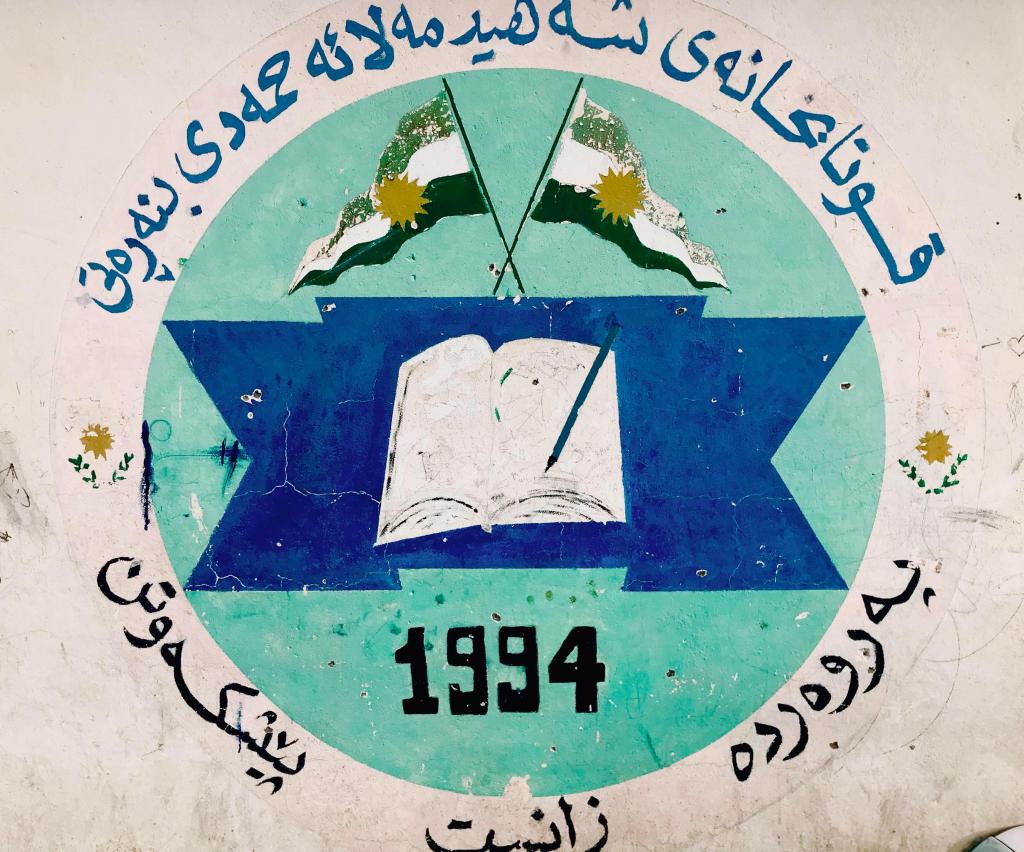
قوتابخانە – school
Monday 28 October: Day 109
We need help. Teaching, lesson planning and all of the gymnastics of setting up a school is exhausting. We can’t speak Kurdish and half of the day we aren’t able to speak to prospective students, who have little to no English. That’s to say nothing of the laundry list of organizational tasks we’re struggling to find time for.
Enter Yahya. The result of a month-long search of an office assistant that drew applicants from Lebanon and India, Yahya has descended upon the English Access Institute like mana from heaven. He’s eager, optimistic and yet grounded, the kind of man that turns organizations into success factories. He’s well-organized, open-minded, hardworking and hilarious.
He has spent his first week organizing our first big event for Saturday, inputting student records on to a new cloud-based platform, preparing for new classes on Sunday and turning the office into a usable work space. His wife, Dilan, works at a beauty store and together the two of them have the kind of modern, equitable relationship that epitomizes the changing social structure of Kurdistan and the Middle East in general.
We’re lucky to have found Yahya when we did. Here’s to great things, comrade.
يارمەتى – school
Tuesday 30 October: Day 111
“The present tense is an ocean. We use it for actions that have a wide, undefined timeframe, like habits or statements about generalities. Present simple actions are static and unchanging.
The present continuous is a river. Action is occurring at this moment, with a clear understanding of where it began and where it is going. With the present continuous, you’re swimming in the river with the flow of the action being described at this very moment.
The present perfect is like Dirbandikhan – a river, dammed up in a clear, static reservoir. We can see where the action is and all that it has entailed. Like a damn, the present perfect turns dynamic action into usable blocks of ideas that we can talk about without losing our control in the river.
Now imagine a mighty river, spanning many countries and ranges. To make the most of this river, we have been building many dams – one for this city, another for that one, as many as we can afford. This is the present perfect continuous: each partition shows a beginning and an end, but the river of sequential action still moves through each separation.
‘Past’ and ‘future’ just tell us which direction we are gazing from upon the water. The future perfect continuous – we will have been speaking – is the last and most confusing tense of English verbs, but it only means that we are standing at the cusp of that first dam and looking on at the dozens of separate structures built along the same great river, all flowing downstream.”
ڕووبار – river
Wednesday 31 October: Day 112
To build a school, we need land. To get land, we need a license from the government authorizing our school. To get that license, we need to have land for the school.
See the problem?!
We took an earnest stab at the beast today. With no appointment Mitsu and I went to several mis-named education offices in Kalar before finding the office of Mr. Dara Muhammed, the Minister of Education for the Garmian Governate. After a few more urgent appointments this well-mustached bureaucrat welcomed us in to his office for pleasantries. Obligatory cups of water (served in flimsy pudding cup-like containers that should make any environmentalist cry) were served and the back-and-forth exchange of respectful admiration and promises of mutual cooperation and social goods took place.
In all seriousness, we learned a lot from that meeting. Nothing comes easy, but having friends in high places helps.
وەزير – minister
Thursday 1 November: Day 113
Milk and Honey, Rupi Kaur, 2014
Best read after disagreements with your partner when needing to remember the literal goddess living with you.
“if you were born with the weakness to fall you were born with the strength to rise”
“how you love yourself is how you teach others to love you”
“our backs tell stories no books have the spine to carry”
“you might not have been my first love but you were the love that made all other loves seem irrelevant”
“a lot of times we are angry at other people for doing what we should have done for ourselves”
 certification
Leave a comment