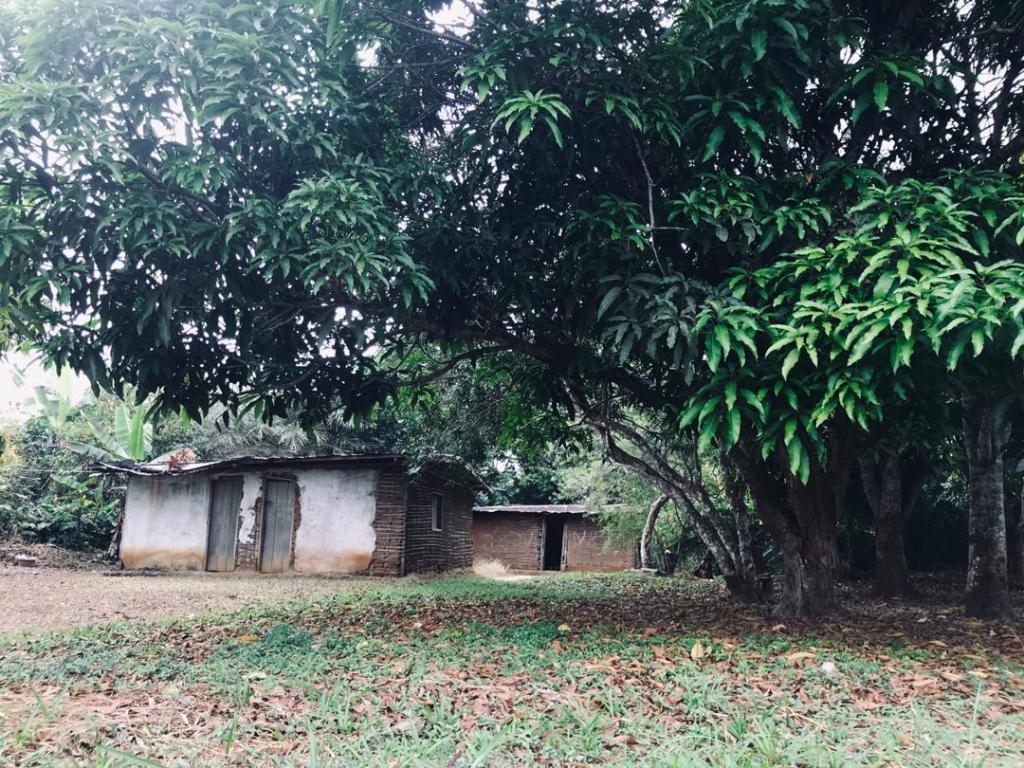
The first of a five-part post detailing a long walk I took over Christmas break.
Saturday 19 December: Yaoundé
20:00
A line of clothes, one shirt for each color of the rainbow, flows in a current of wind like Tibetan prayer flags. The woman wedged between me and the window coughs coarsely, painfully, and plays with her phlegm in a tissue. The bus driver passes a second car on a blind, uphill turn. Rain blankets the side of a fang-shaped cliff, the plaque of jungle growing vertically on its eastern torso disappearing under a gray deluge. I force the seat in front of me inches forward so that I can rest my smarting right knee and sacrifice my left.
The three-hour bus ride stretches into four, and then five, and then six. My ankles are twisted and shaking from pain. My kneecaps are pried from their sockets with each pothole. I tell myself that this pain is an illusion, that the burning sensation along the sides of my feet are temporary rebellions against the grand oneness of all things. Everything still hurts.
A young man follows me from the bus, refusing to leave me be. He wants one of my cigarettes. I tell him to pay me for it. He says that he “is inspired to be as courageous as me one day” – a threat. I look to the staff of the restaurant I’m in front of for support. They never look at me.
…
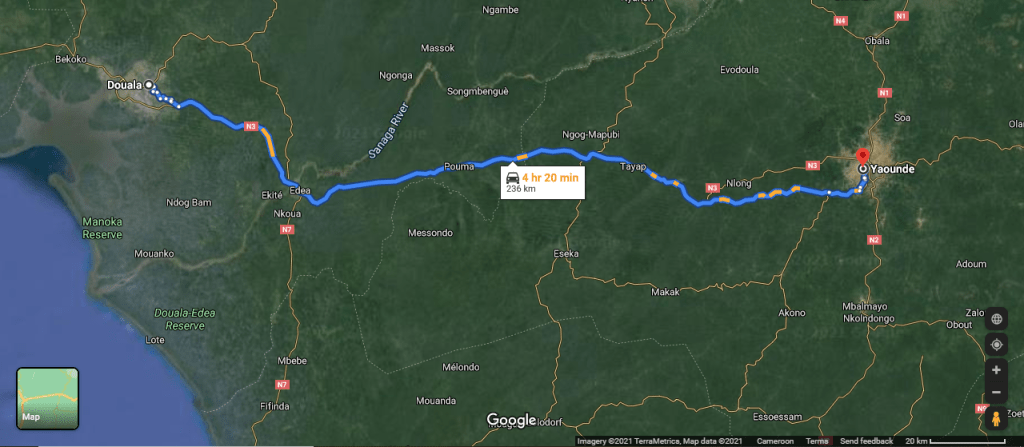
I’m starting a hike. My plan is to start in Yaounde, the capitol of Cameroon, and then go south to Ebolowa (“-va”) before cutting west to Kribi, where I’ll meet Mitsu. I don’t really know what to expect other than pain and challenge. As if the past month hasn’t given me enough of those; Mitsu and I are having some problems, I’ve moved to a new country, I’m starting my first job teaching proper high school English. This hike feels offensive, like I’m asking to be put in my place. And maybe I am.
Away from the threatening young man, I had to figure out where I was. I tucked away into a small café and made friends with my waiter, where I learned that my Couchsurfing lead fell through and I would need to stay at a local Presbyterian mission. I negotiated my way to the place, still wearing a sweaty white undershirt and Kurdish pants, and ended up crashing the wedding reception of the pastor’s brother-in-law. I felt so awkward that I left, looking for WiFi to download some maps to use offline. Ended up at a walled-off, alien Hilton, strangely floating in the empty “diplomatic” quarter of Yaounde, surrounded by white people being served by Cameroonians selling sodas for six times the price you could get outside the fortress. My maps were loaded but my phone died mid-conversation with mom. Making my way back to the mission, I sat at a dressed up wedding table and made small talk with the French-only guests until my room was ready. I’m heading to the nearest bar I can find.
…
23:35
Street scene, from left to right:
Fire cart. Orcish metal cage containing Sauron’s eye lashing out. Three men laughing, the orange glinting off dark wet skin. Three Hephaestuses, masters of the forge.
Two rings. The first, an elaborately placed halo of grapefruit angled towards the sky like a searchlight. The second, a plump secondary schooler with a battery-powered flashing neon crown. Can’t tell if she’s talking or dancing.
A Nubian step pyramid of jack fruit, too ripe, all with wedges cut from 11 to 1 o’clock. Relatively mundane in context.
Two parked cars. Music.
A viewing gallery of t-shirts hangs on the wall. Well-lit.
…
Sunday 20 December: Yaoundé
10:39
- Siddhartha wants to leave privilege of Brahmin lifestyle to become a Samana
- Siddhartha “learns nothing” and goes to Gotoma; impressed by teachings but leaves friend Govinda to experience world alone.
- Finds Kamala, learns about sex, becomes a business apprentice. Totally naïve, everything is a game.
- Develops gambling habit, begins to turn astray. Decides to abandon current life and considers suicide. “Painfully aware of Samsara.” Meditates, sees Govinda, starts over by the river.
- Works with Vesudiva as a ferryman. Meets his son, who leaves him. Comes to see the sufferings of others as his own. Listens to the river.
- Sees Govinda again. No longer feels like he is seeking. Govinda sees the holiness of the Buddha in him.
…
Monday 21 December: Ekalia
16:30
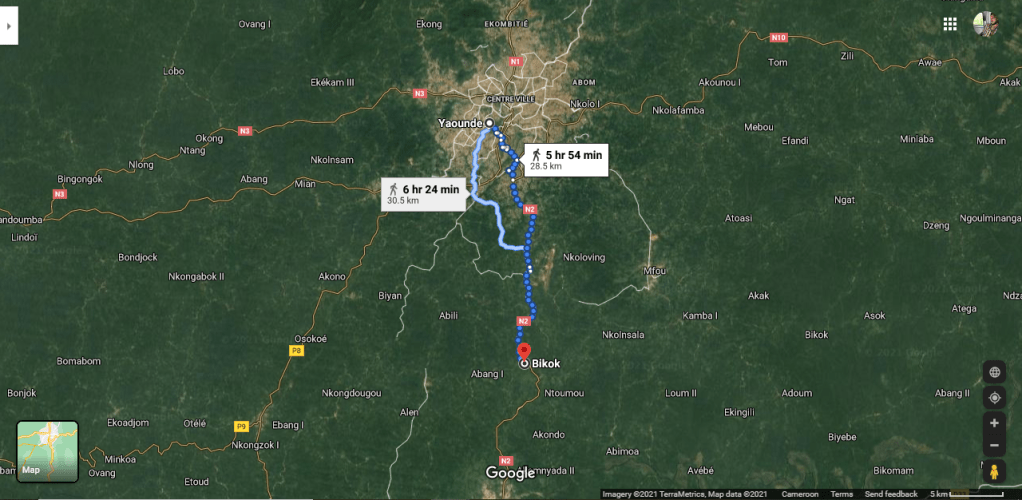
Left later than I hoped for. Some English speaking trickster chatted with me over libations and then harassed me for money. Didn’t sleep well, woke up with a headache. Started walking around 8:00.
First stop: dejuner by the modern gas station. Woman made “Rolexes,” egg sandwiches, but without the chapati that is common in East Africa. Bought toothbrush, toothpaste, water and cigarettes. Walked.
Second stop: Nkolda, outside Yaounde. Sat at coffee stand and talked to the mother/daughter business team. An esteemed man, an electrician at the Japanese embassy, joined us. Talked about Trump – he liked his honesty (!) but not his Africa policy. Impressed by my journey – I’m starting to feel better about this. Walked.
Third stop: small village by side of highway. Three benches under a tree. A dog slept on one, splayed out; school girls sat giggling on the other; I in the middle. The mother started arguing with the grandmother in a Bantu language (za, kwa-, mzungu), but everyone was friendly.
Came to a checkpoint, a large crowd swarming each vehicle as they passed through. Uniformed officers sat nearby watching the traffic, occasionally receiving cash from young merchants. I sat in shade and watched from a distance, trying to understand. Nothing to understand – only peanut sellers.
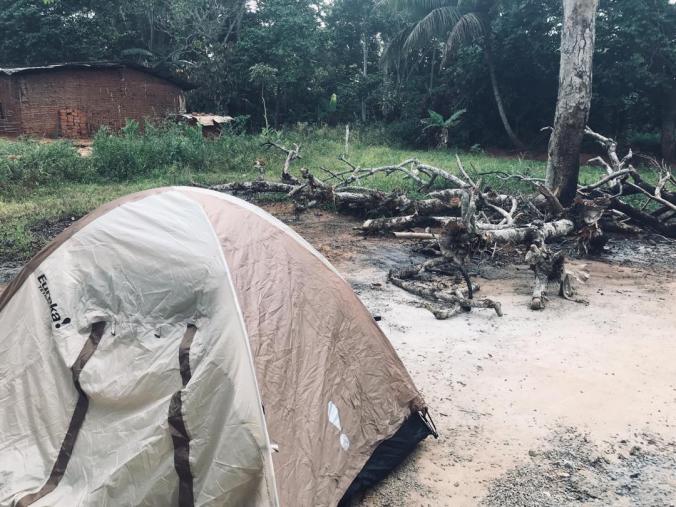
Found my spot for the night, in Ekalia, a village near Bikok (where I had intended to stay tonight). Relaxed at the village bar and watched people – young men on bikes pooling change and spending profits on drinks for others. Harmony. Lots of older people milling about, watching the cars speed past. Traditional. Safe. I translated and wrote a note for the owner of the bar, who was surprised by my request but welcomed me warmly. Set up my tent in the dirt lot behind the bar and sat down to write. The day was over at 5:00.
Salud. Je m’appelle Christopher. Je suis un Americain. Je suis professeur d’anglais a Douala. Je marche de Yaounde a Ebolowa. Je veux rester dans votre village et je peux dormir dehors parce que j’ai une tente. Je ne peux parler francais mais je ne vais pas causer de problemes. Merci beaucoup!
…
Tuesday 22 December: Yaoundé
23:30
Zackary Makomo is the Pentecostal pastor of the small village I tried to stay at last night. His eyes are so crossed that he cannot read a phone screen, a fact I learned around 8:00 last night. Pasteur Zackary informed me, that as a member of the local Comite du Vigilance, he was required to take me to a slightly larger village north of Ekalia and introduce me to the Gendarmerie, who register all travelers, and Pasteur Zackary assured me that this was ordinary, that I would return to my open tent and unpacked backpack, so we moto’d off in to the night, up the same road I had spent six hours walking south on for 22 kilometers that very day.
The road was dark and cold. Segments were unpaved and nothing was even, and we didn’t have helmets. We had previously communicated despite several checkpoints of language: I’d think of a question in plain English, type it into a French translator, carefully escriber the translation on to a large blank page, and then he would hold this alien birth of a message to the single mosquito-Mecca bulb outside the bar, and think about it, and then carefully respond slowly and carefully in French. I would try to understand. None of this is possible on the back of a moto, eyes watering from the dust kicked up by passing drunk young men. So we just rode on in silence.
Pastuer Zackary hesitantly pulls up to the Gendarmerie office. A large fight is breaking out down the hill from the station, shouts cascading out in the dark. One thin, small man wearing a turquoise-plaid shirt sporting a wiry mustache is shouting at a woman for not cleaning his motorcycle. I sit next to Pasteur Zackary on a crickety bench. The only light flickers. Thin Man is not happy that I am alive and dismisses my attempts at communication. Pasteur Zackary tries to talk to him but Thin Man waves away this elderly half-blind man of faith like an irksome fly. A uniformed young man comes out, a head taller than me and with more muscle mass than my brother, each step of his heavy and sure. Big Man is clearly the boss of Thin Man, who listens with this facial expression somewhere between bitter-lemon and kidney-stone, not saying a word. I pass Big Man my passport and emails pulled up on my phone, but after what appeared to be an exceedingly challenging effort at critical thinking, grunted “no permission” several times.
After some haggling over my short term lodging – Thin Man favored the local jail, Big Man wanted me to find a bus back to Yaounde six hours after the busses stopped running – Pasteur Zackary convinced Thin Man and Big Man to allow me to return to Ekalia, pack my belongings and then drive back to Yaounde. But as we whistled through the blustery night back to his village, Pasteur Zackary (through an exceptionally precarious game of charades) informed me that he doesn’t like those soldiers very much, that they only want money, and that I should pass the night in his home. Je veux comprender so at the bar we painfully played the communication game again. He said that the next town down the road – my planned stopping point for the following day – was just south of this gendarmerie’s administrative division (de-vi-zee-yon) and once there I wouldn’t have this problem anymore. He gave me his number to reach him when I came across other earnest but perhaps misguided Comite du Vigilance members.
And then we ate. Pasteur Zackary led me to his home and his family prepared a slow-cooked meal of grilled river fish with a garlic and pepper sauce, rolled doughy cassava to absorb the richness of the fish, and a bowl of sweet sorghum-maize porridge, completed with fresh French bread. Learning about Pasteur Zackary, his madame and frei and hard-working daughter, was my first French lesson. I learned my personal pronouns and the words for past and future. I learned how gender works for basic nouns. I learned that an American Pentecostal missionary had visited Ekalia ten years prior and had converted the community. I remembered my life in Mucubira and was overwhelmed by the care and respect afforded to me, le blanc, mzungu, the stranger.
This would not last. A man came to the simple cloth door of the cement home and gave Pasteur Zackary his phone. The village chieftain was on the line. In plain English, I was ordered to return to Yaounde now. The Thin Man had called to make sure that I was gone, and now the family might face problems because of my passage through their village. I hugged my hosts goodbye and waited by the only road, staring at the ring of light around the half-moon, and left.
…
 certification
Leave a comment