Saturday June 18 – Friday June 24
“There are no bandits here.” That’s what the kind man squatting in the shade of the Casablanca airport said to me, after I shared a lighter and I started testing out the language reality of this new place. He pointed to a large chart near the driveway of this humble airport, with destinations written in French and Arabic beside latin-script pricing. The taxi drivers leaned against their cars, lazy in the afternoon sun, reflective sunglasses on display. Squatter explained – at least I think he did, our French is about the same level – that they fixed the prices long ago so that strangers would not be taken advantage of. After the last drag he rose, and I watched him demonstrate how to get a taxi at an airport in Morocco, and he waved goodbye before driving off. Every day is a school day.
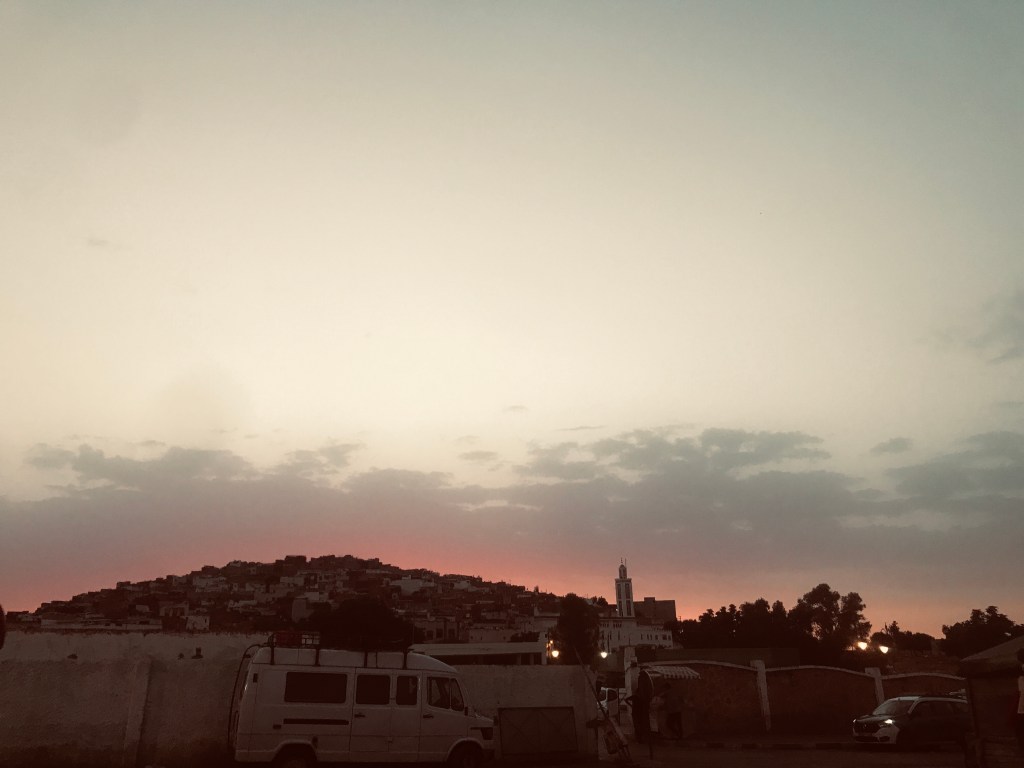
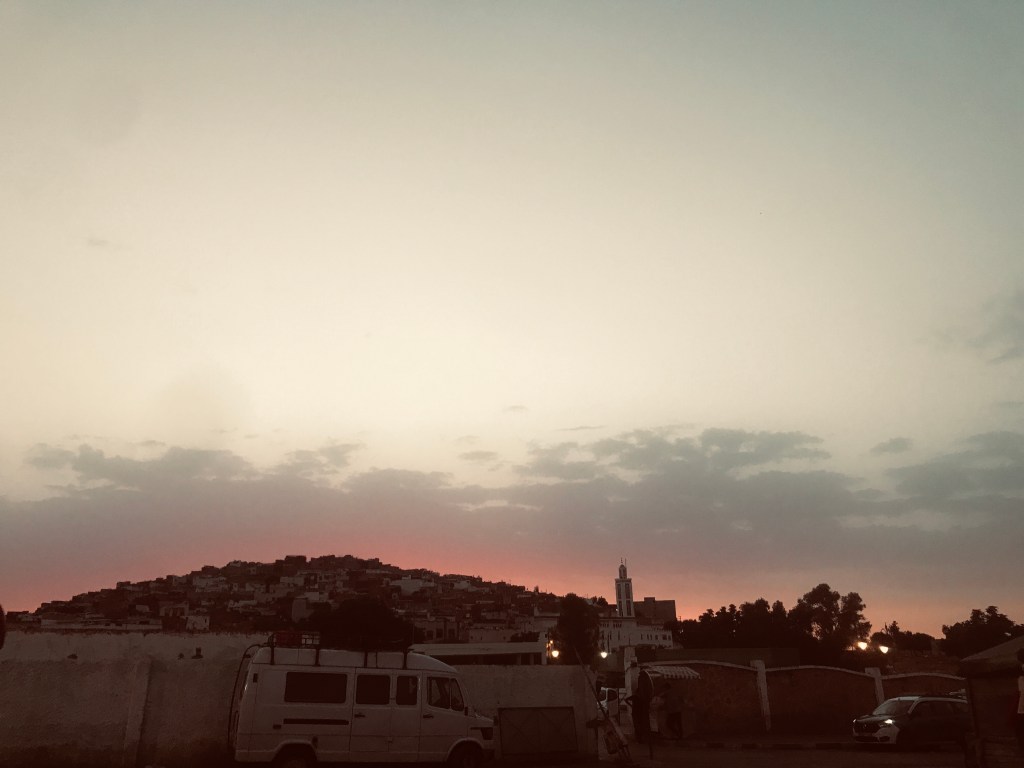
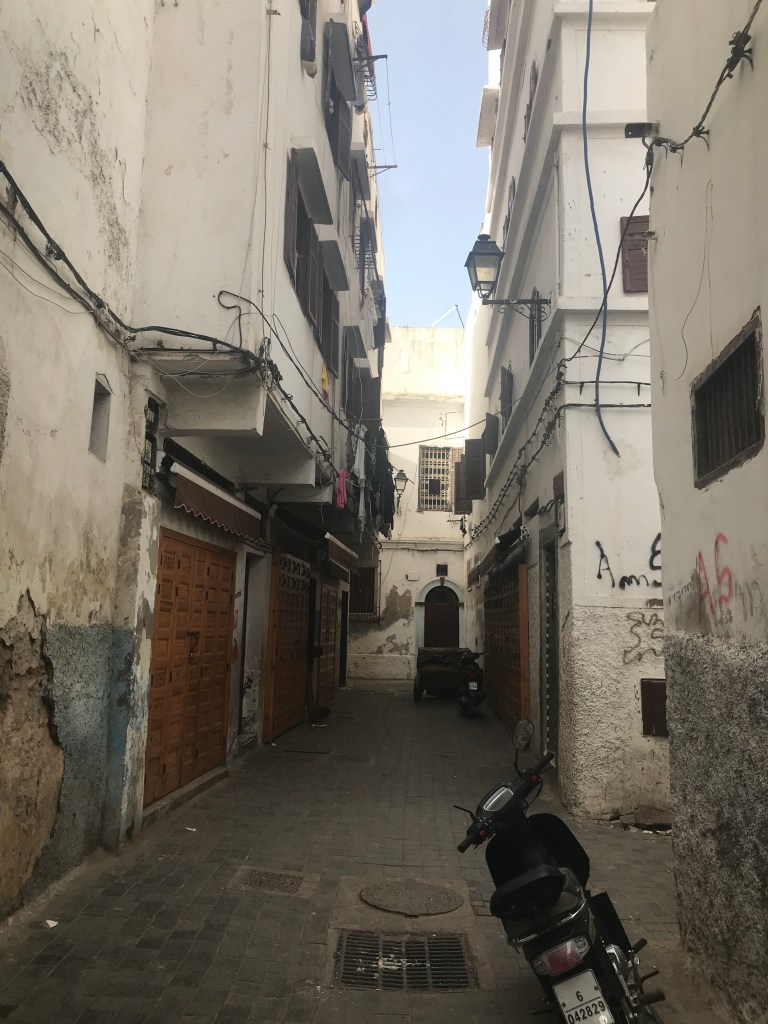
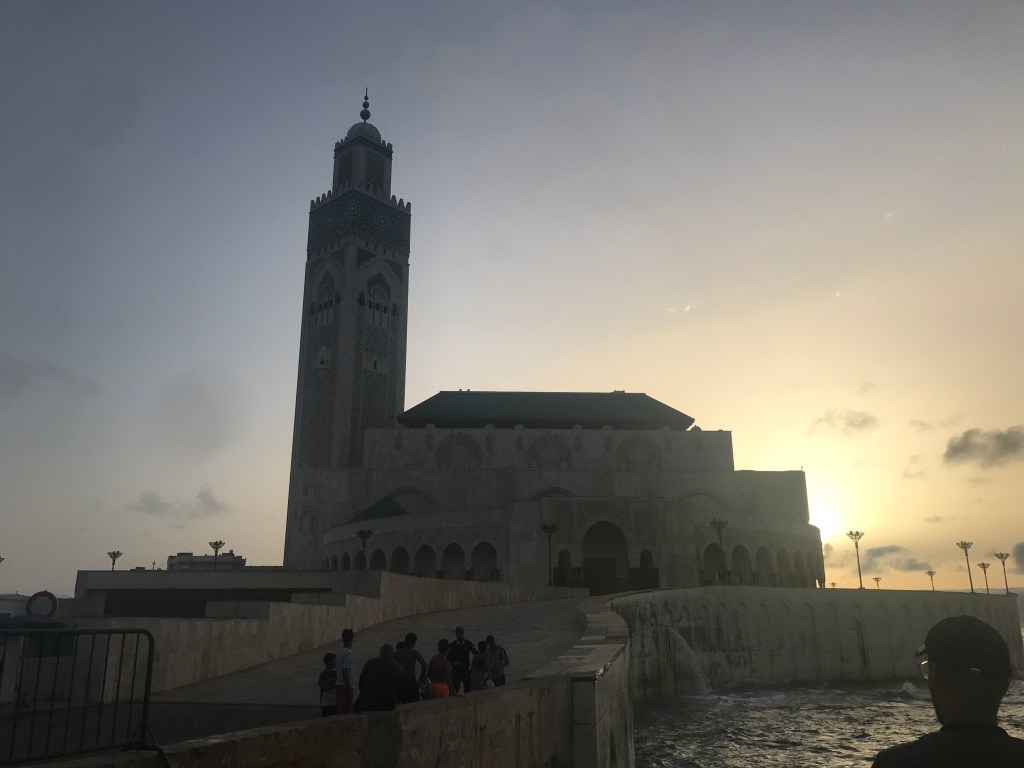
Morocco is a friendly country. I landed a week ago and spent the night in Casa. The town is modern, an economic magnet for bright students around the country. It is not high on most tourist’s to-do lists, but a large mosque – part cathedral, part castle – overlooks the Atlantic Ocean in the sunset regally. It’s placed just outside Casa’s medina quarter, a windy, compact neighborhood built within walls where serfs would hold out against European invaders a century ago and which are now continuous market stalls and congenial guesthouses called riads. I spent my first night on the roof, laughing in familiar North American English with a Canadian and relaxed French with the young Moroccans hanging out with us, and lost at chess twice. My belly was full of clay pot chicken and rice and warmed by mint tea.
The bus to Chefchaouen, in the northern province near Tangier, was eight hours. The countryside became taller and taller as the late sun slowly found its way to sleep. Legend, and perhaps the law, say that all the rivers are owned by King Hassan II, and he lets these massive brambles spotted with pink blossoms grow unhindered on their banks. These arteries of pink lace the land. I finished Frank Spencer’s Dune and slept, and at the bus station was greeted by three young guys who took me to the edge of this new town’s medina where I wondered to my resting place.
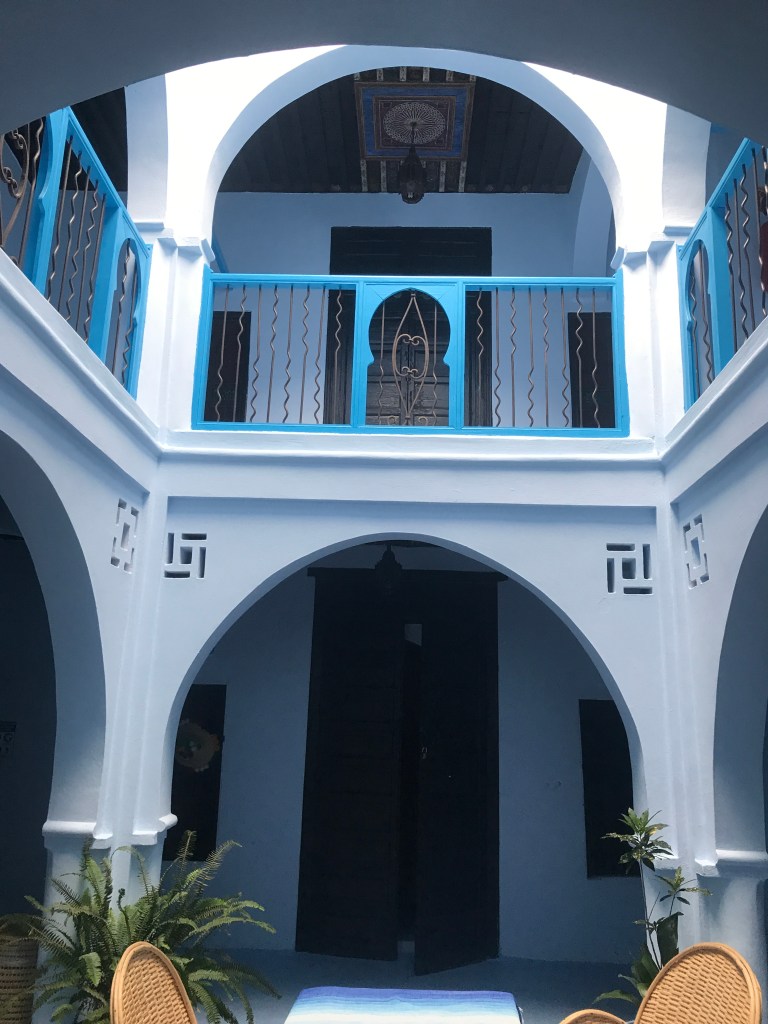
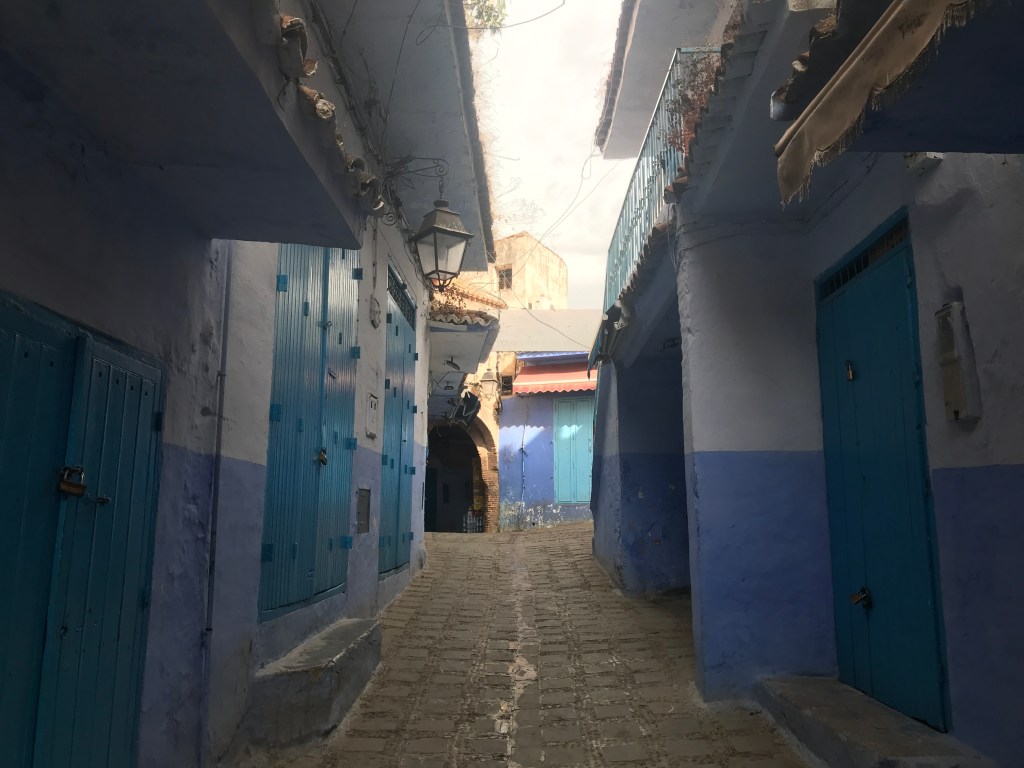
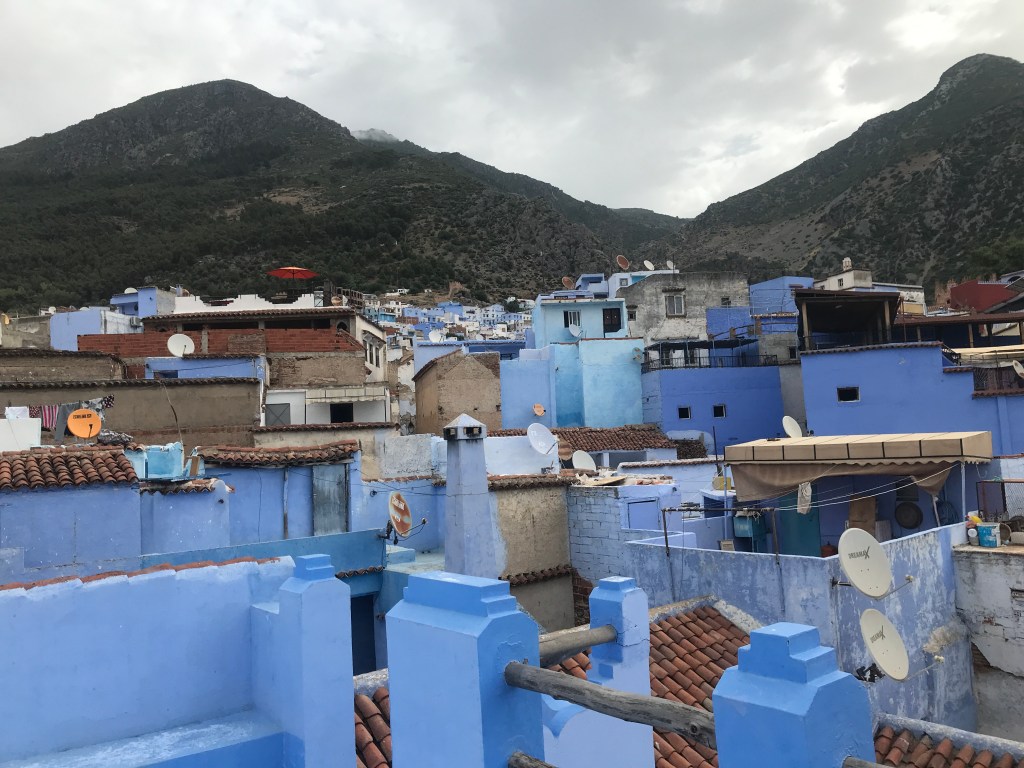
I am in a New Place. Chefchaouen is named the “Blue City.” The medina is painted a every shade of blue, and always has been, and the silly streets are fully of kids giggling and backpackers gawking and arched doorways with pinched peaks and the smell of fresh bread. Roosters yell at dawn and cats stretch awake from inaccessible cliffs. I thank my host, and the honeymooning couple living through their dream of love I met the night before, and set out again. I met Paul, the host of Farm Finn, at the gates of the medina. His Landrover Defender was black and bruised, specked with tan mud camouflage and sporting doors that don’t close entirely, and I knew that I was going where I needed to go. We went to the mountains.
***
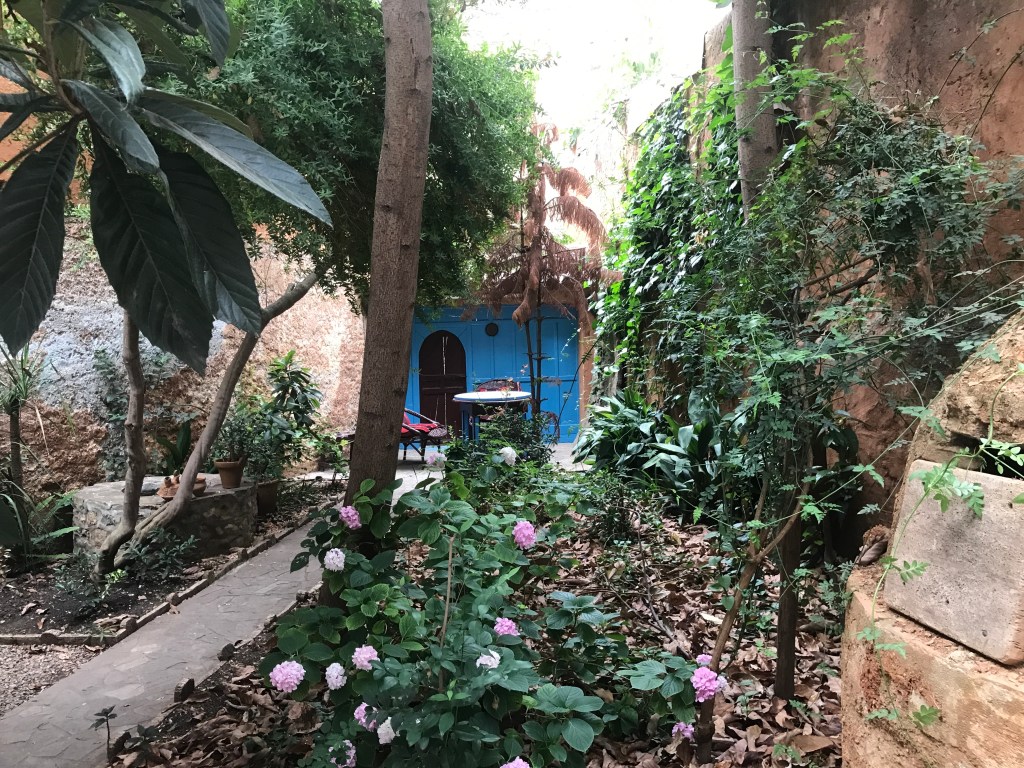
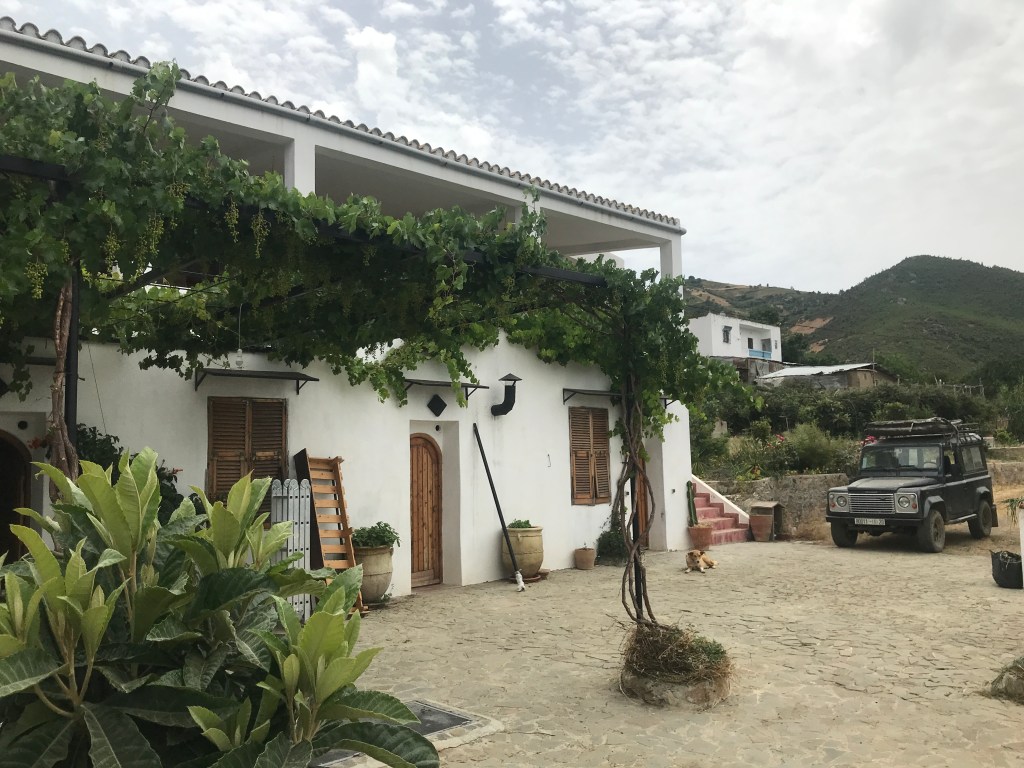
Farm Finn is a permagardening, water-conscious project developed by my host Paul in concert with UNICEF. The project has several stages. First, the foundation must be built. The farm is terraced on the side of a steep hill, with a modern, open white villa at the top, facilities for goats and chickens next to grapevines below, and several more layers of rich turned food beds descending downwards. The first phase is complete, so now we are designing the systems that will keep this place running. A gray water system, recently completed, takes laundry, dish and bathwater downhill to three large gravel tubs which filter industrial chemicals out and then pumps the clean byproduct to a sprawling web of piping that waters the farm. Other systems that are getting attention include the compositing process, a “chicken tractor”, a natural reservoir, and the recycling of old building materials for new projects. This is where we’re at.
Once these systems are in place, the third phase begins. The villa will function as a hotel, retreat, art space and cultural center. Vocational classes on water-conserving agriculture, composting, and natural insect repellant will be taught to tourists and local students alike. Funds from the hotel will enable expansion of these community outreach programs and the hiring of professionals who can improve upon the foundation even further. And once these programs are designed and tested, Farm Finn can become a model for other integrated spaces, serving as a template for projects that create sustainable impacts in local economies, ecologies and societies all throughout Morocco.
I of course showed up just wanting to get my hands dirty. Dirty they are. But I can’t stress enough how much of an impact our immediate environment has on our moods. I’ve felt light and warm since arriving, and the soft ebb of dusty valley sunsets, the morning rooster cries, the bray of donkeys, the sweetness of plump dates, and the beauty of humanity’s best have all made their impressions. I hope to share these with you.
***
Figs hang from the branch,
shaded from desert sun,
watered by roaming clouds.
They sit fat, full,
obscenely swollen –
the skin is taught,
as if anticipating
the roundness of a cupped hand
the pressure of a thumb.
I pull one,
the soft snap of stem from branch,
and split it open.
Glucose-heavy tears drip down my wrist
purple paper crumpling, laughs,
pink folds of flesh smile back.
These are joyful weepings
and every drop is savored
on the lips.
***
An apocalyptic desert hellscape. The brutal accumulation of power. Religion exploited for messianic revolution. The terror of our inability to change the course of time.
Frank Spencer’s Dune was the first book I read in Morocco. I watched the new Denis Villeneuve version, which covers the first half of Spencer’s epic, when it came out in the winter. I started reading the novel, but couldn’t get in to it. Now, after sitting on a bus that runs through water-parched valleys, after appraising the hard mathematics of conservation at Farm Finn, I appreciate the radical approach Spencer saw in the survival of his desert Fremen.
The Fremen are natives to Arrakis, a bi-lunar desert wasteland that functions as the main setting in this science fiction novel. Fremen have lived in and with the desert for thousands of years by the start of the plot, and have shaped their entire culture around the preservation of water. They wear skintight protective armor called “stillsuits” which trap every spare drop of moisture from the body and recycle it for consumption. They drain the blood from the dead, adding their “water” to a collectively owned cistern that nourishes the community. They spit in agreement, giving this gift to uninformed and offended outsiders. They hide in the shade and live in the night, harvesting drops of condensation before sunrise.
The Fremen have adapted to their environment, and the cold logic of natural selection has whittled this nomadic culture into another feature of Arrakis, like the billowing sandstorms that ravage plant life and the leviathan sandworms that hunt by awareness of regular rhythm. Again, these people – and they’re still very much human, even if terminally addicted and enlightened by the drug/strategic resource mélange which the galactic fiefdoms depend upon and mine for spaceflight – have had millennia to make these adaptations. They still use human language and feel human emotions. They have rights and aspirations and histories that are manipulated by whatever foreign power inhabits the few cities on the edges of inhospitable desert. The Fremen contrast with the landed estates of these few aristocratic city-dwellers, whose economy is exploitative through and through, and whose princesses and princes grow fat and rosy with fresh water while the huddled poor outside their citadels beg for rag drippings.
I’m touched by how Spencer wove his own observations about modern water scarcity, the divide in access between rich and poor, and the creativity of ecological adaptation into the identity of the Fremen. Spencer is astute in his observations, and heavy-handed in his analogies, but the real beauty of the Fremen lies in their relationship to the work as a whole: they are the good guys, the victors, the truly enlightened. They are the future, both as an awakening army of crusaders who will challenge imperial rule within the plot and as model of integration with a hostile environment outside the plot, with the audience. The Fremen are the answer.
The question, then, is found all around us. Water is not an infinite, renewable resource. One of my first conversations with a native Moroccan, over tea and the leftovers of clay pot-cooked pumpkin stew, was about the environment. “Since I was a girl, the snow has gone.” Us foreigners stopped chewing. She went on to explain that in the old days, snowfall in the winter would compact on mountaintops and water the valleys in the spring and summer. Now, there is no snow, so the fields remain dusty and parched throughout the year. The absence of water during the growing seasons has made environmentally unsustainable agricultural practices more necessary – draining aquifers, heavily polluting fertilizers, river rerouting – which in turn aggravates water collection in the fall and winter. What used to be reliable growing seasons and the slowly turning wheel of harvests has become chaotic, unpredictable.
The broken cycle of growing, harvesting, seeding and storing food is found in pieces globally. In the West, we are insulated from the worst of the changes, although our credit-balanced accounting of what and from where we eat has been changing recently. War in Ukraine has snapped weaker cycles which depended on the bluster of marginal trade for national full bellies; take Egypt, which imported most of its wheat from Ukraine, and must now find a source of calories in a country where only one percent of the land is arable. Famine in Ethiopia, South Sudan, many Sahelian countries (Mali, Niger, etc.), Yemen, and Afghanistan serve as repeated examples of this upended cycle. As with many injustices wrought by the West, climate change is a double jeopardy: caused by the same countries who have the stability and geography to weather the worst of the chaos. Our brothers and sisters in these places are dying of thirst.
Moroccans are not dying of thirst, at least not yet. Morocco sits in a categorical belt of countries where NGOs can have the greatest impact; it is developed enough to have cooperative national institutions, healthy (and thus old) enough to have witnessed monumental environmental change, educated enough to appreciate the evidence-based solutions of mitigative efforts, yet meanwhile precariously positioned, geographically and economically, to warrant excited attention from outside donors. Without support, the Sahara will grow and Morocco will run out of water, which really means that the slow pruning of skin and drying of wells and smacking of cracking gums in the countryside will proceed uninhibited.
Education is one possible answer. At Farm Finn, we use our water judiciously. Showers are short and water bottles are rarely filled. Plants that need large amounts of water are not grown, and soil nutrition is managed minutely by mixing mycelium, compost, and heteroculture plant life to achieve what simple watering would normally do. These methods are crazy to the local farmers who have been using the same practices as their great-great-grandmother, but so is this Brave New World we all inhabit, so they are open to change. By testing new methods on our farm, we can help develop resiliency in the local community. Lead by example, that sort of thing.
Change will never stop, and new patterns and methods will come after our day has passed. But like Spencer’s Fremen, there is more than a reaction, an alarmism, a resistance at work in what we do: there is a nobility in our integration, a harmony, and it breathes through the vines and branches with the same magic as the mélange of Dune’s Arrakis.
***
The mosques sing, first one, then the others in the valley. The chosen choir starts discordantly apart but race up their minarets to join in the harmony. Their praises, a sound of ecstasy and terror, swim between the mountains. Past faces, blurs of dark brunette, truck beds in amber valleys, leaning alleyways and the dark bellies of bridges, the smell of kerosene, appear with each cry. Time is a flat circle. I am in a beautiful land.
***
 certification
Leave a comment